- Plants
- ›Vascular Plants
- ›flowering plants
- ›monocots
- ›Agaves, Orchids, Irises, and Allies
- ›amaryllis, onions, and allies
- ›onion subfamily
- ›Tulbaghieae
- ›Tulbaghia
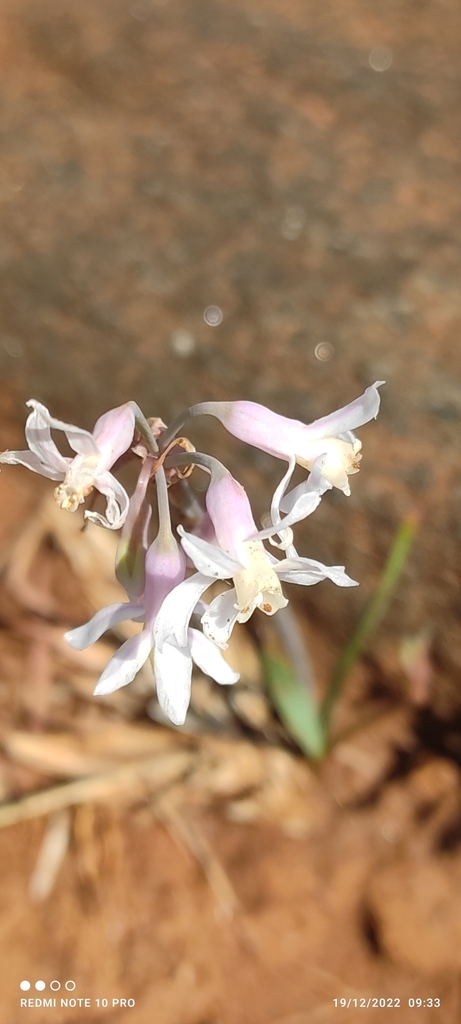
Tulbaghia cameronii
Tulbaghia cameronii is a species of wild garlic in the family Amaryllidaceae.
From the article Tulbaghia cameronii on Wikipedia (CC BY-SA), quoted section by section
Description
Tulbaghia cameronii is a perennial plant that grows to 45 cm in height, with a rootstock diameter of between 1.5 and 2.5 cm. Leaf-bases are reddish brown in colour, and 12.5–37 cm long, linear-lanceolate. The bracts are small and pinkish, up to 3 cm in length. Perianths of T. cameronii are greenish white to purple, the tube 5–8 mm. The seeds of this plant are sub-crescent shaped, and between 3 and 3.5 mm long.
Range & habitat
It is found in tropical east Africa, notably Cameroon, Tanzania, the Congo, Zambia, Malawi, Mozambique, and Zimbabwe, in woodland and woodland grassland on sandy soils and at an elevation of 1000–1500 m.
Wikipedia: “Distribution”
At the table
Flowers and leaves of T. cameronii are sometimes harvested in the wild, and are somewhat edibile when cooked. It is eaten as a side dish mixed with other ingredients. It has no known medical uses.
== References ==
Wikipedia: “Edibility”
Where it lives
Recorded sightings
—
geo-referenced records in GBIF, from museums, herbaria and field observers.
Drag the globe to turn it. Dots are where records exist, not a range map; darker means more records.
In the stacks
Searching the stacks…
Every page naming Tulbaghia cameronii in the Biodiversity Heritage Library →
This page is assembled live from iNaturalist, GBIF, Wikipedia, the Source Library and the Internet Archive. It is not yet part of the hand-edited codex. iNaturalist taxon 595800.