- Plants
- ›Vascular Plants
- ›flowering plants
- ›Dicots
- ›saxifrages, stonecrops, and allies
- ›witch-hazel family
- ›Trichocladus
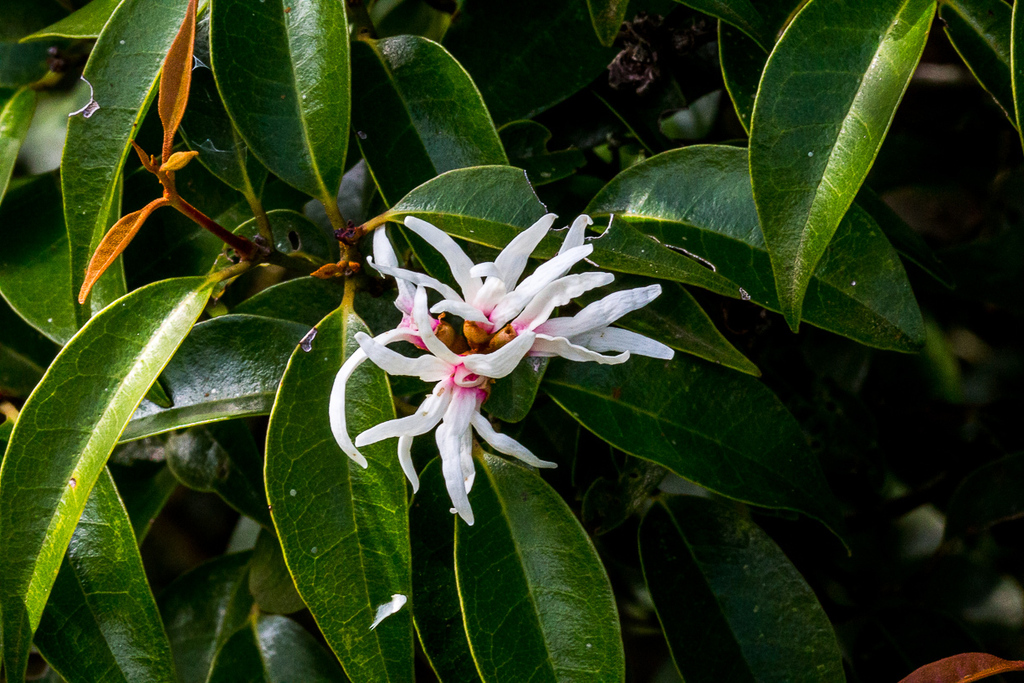
Splendid Witch-hazel
Trichocladus grandiflorus
Trichocladus grandiflorus is a species in the genus Trichocladus, in the family Hamamelidaceae. It is also called splendid witch-hazel.
From the article Trichocladus grandiflorus on Wikipedia (CC BY-SA), quoted section by section
Description
The evergreen Trichocladus grandiflorus, though sometimes a shrub, is typically found in the form of a tree, to 7 meters, and occasionally grows very large, up to 30 meters. It is native to South Africa and Eswatini, where it may be found on the fringes of mountain mist-belt forests, in wooded ravines, and in low-altitude evergreen forests. Leaves: Its leaves are alternate or opposite, and are ovate to lanceolate, with a pointed tip and slightly more rounded base. Young leaves are a conspicuous bronzy reddish-brown, with velvet-like hairs, but soon change, becoming pale and glabrous on the undersides, with very prominent veins, and remaining glossy green above. Adult leaves tend to be between 5 cm and 10 cm in length, and 2.5–5 cm wide. Flowers: Handsome flowers, nearly 4 cm in diameter, in loose axillary or terminal heads, are white tinged, becoming purple near the base, and closely resemble Hamamelis in shape. Petals are crinkly and long, to 2.5 cm, and at 4 cm in diameter are comparatively broad for this genus. Male and female parts are borne on separate flowers, either on the same specimen or different specimens (may be either monoecious or dioecious). Flowers from December to January. Fruit: Small, dark, 2-valved capsules that appear 4-valved at the apex are borne from February to May, but may be much later.
Wikipedia: “Description and range”
How it is grown
These attractive trees are not difficult to cultivate, but remain surprisingly little known and rarely cultivated in gardens. Grows well in cool (temperate) greenhouses. Compost and care similar to that of Gardenia.
Wikipedia: “Cultivation”
In human culture
Trichocladus is derived from the Greek terms trichos (τριχός; gen. 'hair') and klados (κλάδος; 'branch') and means approximately 'hairy-branched'. Grandiflorus derives from Latin terms grandis ('grand, large') and florum (gen. 'flower') and means approximately 'with large flowers'.
== References ==
Wikipedia: “Etymology”
Where it lives
Recorded sightings
—
geo-referenced records in GBIF, from museums, herbaria and field observers.
Drag the globe to turn it. Dots are where records exist, not a range map; darker means more records.
In the stacks
Searching the stacks…
Every page naming Trichocladus grandiflorus in the Biodiversity Heritage Library →
This page is assembled live from iNaturalist, GBIF, Wikipedia, the Source Library and the Internet Archive. It is not yet part of the hand-edited codex. iNaturalist taxon 595644.