- Plants
- ›Vascular Plants
- ›flowering plants
- ›monocots
- ›lilies, supplejacks, and allies
- ›lily family
- ›true lily subfamily
- ›true lilies and allies
- ›Erythronium
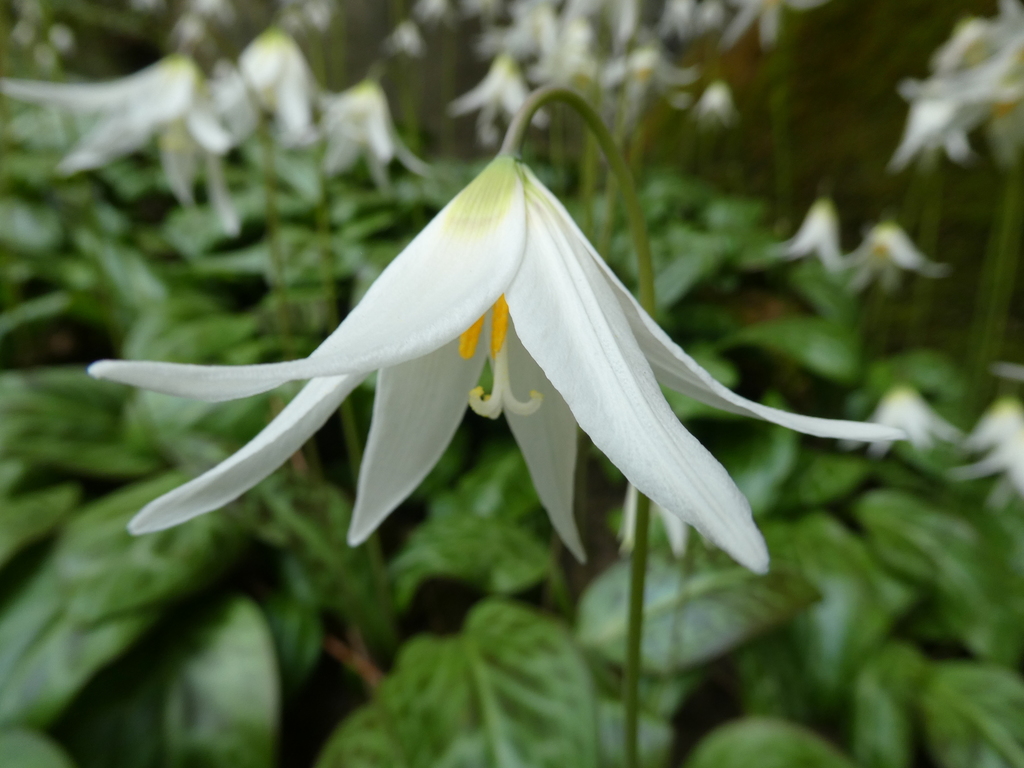
giant white fawn lily
Erythronium oregonum
Erythronium oregonum is a North American species of flowering plant in the lily family which is known by the common name giant white fawnlily or Oregon fawn-lily.
It is native to western North America, where it grows in the Pacific Coast Ranges from southwestern British Columbia to northern California.
From the article Erythronium oregonum on Wikipedia (CC BY-SA), quoted section by section
Description
Erythronium oregonum is wildflower growing from a bulb 3 to 5 centimeters wide and produces basal, lance-shaped green leaves up to 22 centimeters long and often mottled with brown and white. Thin naked stalks reach up to about 40 centimeters in height, each bearing one flower or sometimes more. Each flower has white tepals with yellow bases, sometimes streaked with dull red. The flower is often nodding, facing the ground. Its tepals are recurved so their points face upward. The stamens and stigma are white and the anthers may be white to yellow. They are pollinated by beetles and flies.
Range & habitat
In North America from southern British Columbia south to northern California, west of the Cascade Range to the Coast Range and Siskiyous. It grows in meadows, rocky outcrops, and coniferous forests.
Wikipedia: “Distribution and habitat”
At the table
Bears have been known to eat the entire plant. Native Americans ate the roots raw or cooked.
Wikipedia: “Uses”
In human culture
"John Burroughs is said to have named this species 'fawn lily' because he thought the two leaves looked like the pricked ears of a fawn. More likely, 'fawn' alludes to the mottled leaf coloring."
Wikipedia: “History”
Where it lives
Recorded sightings
—
geo-referenced records in GBIF, from museums, herbaria and field observers.
Drag the globe to turn it. Dots are where records exist, not a range map; darker means more records.
In the stacks
Searching the stacks…
Every page naming Erythronium oregonum in the Biodiversity Heritage Library →
This page is assembled live from iNaturalist, GBIF, Wikipedia, the Source Library and the Internet Archive. It is not yet part of the hand-edited codex. iNaturalist taxon 59520.