- Plants
- ›Vascular Plants
- ›flowering plants
- ›Dicots
- ›proteas, lotuses, planes, and allies
- ›Protea family
- ›Singlet Proteas
- ›Hairiseed Proteoid Clade
- ›Protea
- ›Ligulatae
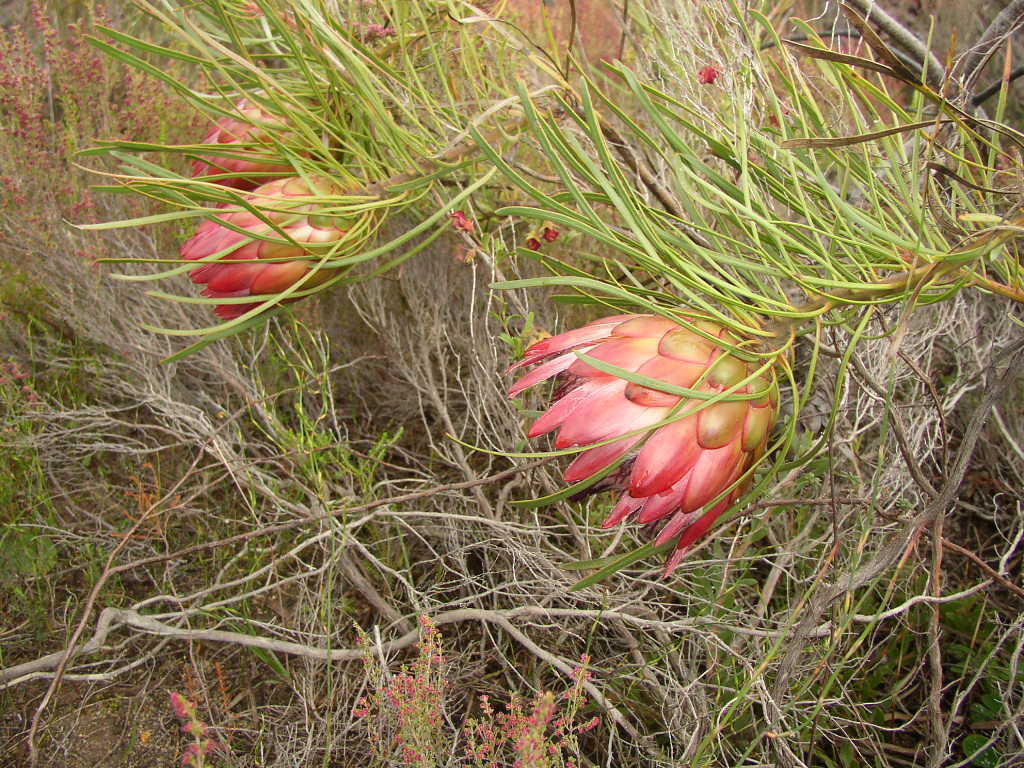
Bashful Sugarbush
Protea pudens
Protea pudens, also known as the bashful sugarbush, is a low-growing, groundcover-like, flowering shrub in the genus Protea. It is only found growing in the wild in a small area in the Western Cape province of South Africa.
In Afrikaans this species is known by the vernacular name of aardroos suikerbos.
From the article Protea pudens on Wikipedia (CC BY-SA), quoted section by section
Description
The plant grows as a prostrate shrub flat along the ground, forming a mat up to 1 metre (3 ft 3 in) in diameter, 30 centimetres (12 in) in height. It is sparsely branching; the stems are 1 centimetre (0.39 in) in diameter. It blooms with the inflorescences usually at ground level. It blooms in the winter, from May to September, with the peak from July to August. The plant is monoecious with both sexes in each flower. The flowers have no scent. The bracts subtending the inflorescence are deep pink in colour.
Range & habitat
The plant is endemic to the southwestern Cape Region in South Africa, and occurs in a small area on flats near the village of Elim, and elsewhere on the Agulhas Plain, in the Western Cape province. The extent of occurrence only consists of 67 km2 (26 sq mi), wherein it is only known to occur at four localities.
Wikipedia: “Distribution”
What it does
The plant grows in heavy, sandy clay, or shale-derived, gravelly soils, at altitudes of 23, to 30–40 metres (100–130 ft). It grows in a specific type of ferricrete-soil, fynbos habitat. Pollination occurs through the action of birds. Possible wildfires will destroy the mature plants, only the seeds will survive such an event. The seeds are stored in the many caps (fruits) in the dried, fire-resistant seed head, which is itself retained on the plant after senescence. The fruits are woody and persistent. The seeds are released from the caps after wildfires and dispersed by means of the wind.
Wikipedia: “Ecology”
Where it lives
Recorded sightings
—
geo-referenced records in GBIF, from museums, herbaria and field observers.
Drag the globe to turn it. Dots are where records exist, not a range map; darker means more records.
In the stacks
Searching the stacks…
Every page naming Protea pudens in the Biodiversity Heritage Library →
This page is assembled live from iNaturalist, GBIF, Wikipedia, the Source Library and the Internet Archive. It is not yet part of the hand-edited codex. iNaturalist taxon 592534.