- Plants
- ›Vascular Plants
- ›flowering plants
- ›Dicots
- ›nightshades, bindweeds, gooseweeds, and allies
- ›nightshade family
- ›nightshades and allies
- ›nightshades and jaltomatas
- ›Solanum
- ›Solanum nigrum
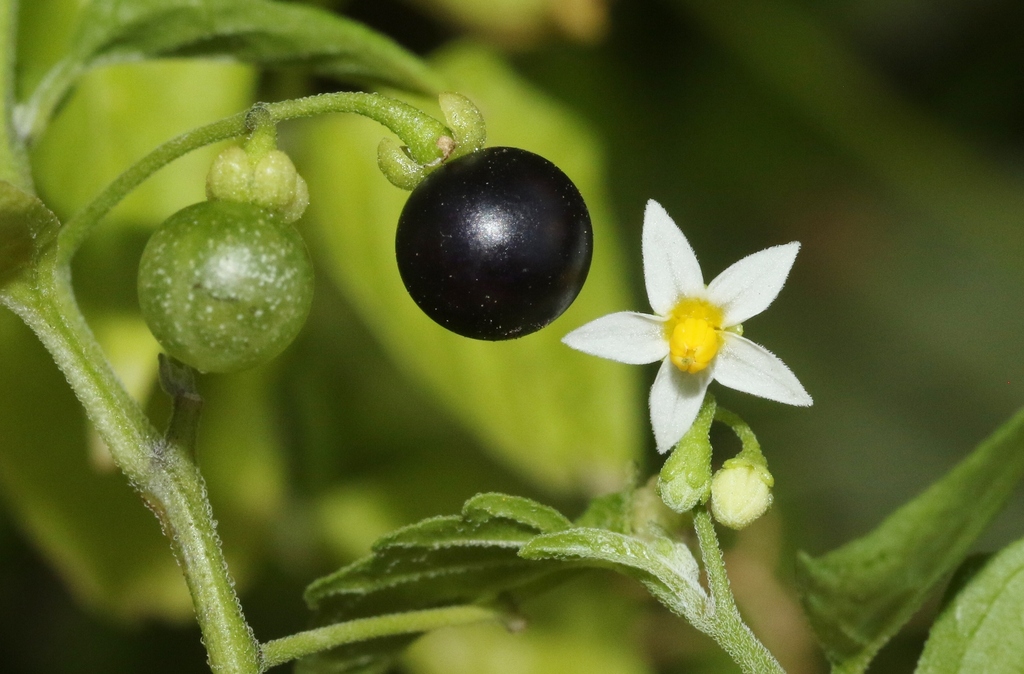
American black nightshade
Solanum americanum
Solanum americanum, commonly known as American black nightshade, small-flowered nightshade or glossy nightshade is a herbaceous flowering plant of wide though uncertain native range. The certain native range encompasses the tropics and subtropics of the Americas, Melanesia, New Guinea, and Australia.
From the article Solanum americanum on Wikipedia (CC BY-SA), quoted section by section
Description
Solanum americanum grows up to 1–1.5 metres (39–59 in) tall and is an annual or short-lived perennial. The leaves are alternate on the branch, and vary greatly in size, up to 10 centimetres (4 in) long and 7 cm (3 in) broad, with a 4 cm (1+1⁄2 in) petiole and a coarsely wavy or toothed margin. The flowers are about 1 cm diameter, white or occasionally light purple, with yellow stamens. The fruit is a shiny black berry 5–10 millimetres (1⁄4–3⁄8 in) diameter, containing numerous small seeds.
Range & habitat
It has a wide but uncertain native range. The certain native range encompasses the tropics and subtropics of the Americas, Melanesia, New Guinea, and Australia. The plant is widely naturalised around the tropical Pacific and Indian Oceans, including Hawaiʻi, Indochina, Madagascar and Africa, possibly via anthropogenic introduction in these locales.
Wikipedia: “Distribution and habitat”
At the table
Despite the toxic compounds that they contain, cooked greens and ripe berries of S. americanum are eaten throughout their range. The ripe fruit is cooked into jams and preserves, or eaten raw. In Africa, South America, New Guinea and Oceania the young green shoots of S. americanum are cooked and eaten as greens, after boiling in water. The cooking water used for boiling the leaves is discarded as it contains the soluble alkaloids. In Kenya, Cameroon and Papua New Guinea the leaves are sold as a leaf vegetable in the markets. The leaves are used in a West Indian stew, and it is known as branched calaloo. In Mauritius it is cultivated and eaten as a pot-herb and used in bouillon. Experts warn that care should be taken since numerous toxins are reported with levels varying with local conditions and varieties.
Wikipedia: “Culinary”
In medicine
It is used as a medicine in Cameroon, Kenya, Hawaiʻi, Panama, Sierra Leone, Tanzania and Pakistan. In China a tea from the whole plant is used to treat cancer of the cervix. It is used as folk medicine for a wide range of conditions, being applied topically and internally.
Wikipedia: “Medicine”
Toxicity
Research indicates the presence of toxic glycoalkaloids, with authorities warning to be careful regarding the use of S. americanum as herbal medicine or food. The green fruit is particularly poisonous and eating unripe berries has caused the death of children. Ripe berries and foliage may also cause poisoning, though the toxicity seems to diminish somewhat with ripening. This is due to high levels of the glycoalkaloids, solanine and solamargine. Other toxins present in the plant include chaconine, solasonine, solanigrine, gitogenin and traces of saponins, as well as the tropane alkaloids scopolamine and hyoscyamine (an isomer of atropine). Significant amounts of solasodine (0.65%) have been found in the green berries. The ripe fruit also contains 0.3–0.45% solasonine, and acetylcholine, and has a cholinesterase-inhibiting effect on human plasma. In Transkei, rural people have a high incidence of esophageal cancer thought to be a result of using S. americanum as a food. Livestock can also be poisoned by high nitrate levels in the leaves. Toxicity varies widely depending on the genetic strain and the location conditions, like soil and rainfall. One field guide of poisonous plants advises, "unless you are certain that the berries are from an edible strain, leave them alone."
Where it lives
Recorded sightings
—
geo-referenced records in GBIF, from museums, herbaria and field observers.
Drag the globe to turn it. Dots are where records exist, not a range map; darker means more records.
In the stacks
Searching the stacks…
Every page naming Solanum americanum in the Biodiversity Heritage Library →
This page is assembled live from iNaturalist, GBIF, Wikipedia, the Source Library and the Internet Archive. It is not yet part of the hand-edited codex. iNaturalist taxon 59035.