- Plants
- ›Vascular Plants
- ›flowering plants
- ›Dicots
- ›myrtles, evening primroses, and allies
- ›myrtle family
- ›Myrtoideae
- ›Melaleuceae
- ›Melaleuca
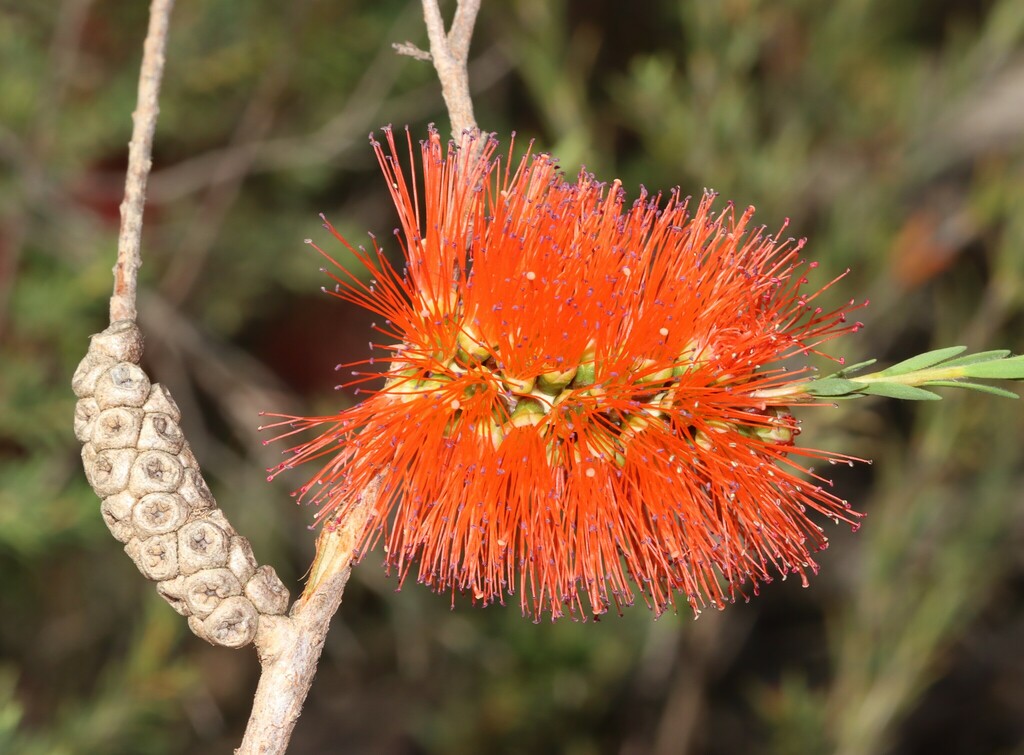
Robin Redbreast Bush
Melaleuca lateritia
Melaleuca lateritia, commonly known as the robin redbreast bush, is a plant in the myrtle family, Myrtaceae and is endemic to the south-west of Western Australia. It is also one of the most widely cultivated of the genus because of its attractive flowers which occur over a long period and for its adaptability to a range of climates. It is a medium-sized shrub normally 2–2.5 m (7–8 ft) high with coarse, fibrous bark.
From the article Melaleuca lateritia on Wikipedia (CC BY-SA), quoted section by section
Description
Melaleuca lateritia is an erect shrub growing to about 2.5 m (8 ft) high, to 3 m (10 ft) wide. The leaves are light green, thin, linear, concave and glabrous, 6–25 mm (0.2–1 in) long, 1–2 mm (0.04–0.08 in) wide and with a pointed tip. They are spirally arranged around the stem. The flowers are bright-orange red, in spikes to 80 mm (3 in) long and 60 mm (2 in) in diameter on lateral branches from old wood, the stem continuing to grow beyond the flowers. Flowering occurs over an extended period from August to April and is followed by fruit which are woody capsules about 6–8 mm (0.2–0.3 in) in diameter which last for many years without releasing their seeds.
Range & habitat
Robin redbreast bush occurs in the Geraldton Sandplains, Jarrah Forest, Swan Coastal Plain and Warren biogeographic regions of Western Australia. It grows in sandy soil in swampy areas.
Wikipedia: “Distribution and habitat”
How it is grown
Melaleuca lateritia is widely cultivated and it is well established in general horticulture. Although native to a dry summer climate it is one of the more adaptable to the wetter summer conditions of Australia's east coast. It grows best in well-drained soil in a sunny position, responds well to pruning to keep it in shape and to annual fertilising at the end of the flowering season. Honeyeaters, especially the eastern spinebill and New Holland honeyeater visit the flowers in Canberra.
== References ==
Wikipedia: “Use in horticulture”
Where it lives
Recorded sightings
—
geo-referenced records in GBIF, from museums, herbaria and field observers.
Drag the globe to turn it. Dots are where records exist, not a range map; darker means more records.
In the stacks
Searching the stacks…
Every page naming Melaleuca lateritia in the Biodiversity Heritage Library →
This page is assembled live from iNaturalist, GBIF, Wikipedia, the Source Library and the Internet Archive. It is not yet part of the hand-edited codex. iNaturalist taxon 589714.