- Plants
- ›Vascular Plants
- ›flowering plants
- ›Dicots
- ›proteas, lotuses, planes, and allies
- ›Protea family
- ›Singlet Proteas
- ›Nutseed Proteoid Clade
- ›Cape Nutseed Proteoids
- ›Leucadendron
- ›Alatosperma
- ›Compressa
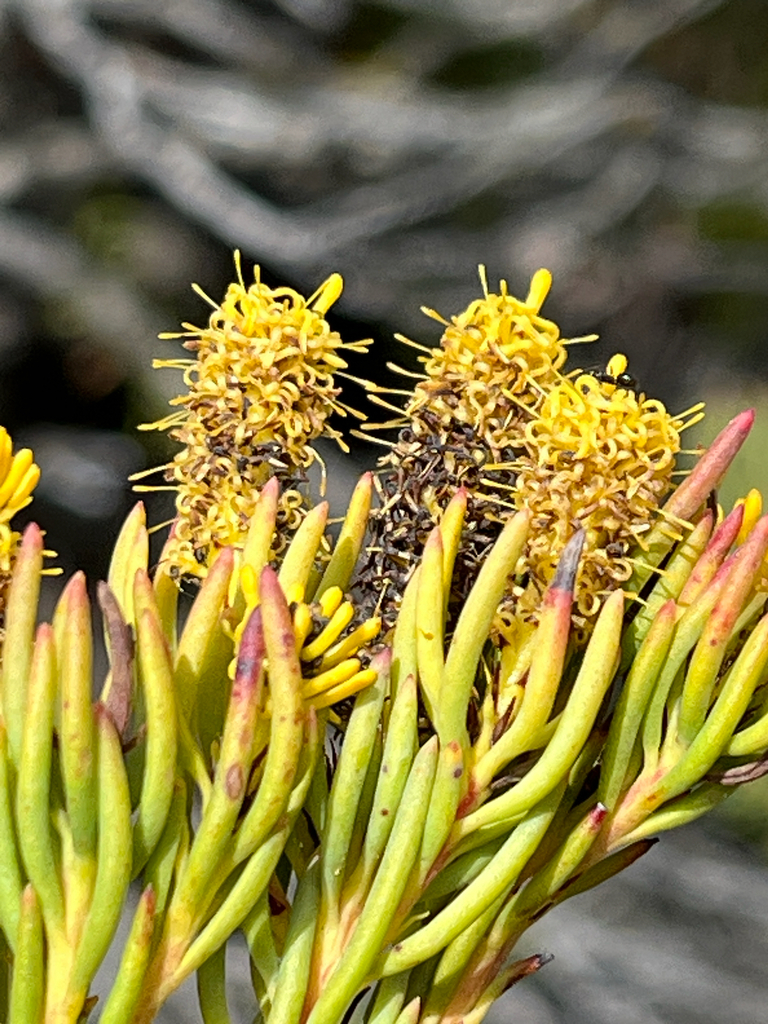
Laingsburg Conebush
Leucadendron osbornei
Leucadendron osbornei, the Laingsburg conebush, is a flower-bearing shrub belonging to the genus Leucadendron and forms part of the fynbos. The plant was discovered by David Osborne and is native to the Western Cape, South Africa.
From the article Leucadendron osbornei on Wikipedia (CC BY-SA), quoted section by section
Description
The shrub grows 3 m (9.8 ft) tall and flowers in October. The plant dies in a fire but the seeds survive. The seeds are stored in a toll on the female plant and fall to the ground after a fire where they are spread by the wind; the seeds have small wings. The plant is unisexual and there are separate plants with male and female flowers, which are pollinated by small beetles. In Afrikaans, it is known as laingsburgtolbos.
Range & habitat
The plant is found on the Elandsberg, Anysberg, Touwsberg, and Matjiesgoedberg in the Klein Karoo. The plant grows mainly in sandy soil at altitudes of 800–1,600 m (2,600–5,200 ft).
Wikipedia: “Distribution and habitat”
Where it lives
Recorded sightings
—
geo-referenced records in GBIF, from museums, herbaria and field observers.
Drag the globe to turn it. Dots are where records exist, not a range map; darker means more records.
In the stacks
Searching the stacks…
Every page naming Leucadendron osbornei in the Biodiversity Heritage Library →
This page is assembled live from iNaturalist, GBIF, Wikipedia, the Source Library and the Internet Archive. It is not yet part of the hand-edited codex. iNaturalist taxon 589080.