- Plants
- ›Vascular Plants
- ›flowering plants
- ›Dicots
- ›Soapberries, Cashews, Mahoganies, and Allies
- ›Cashew Family
- ›cashews, sumacs, and allies
- ›Rhus
- ›Rhus aromatica
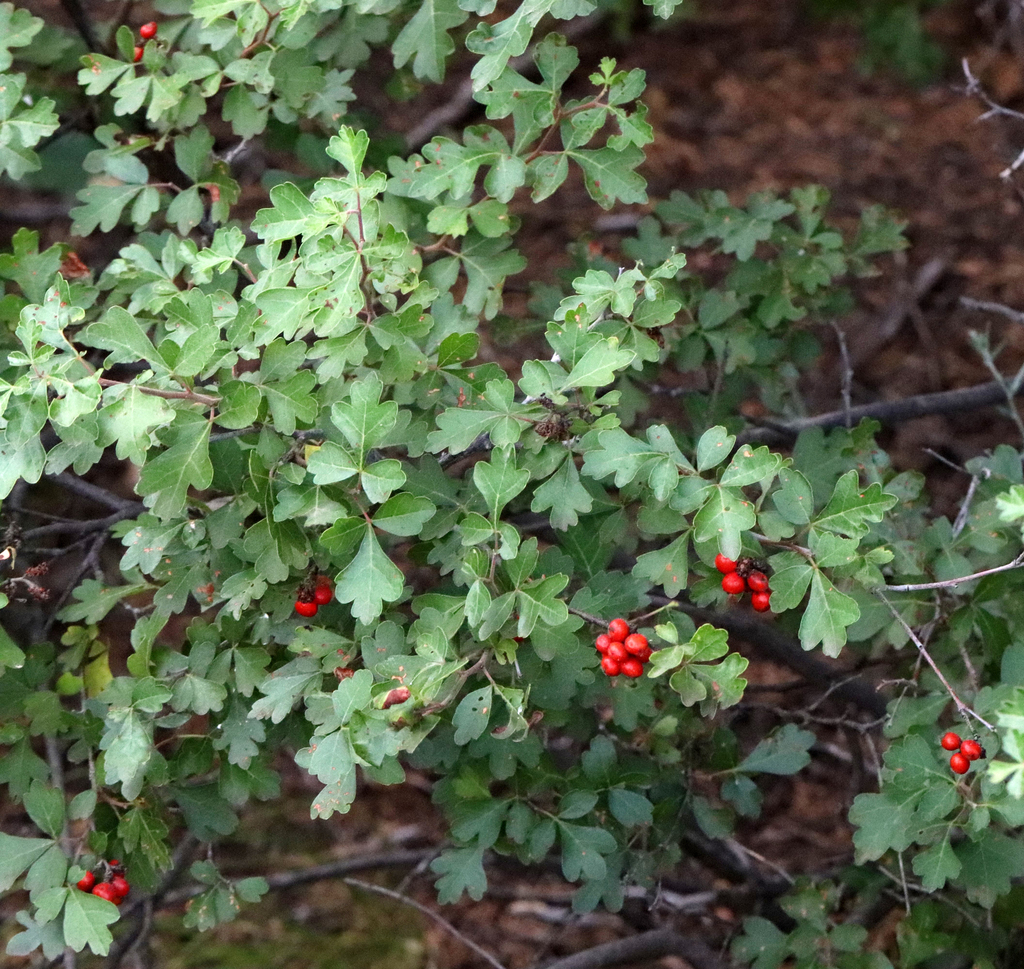
fragrant sumac
Rhus aromatica
Rhus aromatica, the fragrant sumac, is a deciduous shrub in the family Anacardiaceae native to Canada and the United States from southeast Ontario to Vermont down into central Florida to west Texas up through Nebraska over to southern Wisconsin back to Ontario. It grows in upland open woods, fields, barrens, and rocky cliffs.
From the article Rhus aromatica on Wikipedia (CC BY-SA), quoted section by section
Description
Fragrant sumac is a woody plant with a rounded form that grows to around 2 ft (0.6 m) to 5 ft (1.5 m) tall and 5 ft (1.5 m) to 10 ft (3.0 m) wide. The plant develops yellow flowers in clusters on short lateral shoots in March through May. The flower is a small, dense inflorescence that usually opens before the plant's leaves do. Flowers and drupes appear earlier in the year than on other Sumac species. The species is polygamodioecious, which means that it is mostly dioecious, primarily bearing flowers of only one sex, but with either a few flowers of the opposite sex or a few bisexual flowers on the same plant. Male (staminate) flowers develop in yellowish catkins, while female (pistillate) flowers develop in short bright yellow panicles at the ends of branches. Pollinated flowers develop clusters of 5 mm (0.2 in) to 7 mm (0.3 in) hairy red drupes containing a single nutlet during June through August. The fruits become an important winter food for birds and small mammals that can remain on the plant until spring if not eaten. The plant's alternate leaves are usually compound, and have three leaflets that vary in shape, lobing, and margination. There is a single leaf variety that grows in dry areas of SW. North America. The unstalked leaflets are ovate to rhomboid, more or less wedge-shaped at the base, coarsely-toothed and usually shiny glabrous above. …
Range & habitat
Fragrant sumac is common along the forested eastern margins of the Great Plains and in open or otherwise disturbed sites on the margins of the Gulf Coast prairie. It grows at a range of sites including open rocky woodlands, valley bottoms, lower rocky slopes, and roadsides. It is not widely used for landscape plantings but can be used as a ground cover, especially on banks. The plant's colorful fall foliage is its main ornamental feature. The plant grows in deep shade to full sun and well-drained slightly acid soils to well-drained alkaline with a pH range of about 6.0 to 8.5. It has a shallow, fibrous root system and is easily transplanted. Some of its branches can trail upon the ground and develop roots. The plant can ground sucker to form a colony. Developed thickets provide cover for small mammals and birds. Rhizomes and roots in the soil allow R. aromatica to sprout following fire events.
Wikipedia: “Distribution and habitat”
At the table
Historically, Native American tribes have used fragrant sumac to treat health problems and various illnesses. The ripe berries were made into a tart drink. In addition to this, the leaves and bark were used in leather making due to their high tannin content. To create a smoking mixture, the leaves were combined with tobacco. R. aromatica can be used to stabilize soil and prevent erosion on embankments or hard-to-cover areas. A study showed strong antiviral activity against two types of herpes in vitro using aqueous extractions of R. aromatica.
Wikipedia: “Uses”
Where it lives
Recorded sightings
—
geo-referenced records in GBIF, from museums, herbaria and field observers.
Drag the globe to turn it. Dots are where records exist, not a range map; darker means more records.
In the stacks
Searching the stacks…
Every page naming Rhus aromatica in the Biodiversity Heritage Library →
This page is assembled live from iNaturalist, GBIF, Wikipedia, the Source Library and the Internet Archive. It is not yet part of the hand-edited codex. iNaturalist taxon 58738.