- Plants
- ›Vascular Plants
- ›flowering plants
- ›Dicots
- ›Soapberries, Cashews, Mahoganies, and Allies
- ›Cashew Family
- ›cashews, sumacs, and allies
- ›Toxicodendron
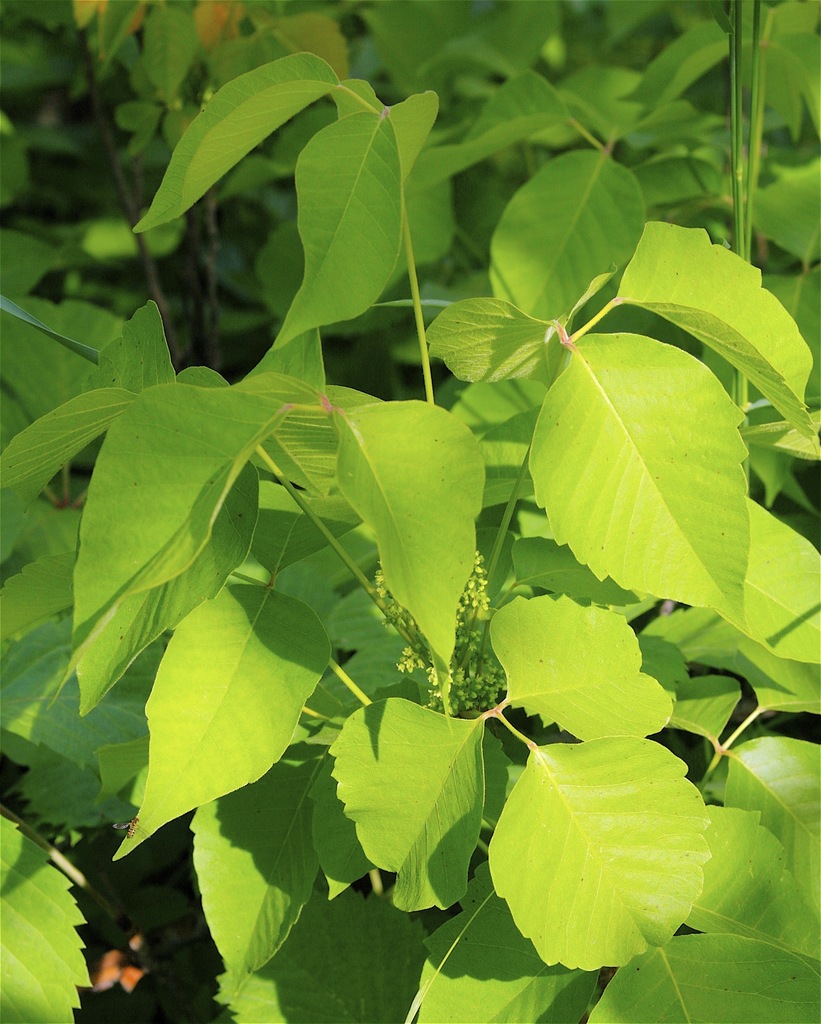
western poison ivy
Toxicodendron rydbergii
Toxicodendron rydbergii the western poison ivy, is a species of Toxicodendron in the cashew family. It is native to most of Canada from the Maritimes to British Columbia, and most of the contiguous United States except the southeastern states, New Jersey, Delaware, and California. It can be found growing in forests, and other wooded areas, usually near streams and rivers.
From the article Toxicodendron rydbergii on Wikipedia (CC BY-SA), quoted section by section
Description
Unlike Toxicodendron radicans (eastern poison ivy), which often appears as a trailing or climbing vine, T. rydbergii is a shrub that can grow to 1 m (3 ft) tall, rarely up to 3 m (10 ft). The leaves are trifoliate and alternate. The leaflets are variable in size and shape, and are usually 15 cm (6 in) long, turning yellow or orange in autumn. On the compound trifoliate leaves, the two leaflets opposite each other are typically asymmetrical, in contrast to the terminal leaflet which always shows bilateral symmetry. The fruits are small, round, and yellowish. Like other members of its genus, all parts of this plant contain urushiol, the substance that causes an itchy rash in most people.
Range & habitat
It is native to most of Canada from the Maritimes to British Columbia, and most of the contiguous United States except the Southeast, Nevada, Oregon and California. It is apparently extirpated from West Virginia. It can be found growing in forests, and other wooded areas, usually near streams and rivers.
Wikipedia: “Distribution and habitat”
Toxicity
Because it contains urushiol, contact with the plant can cause severe contact dermatitis in most individuals.
== References ==
Where it lives
Recorded sightings
—
geo-referenced records in GBIF, from museums, herbaria and field observers.
Drag the globe to turn it. Dots are where records exist, not a range map; darker means more records.
In the stacks
Searching the stacks…
Every page naming Toxicodendron rydbergii in the Biodiversity Heritage Library →
This page is assembled live from iNaturalist, GBIF, Wikipedia, the Source Library and the Internet Archive. It is not yet part of the hand-edited codex. iNaturalist taxon 58729.