- Plants
- ›Vascular Plants
- ›flowering plants
- ›monocots
- ›Agaves, Orchids, Irises, and Allies
- ›Aloe family
- ›Aloes and allies
- ›Gasteria
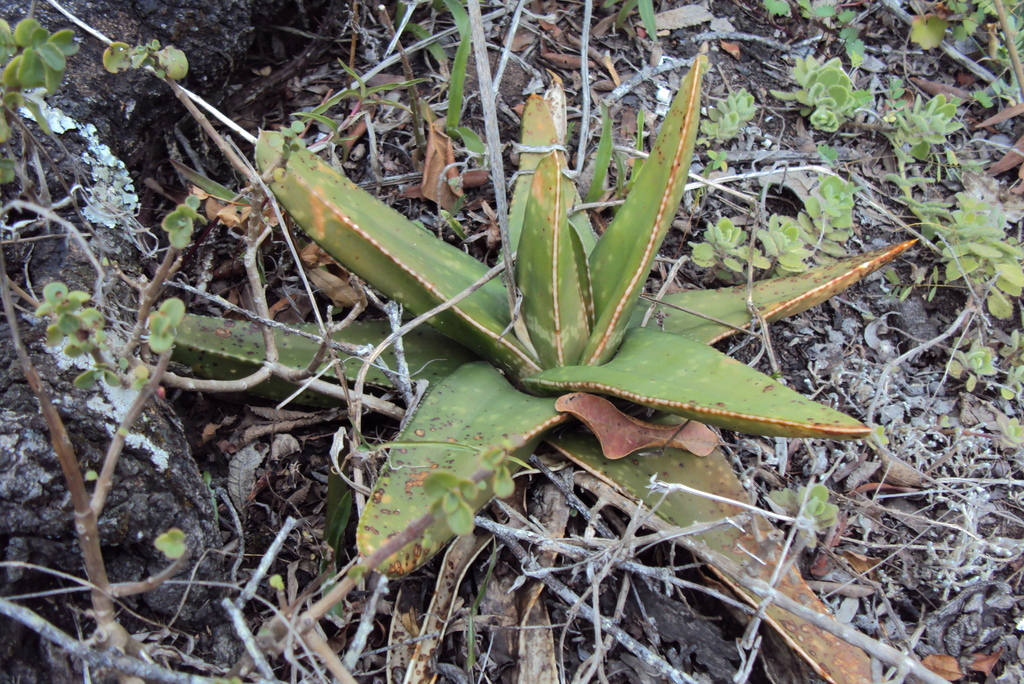
Natal Oxtongue
Gasteria croucheri
Gasteria croucheri ("Natal Gasteria") is a succulent plant, native to KwaZulu-Natal Province, South Africa.
From the article Gasteria croucheri on Wikipedia (CC BY-SA), quoted section by section
Description
It is one of the larger Gasteria species (up to 400 by 600mm), closely related to Gasteria excelsa just to the south, and to Gasteria batesiana to the north. It has smooth, thick, straight leaves. These are dark grey-green, and lightly spotted (though juvenile plants sometimes have some rough tubercles). In full sun or under stress, the leaves can assume a purple colour. The leaves have hard, waxy, white margins and keels. The upper surface of the leaves are slightly concave. They are lanceolate and trigonous, with a point that is rounded but with a tiny spike. Juvenile plants have distichous leaves (their flat leaves in two opposite ranks) but adult plants form an erect rosette, with thick, sharp, keeled leaves. The tall inflorescence appears at the beginning of summer.
Range & habitat
This species occurs mainly in KwaZulu-Natal Province as far north as Durban. In the south it also extends slightly into the Eastern Cape but only as far as the Mzimvubu River. This is a relatively wet region, and its habitat is typically cliff faces or rocky outcrops. It is especially common on rocky slopes near the coast. To the north of its range, it becomes more like Gasteria tukhelensis or Gasteria batesiana, becoming smaller and offsetting to form clumps. To the south, it gradually changes into Gasteria excelsa, becoming larger and solitary (non-clumping).
Wikipedia: “Distribution”
In medicine
The Zulu people of KwaZulu-Natal call this species iqhomololo or impundu ("the invisible-maker") due its use as a medicine for camouflage during war. Considered good luck, it is often planted on roof-tops, in the belief that it will divert lightning. It is currently popular as an ornamental in landscaping. However it has a large root system and benefits from a sufficiently large container.
== References ==
Wikipedia: “Traditional use”
Where it lives
Recorded sightings
—
geo-referenced records in GBIF, from museums, herbaria and field observers.
Drag the globe to turn it. Dots are where records exist, not a range map; darker means more records.
In the stacks
Searching the stacks…
Every page naming Gasteria croucheri in the Biodiversity Heritage Library →
This page is assembled live from iNaturalist, GBIF, Wikipedia, the Source Library and the Internet Archive. It is not yet part of the hand-edited codex. iNaturalist taxon 586145.