- Plants
- ›Vascular Plants
- ›flowering plants
- ›monocots
- ›Agaves, Orchids, Irises, and Allies
- ›Orchids
- ›Orchidoid Orchids
- ›Orchideae
- ›Disa Orchids
- ›Disa
- ›Disa
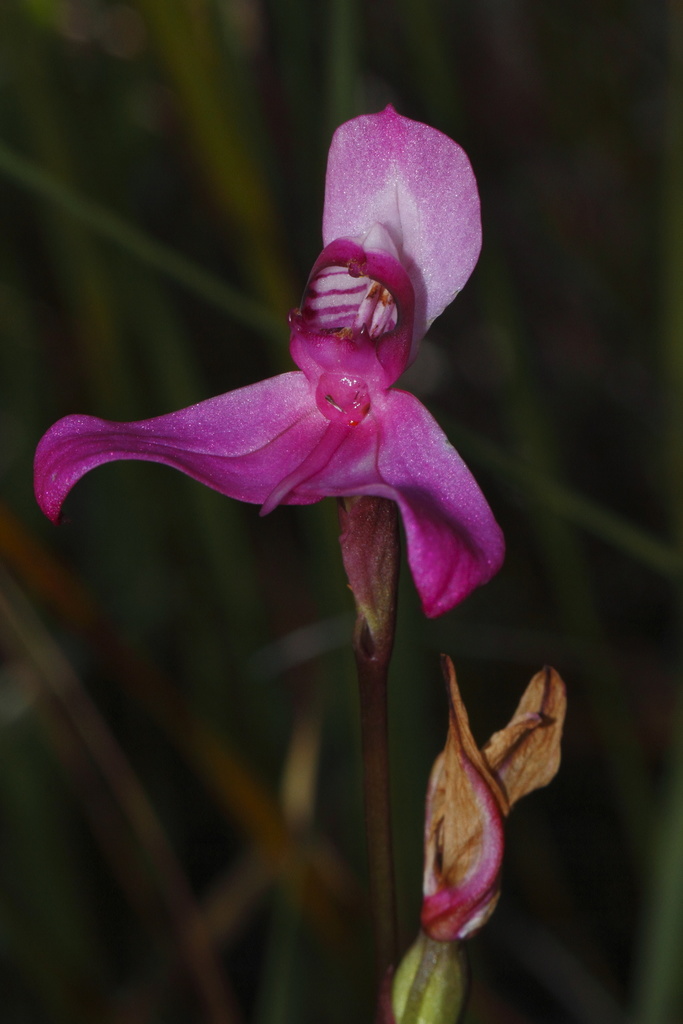
Disa venosa
Disa is a genus of flowering plants in the family Orchidaceae. It comprises about 182 species. Most of the species are indigenous to tropical and southern Africa, with a few more in the Arabian Peninsula, Madagascar, and Réunion. Disa bracteata is naturalised in Western Australia, where the local name is "African weed-orchid."
The genus Disa was named by P.J. Bergius in 1767. It was named after Disa, the heroine of a Swedish legend.
From the article Disa (plant) on Wikipedia (CC BY-SA), quoted section by section
Description
The plants grow from a fleshy tuberous root which is a source of maltodextrins which are used as a sugar substitute. Some species attain a height of 90 cm (35 in). The flowers are solitary or arranged in racemes. The petals and the lip are small. The flowers consist essentially of the sepals. The flowers range in color from very light to dark red.
What it does
Disa exhibits a variety of pollination syndromes. Each species of Disa usually has a single species as pollinator and nearly every available pollinating insect is employed by some species of Disa. Species that adapted to the same pollinator often independently evolved a similar floral morphology which confounded the infrageneric classification of Disa until cladistic analysis was applied to DNA sequences from this genus. Examples of convergent evolution in Disa pollination include the following:
flowers pollinated by butterflies have evolved twice, for example the pollination of Disa uniflora and Disa ferruginea by the Table Mountain Pride butterfly (Aeropetes tulbaghia) (Satyrinae) flowers with conspicuous deception, pollinated by carpenter bees, have evolved twice. long-spurred flowers, pollinated by long-tongued flies, have evolved four times. night-scented flowers, pollinated by moths, have evolved three times. Disa serves as an example of how speciation can be caused by changes in pollinator availability and evolution. Some Disa species are pollinated by sunbirds and have pollinaria that stick to the feet of the sunbirds when they perch on the inflorescence.
Wikipedia: “Pollination”
How it is grown
The species Disa uniflora is well known as an ornamental. It is a spectacular red orchid known as "The Pride of Table Mountain." Other commonly cultivated species include Disa aurata, Disa cardinalis, Disa crassicornis, Disa racemosa, Disa sagittalis, and Disa tripetaloides. Some of the species are grown only in African gardens. Once very rare in cultivation, Disa uniflora is gaining in popularity as a cut flower. However, they are difficult to grow, because of the needed mineral composition of the potting soil. Also, if exposed to excessive moisture, they can be easily killed by rot.
Hybrids. The following species have been used to create more than 400 hybrids : Disa cardinalis, Disa caulescens, Disa racemosa, Disa tripetaloides, Disa uniflora, Disa aurata and Disa venosa.
Disa × brendae (D. caulescens × D. uniflora) (South Africa, SW. Cape Prov.) Disa × maculomarronina (D. hircicornis × D. versicolor) (S. Africa).. Disa × nuwebergensis (D. caulescens × D. tripetaloides) (South Africa, Cape Prov.). Disa × paludicola (D. chrysostachya × D. rhodantha) (South Africa, KwaZulu-Natal).
Wikipedia: “Horticulture”
Where it lives
Recorded sightings
—
geo-referenced records in GBIF, from museums, herbaria and field observers.
Drag the globe to turn it. Dots are where records exist, not a range map; darker means more records.
In the stacks
Searching the stacks…
Every page naming Disa venosa in the Biodiversity Heritage Library →
This page is assembled live from iNaturalist, GBIF, Wikipedia, the Source Library and the Internet Archive. It is not yet part of the hand-edited codex. iNaturalist taxon 584048.