- Plants
- ›Vascular Plants
- ›flowering plants
- ›monocots
- ›grasses, sedges, cattails, and allies
- ›bulrushes, cattails, and allies
- ›Typha
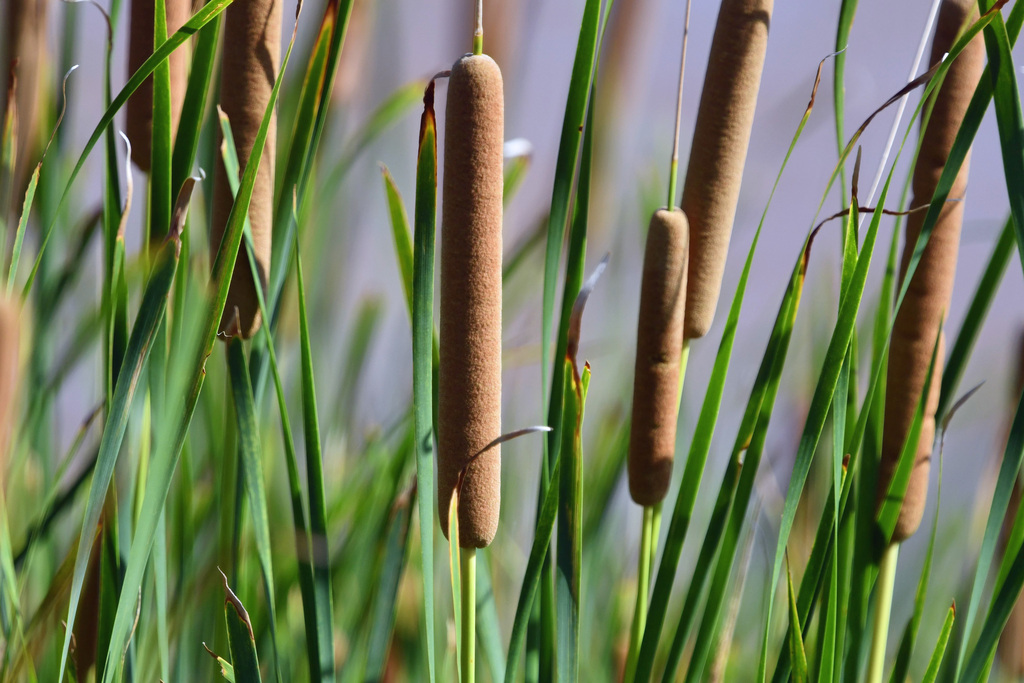
southern cattail
Typha domingensis
Typha domingensis, known commonly as southern cattail or cumbungi, is a perennial herbaceous plant of the genus Typha.
From the article Typha domingensis on Wikipedia (CC BY-SA), quoted section by section
Range & habitat
It is found throughout sutropical and tropical regions worldwide. It is sometimes found as a subdominant associate in mangrove ecosystems such as the Petenes mangroves ecoregion of Yucatán. The Southern Cattail grows between 2.0 and 2.5 meters in length and has flat sheaths to protect its core. It thrives in marshes and ecosystems where the land has a similarity to wetlands. It can also survive in high salinity water sources, making it much more resilient than similar species to this kind of cattail.
Wikipedia: “Distribution and habitat”
At the table
In the Mesopotamian Marshes of southern Iraq, Khirret is a dessert made from the pollen of this plant. In Turkish folk medicine the female inflorescences of this plant and other Typha are used externally to treat wounds such as burns. Extracts of T. domingensis have been demonstrated to have wound healing properties in rat models. Water extracts of the fruit, female flower and male flower of Typha domingensis exhibit iron chelating activity as well as superoxide and nitric oxide scavenging activities. By contrast, only the fruit and female flower extracts were found to have alpha-glucosidase inhibitory activity. A partially purified, proanthocyanidin-rich butanol fraction of the fruit was shown to be a competitive inhibitor of alpha-glucosidase, which also had concurrent antioxidant activity. Typha domingensis can reduce water contamination by enterobacteria, which are pathogens, by up to 98 percent. It improves the water quality and the Southern Cattail is used in artisanal crafts due to their wide reed sheaths which ease the weaving process. Areas where the cattail and bulrush is harvested in much larger methods, such as the coastal areas of San Jeronimo, Patzcuaro and Tzintzuntzan, Michoacán seem to exhibit larger than average cattail sizes, lengths, and population density. …
Wikipedia: “Uses”
Where it lives
Recorded sightings
—
geo-referenced records in GBIF, from museums, herbaria and field observers.
Drag the globe to turn it. Dots are where records exist, not a range map; darker means more records.
In the stacks
Searching the stacks…
Every page naming Typha domingensis in the Biodiversity Heritage Library →
This page is assembled live from iNaturalist, GBIF, Wikipedia, the Source Library and the Internet Archive. It is not yet part of the hand-edited codex. iNaturalist taxon 58392.