- Plants
- ›Vascular Plants
- ›flowering plants
- ›monocots
- ›grasses, sedges, cattails, and allies
- ›Rushes and Allies
- ›Juncus
- ›Agathryon
- ›Juncotypus
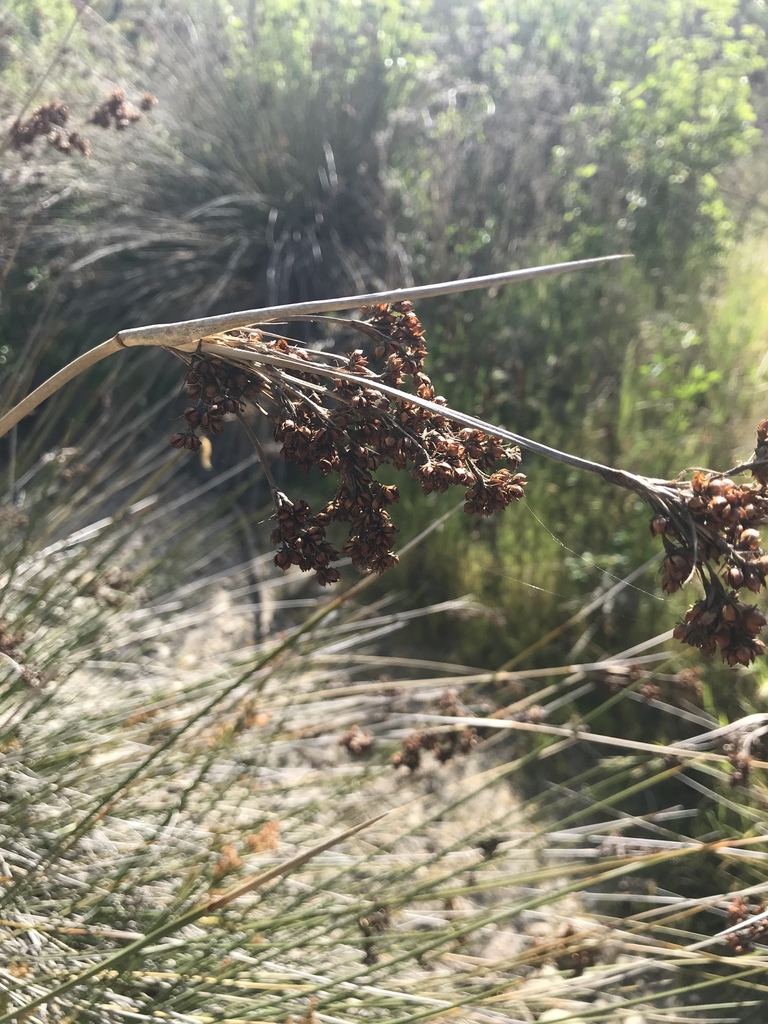
Basket Rush
Juncus textilis
Juncus textilis is a species of rush known by the common name basket rush. It is endemic to California, where it grows along the coast and in the coastal mountain ranges of the southern half of the state.
From the article Juncus textilis on Wikipedia (CC BY-SA), quoted section by section
Description
Juncus textilis is a rhizomatous perennial herb growing to a maximum height between 1 and 2 metres (3.3 and 6.6 ft). The stems are cylindrical with faint longitudinal grooves. The leaves lack blades and appear as small brown sheaths around the base of the stems. The long, bushy inflorescence arises from the side of the stem and splits into long branches bearing clusters of many flowers. Each flower is cupped by small, clear bractlets and has pointed greenish brown tepals. There are six stamens with large anthers. The fruit is a dark brown, shiny capsule.
At the table
This species of rush has been used historically for basket weaving by several Native American peoples of southern California, such as the Cahuilla, Kumeyaay, and Chumash, among others. Juncus textilis is an important plant endemic to California; Chumash people use it today for basket-making as they have for centuries. The rush was [sic] valued for its varied colors, from deep red to sun-dried tan; the stems were [sic] dyed black with sea plants such as Suaeda species and yellow with Psorothamnus emoryi. The tassels atop the rushes can be shaken for seeds, which can be eaten like grains. In springtime, the tender white bases can be eaten as emergency rations.
Wikipedia: “Uses”
Where it lives
Recorded sightings
—
geo-referenced records in GBIF, from museums, herbaria and field observers.
Drag the globe to turn it. Dots are where records exist, not a range map; darker means more records.
In the stacks
Searching the stacks…
Every page naming Juncus textilis in the Biodiversity Heritage Library →
This page is assembled live from iNaturalist, GBIF, Wikipedia, the Source Library and the Internet Archive. It is not yet part of the hand-edited codex. iNaturalist taxon 58349.