- Plants
- ›Vascular Plants
- ›flowering plants
- ›Dicots
- ›Mallows, Rock Roses, and Allies
- ›Mallow and Hibiscus Family
- ›Malvoideae
- ›Malveae
- ›Malva
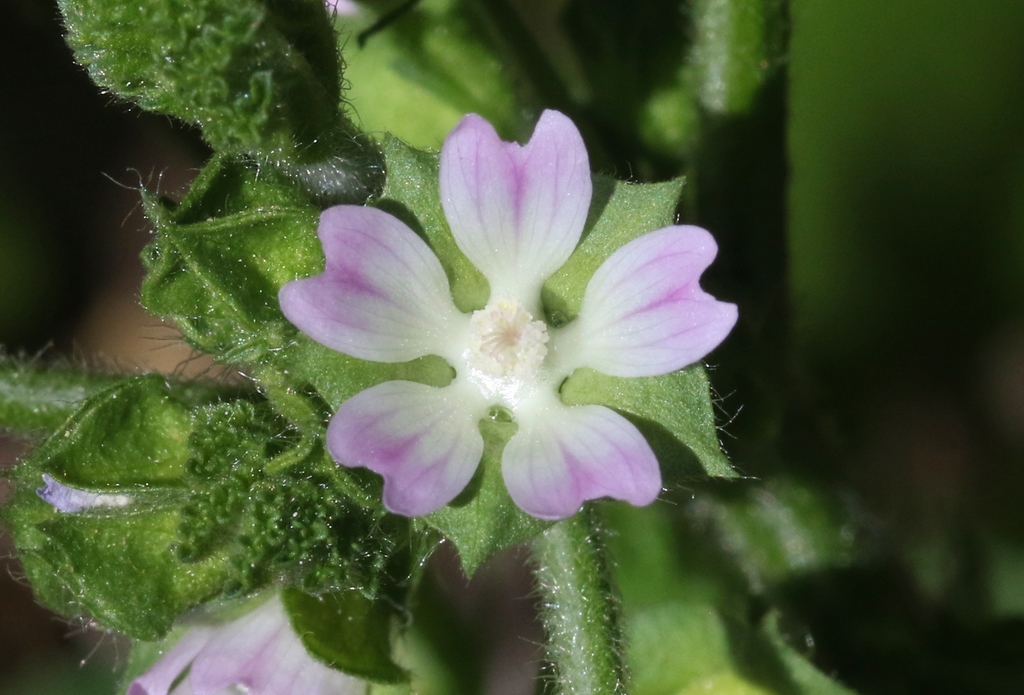
cheeseweed mallow
Malva parviflora
Malva parviflora is an annual or perennial herb that is native to Northern Africa, Europe and Asia and is widely naturalised elsewhere. Common names include cheeseweed, cheeseweed mallow, Egyptian mallow, least mallow, little mallow, mallow, marshmallow, small-flowered mallow, small-flowered marshmallow and smallflower mallow. M. parviflora leaf extracts possess anti-inflammatory and antioxidant activities. It has a decumbent or erect habit, growing to 50 cm in height. The broad leaves have 5 to 7 lobes and are 8...
From the article Malva parviflora on Wikipedia (CC BY-SA), quoted section by section
Description
M. parviflora has a decumbent or erect habit, growing up to 50–80 cm in height. The broad leaves have 5–7 shallow lobes and are 8–10 cm in diameter. The lobe edges are round-toothed, with varying hairiness. It has small white or pink flowers year-round at the base of leaf stalks; flowers have 4–10 mm long petals. The 2 mm seeds are reddish-brown and kidney-shaped. Newly sprouted plants have hairless, heart-shaped cotyledons with long stalks. These cotyledons are 3–12 mm long and 3–8 mm wide. Stalks usually do have hairs. The first leaf is rounder and larger than the others. True leaves are round and weakly lobed with wavy, shallow-toothed edges and a red spot at the leaf base. The plant rapidly grows a deep taproot. M. parviflora has a diploid chromosome count of 42.
Range & habitat
M. parviflora typically grows on agricultural lands and in disturbed sites such as roadsides. Its native range extends from the Mediterranean, through West Asia, and to Central Asia and can be found in Algeria, Egypt, Libya, Morocco, Tunisia, Kuwait, Afghanistan, Cyprus, Iran, Israel, Jordan, Lebanon, Syria, Turkey, Armenia, Azerbaijan, Turkmenistan, Albania, Bosnia and Herzegovina, Greece, Croatia, Italy, Malta, Spain, France, and Portugal. The species is widely naturalized elsewhere, including in North America since the 19th century. It is a naturalized weed in Australia.
Wikipedia: “Distribution and habitat”
At the table
The entire plant is edible and can be eaten both raw and cooked. It has a mild flavor similar to chard and a mild, earthy aroma. M. parviflora has been used in infusions, decoctions, and poultices as part of traditional medicine. In Mexico, M. parviflora is consumed as a quelite and used in traditional medicine to treat wounds and problems with digestion. In the 20th century, naturalist Alfonso Herrera Fernández noted that the dried leaves were used in moisturizing poultices and that the flowers were used in infusions to induce perspiration. Particularly in Zapotitlán, Puebla, the roots are used in infusions to treat dysentery. In Jordan, the leaves are used in infusions and poultices as an emollient, laxative, carminative, and anti-hemorrhoid. In Lebanon, the leaves are used in decoctions to treat catarrhs, kidney infections, kidney stones, respiratory infections, and constipation. In Ethiopia, the roots are used to treat asthma and wounds. Few clinical trials have tested the efficacy of M. parviflora's traditional uses. Preclinical studies have found that extracts from various parts of the plant have antimicrobial and antifungal properties. However, this effect is usually weaker than that of standard antibiotics. The roots and leaves have antioxidant and anti-inflammatory properties. The plant may have an anti-diabetic effect, but the effect's strength is disputed. In mice, M. …
Wikipedia: “Uses”
Toxicity
M. parviflora accumulates pollutants such as cadmium and chromium. In nitrogen-rich soils, the plant's leaves and seeds can be toxic to cattle and poultry due to an accumulation of nitrates. If consumed in large amounts, the plant can damage energy homeostasis in horses, possibly due to its cyclopropene fatty acids.
Where it lives
Recorded sightings
—
geo-referenced records in GBIF, from museums, herbaria and field observers.
Drag the globe to turn it. Dots are where records exist, not a range map; darker means more records.
In the stacks
Searching the stacks…
Every page naming Malva parviflora in the Biodiversity Heritage Library →
This page is assembled live from iNaturalist, GBIF, Wikipedia, the Source Library and the Internet Archive. It is not yet part of the hand-edited codex. iNaturalist taxon 58202.