- Plants
- ›Vascular Plants
- ›flowering plants
- ›Dicots
- ›pinks, cactuses, and allies
- ›Amaranth family
- ›saltbush subfamily
- ›Chenopodieae
- ›Chenopodium
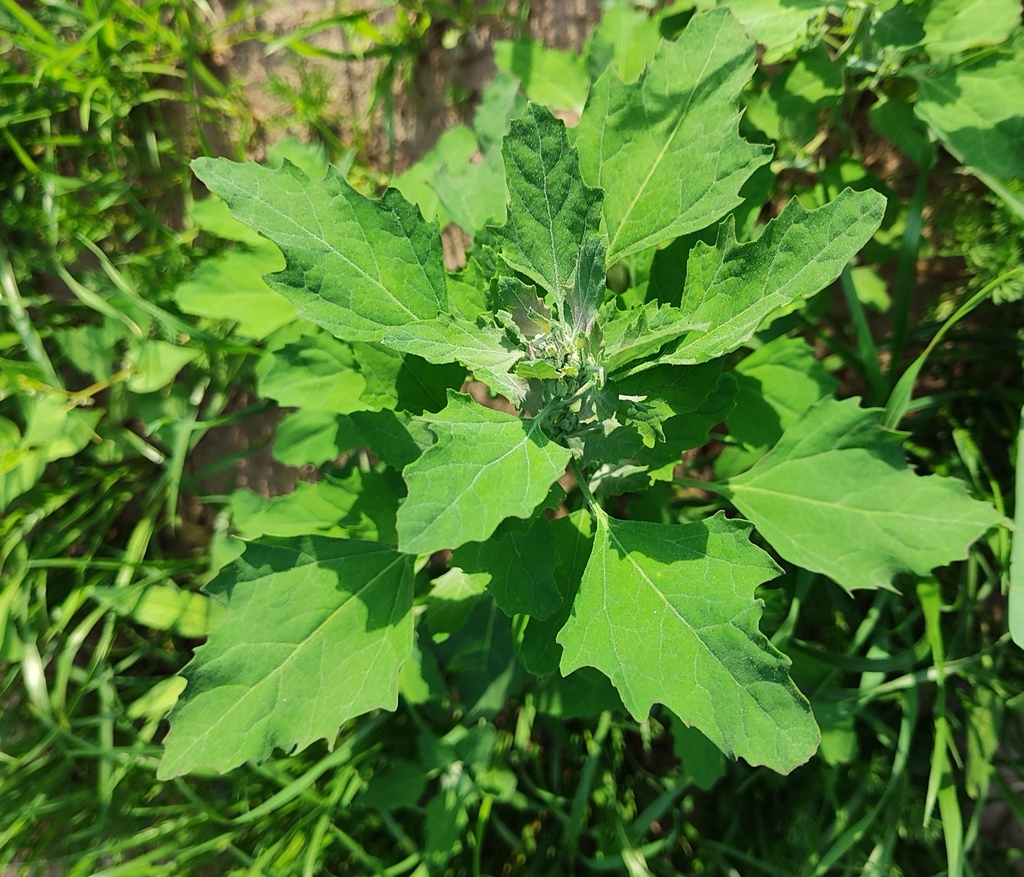
Common Lambsquarters
Chenopodium album
Chenopodium album is a fast-growing annual plant in the flowering plant family Amaranthaceae. Though cultivated in some regions, the plant is elsewhere considered a weed. Common names include lamb's quarters, melde, goosefoot, wild spinach and fat-hen, though several are also applied to other species of the genus Chenopodium, for which reason it is often distinguished as white goosefoot.
From the article Chenopodium album on Wikipedia (CC BY-SA), quoted section by section
Description
It tends to grow upright at first, reaching heights of 10–150 centimetres (4–59 in), rarely to 3 m; it then typically becomes recumbent after flowering (due to the weight of the foliage and seeds) unless supported by other plants. The leaves are alternate and varied in appearance. The first leaves, near the base of the plant, are toothed and roughly diamond-shaped, 3–7 cm long and 3–6 cm broad. The leaves on the upper part of the flowering stems are entire and lanceolate-rhomboid, 1–5 cm long and 0.4–2 cm broad; they are waxy-coated, unwettable and mealy in appearance, with a whitish coat on the underside. The small flowers are radially symmetrical and grow in small cymes on a dense branched inflorescence 10–40 cm long. Further, the flowers are bisexual and female, with five tepals which are mealy on outer surface, and shortly united at the base. There are five stamens.
Similar species. Poisonous black nightshade looks similar to this species when young, but the leaves of C. album have a white mealy texture and its axils have a red streak.
Range & habitat
Its native range is obscure due to extensive cultivation, but includes most of Europe, from where Carl Linnaeus described the species in 1753. Plants native to eastern Asia are included under C. album, but often differ from European specimens. According to Plants of the World Online, the species' natural distribution includes temperate Eurasia from western Europe to China and the Russian Far East, the Indian subcontinent, North Africa, Ethiopia, and the eastern and central United States. It is widely naturalized elsewhere, such as in Africa, Australasia, North America, and Oceania, and now occurs almost everywhere (except Antarctica) in soils rich in nitrogen, especially on wasteland.
Wikipedia: “Distribution and habitat”
At the table
Raw lamb's quarters are 84% water, 7% carbohydrates, 4% protein, and 1% fat. In a 100 gram reference amount, lamb's quarters provide 43 kilocalories, and are a rich source (20% or more of the Daily Value, DV) of vitamin C (96% DV), vitamin A (73% DV), riboflavin (37% DV), vitamin B6 (21% DV), manganese (37% DV), and calcium (31% DV), with several other dietary minerals in lesser amounts.
Wikipedia: “Nutrition”
Where it lives
Recorded sightings
—
geo-referenced records in GBIF, from museums, herbaria and field observers.
Drag the globe to turn it. Dots are where records exist, not a range map; darker means more records.
In the stacks
Searching the stacks…
Every page naming Chenopodium album in the Biodiversity Heritage Library →
This page is assembled live from iNaturalist, GBIF, Wikipedia, the Source Library and the Internet Archive. It is not yet part of the hand-edited codex. iNaturalist taxon 58127.