- Plants
- ›Vascular Plants
- ›flowering plants
- ›Dicots
- ›Mustards, Capers, and Allies
- ›mustard family
- ›Brassicoideae
- ›Brassicodae
- ›Sisymbrieae
- ›Sisymbrium
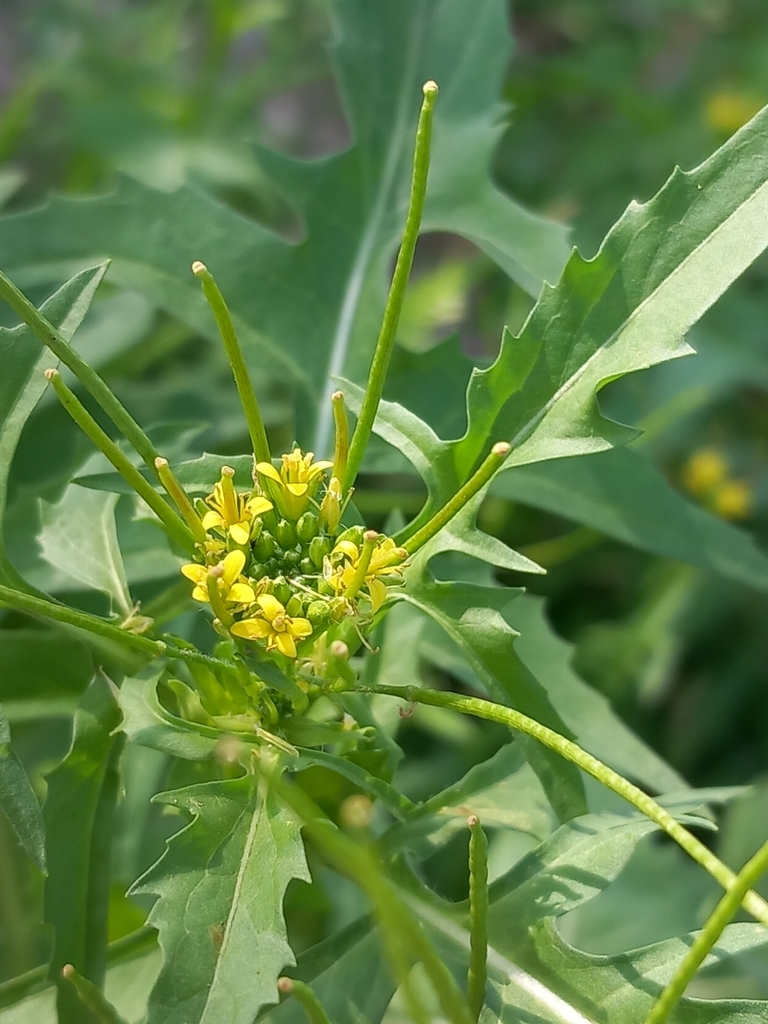
London rocket
Sisymbrium irio
Sisymbrium irio, London rocket, is a flowering plant in the cabbage family. Its English common name originated when it flourished after the Great Fire of London in 1666, although it is not native to Britain and it does not tend to persist there.
It is native to the Middle East, north Africa and southern Europe, and which has spread widely around the world as an invasive plant of dry, disturbed land in towns, deserts and farmland. It has traditionally been used as a medicinal herb for a variety of ailments.
From the article Sisymbrium irio on Wikipedia (CC BY-SA), quoted section by section
Description
London rocket is a winter annual herb which is very variable in size. It can grow to be a large, leafy plant as much as 130 centimetres (51 in) tall in Britain, but only a small, rosette-forming one about 10 cm (4 in) tall in Arabia, where it is native. It has an erect, usually branched stem which is green, terete, solid and almost glabrous, except for a smattering of soft, short hairs (0.5 millimetres or 1⁄32 inch long). The leaves are alternate and imparipinnate or pinnatisect, up to 18 cm (7 in) long, with one to five pairs of lateral lobes and a round or ternate terminal lobe. The petioles are up to 6 cm (2+1⁄4 in) long, channelled and slightly decurrent down the stem, without stipules. They are finely hairy on both surfaces, uniformly green except for a pale midrib, and have a peppery flavour.
The actinomorphic flowers are about 5 mm (1⁄4 in) in diameter and are arranged in racemes of 50–100 or more at the tips of the main stem and the branches. Each flower has 4 yellow petals, 4 green, finely hairy sepals which are nearly as long as the petals, and 6 stamens. The flower stalks (pedicels) are short at flowering time, creating a rather flat-topped and crowded inflorescence, but they elongate as the fruits develop, soon causing them to overtop the flowers. The fruit is a long (3–8 cm) narrow cylindrical silique which stays green when ripe and is slightly torulose (i.e. …
Range & habitat
London rocket is thought to be native in the Middle East and as far eastward as northwest India or Mongolia, and westward throughout North Africa and southern Europe. It has been introduced to North America, where it is considered something of a pest species in the southern US and Mexico, and to South America, Australasia and southern Africa. It has also spread as far east as Korea and Japan. Its status internationally has not been evaluated, but it is not considered to be at risk in most countries in which it occurs, as is classified as Least Concern. London rocket was introduced to Britain by the 1650s and has maintained a scattered distribution since then. It does not tend to persist in any site for long, and is even believed to have disappeared from London by the late 19th century, only to be reintroduced again in the 20th. It comes in via docks and other transport hubs, and it used to turn up in fields that had been treated with wool shoddy. Overall, the population has remained more or less stable for centuries, although its transient nature means there are many more places where it used to occur than there are at any one time, leading to the mistaken impression that it is perpetually declining. One country where it has recently arrived is South Korea, where it has been studied very closely. …
Wikipedia: “Distribution and status”
What it does
The Database of Insects and their Food Plants lists just two species that make use of London rocket: Ceutorhynchus hirtulus is a weevil that lives in the soil and creates stem galls for it larvae, whereas cabbage looper moth larvae eat the leaves of this and many other species in the cabbage family. This species is considered a weed in the Southwestern United States and other regions where it has been introduced.
Wikipedia: “Habitat and ecology”
At the table
In desert regions of Arabia and Egypt, London rocket is considered an important source of fodder for livestock. The leaves, seeds, and flowers are edible to humans, with a spicy flavor similar to cultivated rocket. London rocket is used in the Middle East to treat coughs and chest congestion, to relieve rheumatism, to detoxify the liver and spleen, and to reduce swelling and clean wounds. The Bedouin of the Sinai Peninsula and the Negev desert reportedly used the leaf of London rocket as a tobacco substitute, and a recent study of the alkaloid content of desert-grown plants in Iraq found a high concentration of nicotine in extracts of the aerial parts of this plant. The cured pods can be placed in a basket with live coals and shaken until the pods are parched, then ground into meal and made into soup or stew.
Wikipedia: “Uses”
In human culture
The first published record of this species in Britain was by Christopher Merret in 1666, who described Irio laevis as being "almost everywhere in the suburbs of London on walls and near ditches". It had, however, been noticed at least a decade earlier: William How (1620–1656) had annotated his own copy of his book Phytologia Britannica (1650) with the comment "near White Chappel east from Aldgate, London"; a discovery he attributed to John Goodyer. The term "London" in the common name "London rocket" allegedly comes from its abundance after the Great Fire of London in 1666. Robert Morison, the physician to King Charles II, attributed their appearance to spontaneous generation when he observed that “these hot bitter plants with four petals and pods were produced spontaneously without seed by the ashes of the fire mixed with salt and lime.” By contrast, Dr E.J. Salisbury, in his study of the bombsites of London after the Blitz in 1940, "failed to find a single specimen, nor has any other reliable observer reported it". The term "Rocket" in the common name appears to be derived from the old Latin term "eruca" applied to several loosely related plants in the cabbage family.
Wikipedia: “History”
Where it lives
Recorded sightings
—
geo-referenced records in GBIF, from museums, herbaria and field observers.
Drag the globe to turn it. Dots are where records exist, not a range map; darker means more records.
In the stacks
Searching the stacks…
Every page naming Sisymbrium irio in the Biodiversity Heritage Library →
This page is assembled live from iNaturalist, GBIF, Wikipedia, the Source Library and the Internet Archive. It is not yet part of the hand-edited codex. iNaturalist taxon 58085.