- Plants
- ›Vascular Plants
- ›flowering plants
- ›monocots
- ›grasses, sedges, cattails, and allies
- ›Sedges
- ›Cyperoideae
- ›Rhynchosporeae
- ›Rhynchospora
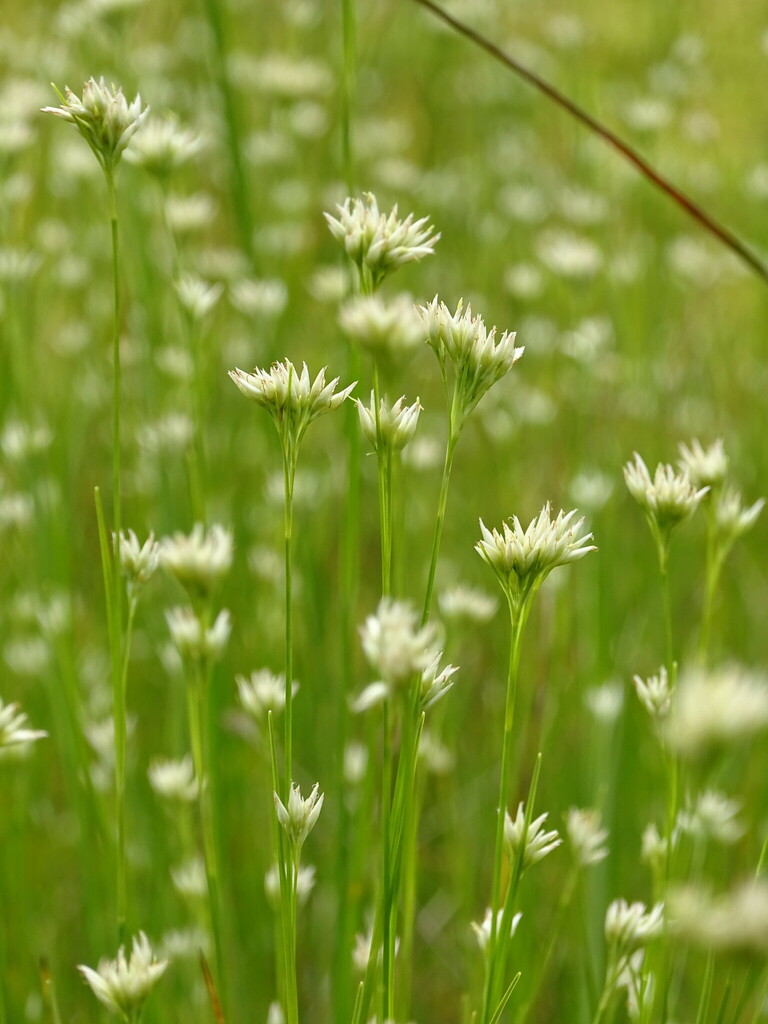
white beak-sedge
Rhynchospora alba
Rhynchospora alba, the white beak-sedge, is a plant in the sedge family, Cyperaceae. It is a tufted herbaceous perennial around 50 cm tall, with white inflorescences that flower in August. The fruit of the sedge is a small achene with a characteristic beak-like cap. It is dispersed by wind or falls by gravity, leading to individuals existing in tight clumps. The species favours wet, acidic and nutrient poor soils, thriving in Sphagnum-dominated bogs, but also peaty grasslands. As such, it is often used as a positive indicator for bog and mire ecosystem health.
The species was first described by Linnaeus in 1753 under a different genus and name, Schoenus albus, but was subsequently reclassified into the novel genus Rhynchospora by Vahl in 1805. It has a wide range across the Northern Hemisphere, extending from the inland wetlands of North America, across Europe to the Korean Peninsula. Due to this large range, there is considerable variation between populations, and numerous varieties have been identified. The plant has few uses, though it is used as an ornamental in the UK.
From the article Rhynchospora alba on Wikipedia (CC BY-SA), quoted section by section
Description
Rhynchospora alba is a perennial herb between 10 and 50 cm in height, though plants up to 75 cm tall can be found in North America. The plant grows in tight clumps, meaning it is often difficult to distinguish individual stems. The plant consists of a single erect stem, which is three-angled and thin, usually 0.5–1 mm thick. The leaves attached to the stem are three-ranked (in spirals around the three edges of the stem) and parallel veined, extending up to 15 cm in length [6], though none overtop the stem. Each leaf is differentiated into a green or straw coloured sheath, which hugs the stem, and a grey/green blade, which is flat and slender (0.7–2 mm) and tapers to a blunt tip. In some specimens, the margins of the blade are sparsely covered in hairs. Unlike many sedge species, there is no ligule (outgrowths at the meeting of the blade and sheath). At the base of the plant, the leaves have no blade, and only the sheaths are present. These are often subtending a 10–20 mm bud, which will overwinter and grow a new plant in spring. While most Rhynchospora have large rhizomes (tuber-like stems below the soil surface), R. alba has very small rhizomes, or none at all, and very shallow root systems. This reflects its different life history to many other sedges – R. …
Range & habitat
Rhynchospora alba favours acidic, nutrient poor conditions and is found across a range of wetland environments. It is most commonly found in ombrotrophic bogs (where plant nutrients are only obtained through rainfall and dry deposition) and Sphagnum moss-dominated communities, where it is one of the few vascular plant species present. Studies into nutrient and mass allocation by R. alba found the plant exhibits much higher rates of nutrient accumulation and loss across the growing season than in other sedges, which rely more heavily on storage and remobilising of nutrients in rhizomes. This is likely related to the much lower levels of interspecific competition experienced by R. alba in these bogs than other sedges in more grass-dominated environments. It is also found in peatlands alongside other sedge species such as Carex species. It has a persistent seed bank, with seeds living up to five years. It is therefore often an early re-coloniser in disturbed environments, where it can become the dominant species in so-called R. alba sedgeland. …
Wikipedia: “Habitat and ecology”
At the table
White beak-sedge is used very little by humans due to its favoured habitat of nutrient-poor acidic bogs, but is sometimes used as an ornamental plant in the UK, and in bog restoration.
Wikipedia: “Uses”
In human culture
The genus Rhynchospora derives from the Greek Rhynkos – "beak" and spora "seed". This, along with the genus’ common name beak-sedge, refers to the long beak-like tubercle at the top of the achene fruit. This is characteristic to the entire genus and is often used for intra-generic classification. The species name alba derives from the Latin albus, or white, and refers to the white glumes surrounding each flower, which give the inflorescence its colour. The species has multiple common names, the most common being white beak-sedge, again referring to the inflorescence colour and shape of the tubercle. It is also known as white beak-rush, though this is misleading, as it is not in the rush family.
Wikipedia: “Etymology”
Where it lives
Recorded sightings
—
geo-referenced records in GBIF, from museums, herbaria and field observers.
Drag the globe to turn it. Dots are where records exist, not a range map; darker means more records.
In the stacks
Searching the stacks…
Every page naming Rhynchospora alba in the Biodiversity Heritage Library →
This page is assembled live from iNaturalist, GBIF, Wikipedia, the Source Library and the Internet Archive. It is not yet part of the hand-edited codex. iNaturalist taxon 57862.