- Animals
- ›Chordates
- ›Vertebrates
- ›Mammals
- ›Therians
- ›Placental Mammals
- ›Primates, Rodents, and Allies
- ›Lagomorphs
- ›Hares and Rabbits
- ›Lepus
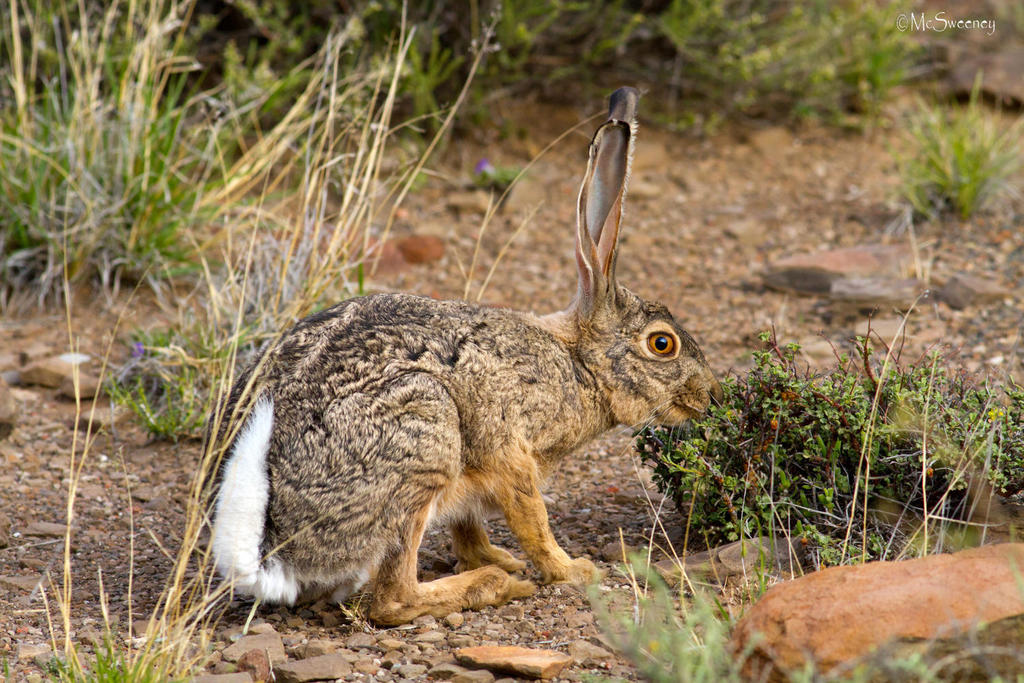
Cape Hare
Lepus capensis
The Cape hare (Lepus capensis), also called the brown hare and the desert hare, is a hare native to Africa and Arabia extending into India.
From the article Cape hare on Wikipedia (CC BY-SA), quoted section by section
Description
The Cape hare is a typical hare, with well-developed legs for leaping and running, and large eyes and ears to look for threats from its environment. Usually, a white ring surrounds the eye. It has a fine, soft coat which varies in colour from light brown to reddish to sandy grey. Unusually among mammals, the female is larger than the male, an example of sexual dimorphism.
Range & habitat
The Cape hare inhabits macchia-type vegetation, grassland, bushveld, the Sahara Desert and semi-desert areas. It is also common in parts of the Ethiopian Highlands, such as Degua Tembien.
Wikipedia: “Distribution and habitat”
What it does
The Cape hare is a nocturnal herbivore, feeding on grass and various shrubs. Coprophagy, the consumption of an organism's own fecal material to double the amount of time food spends in the digestive tract, is a common behaviour amongst rabbits and hares. This habit allows the animal to extract the maximum nourishment from its diet, and microbes present in the pellets also provide nutrients. After a 42-day-long pregnancy, the female gives birth to from one to three young, termed leverets, per litter and may have as many as 4 litters per year. A characteristic of hares which differentiates them from rabbits is that the young are born precocial; that is, the young are born with eyes open and are able to move about shortly after birth. One Cape hare kept in captivity lived to nearly 9 years, but their longevity in the wild is uncertain.
Wikipedia: “Behavior and ecology”
In human culture
An example of an ancient Egyptian mummified Lepus capensis has been recorded in a tomb near Dendera. The Egyptian god Unut was a cape hare.
== References ==
Wikipedia: “In culture”
Listen
Looking for field recordings…
Where it lives
Recorded sightings
—
geo-referenced records in GBIF, from museums, herbaria and field observers.
Drag the globe to turn it. Dots are where records exist, not a range map; darker means more records.
In the stacks
Searching the stacks…
Every page naming Lepus capensis in the Biodiversity Heritage Library →
This page is assembled live from iNaturalist, GBIF, Wikipedia, the Source Library and the Internet Archive. It is not yet part of the hand-edited codex. iNaturalist taxon 57560.