- Plants
- ›Vascular Plants
- ›flowering plants
- ›Dicots
- ›pinks, cactuses, and allies
- ›Stone plants
- ›Brightfig Subfamily
- ›Brightfig Tribe
- ›Carpobrotus
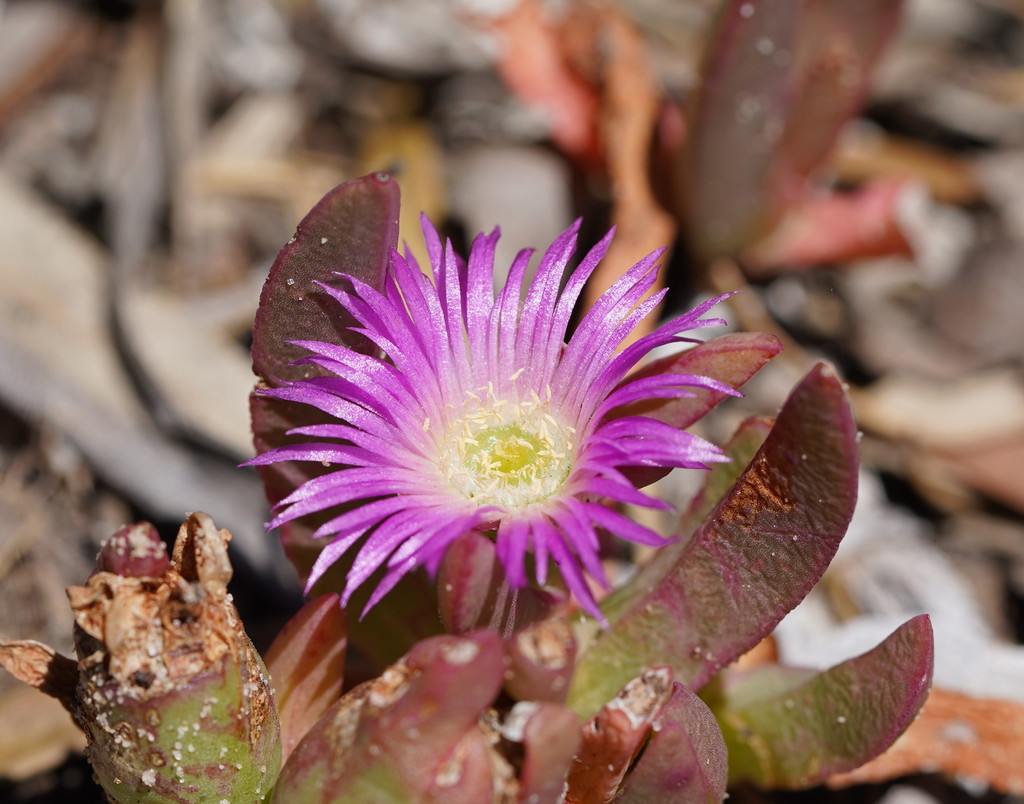
inland pigface
Carpobrotus modestus
Carpobrotus modestus, commonly known as inland pigface, is a succulent perennial of the family Aizoaceae, native to the coasts of Australia. It produces purple flowers which mature into fruits and is mainly used as a groundcover succulent or as a drought tolerant plant.
From the article Carpobrotus modestus on Wikipedia (CC BY-SA), quoted section by section
Description
It is a prostrate succulent with stems up to 50 centimetres (20 in) long and 3 to 8 millimetres (0.1–0.3 in) in diameter. The leaves are 3 to 7 centimetres (1.2–2.8 in) long, 4 to 9 millimetres (0.16–0.35 in) thick, glaucous and often tinged pink, usually slightly thicker than wide near the middle, with flat to slightly convex faces and a smooth or finely toothed keel near the tip. The flowers are about 2 centimetres (0.8 in) in diameter and usually sessile. Each has five sepals, the two longest 8 to 18 millimetres (0.3–0.7 in) long, around 45 to 60 petal-like staminodes 6 to 12 millimetres (0.2–0.5 in) long that are purple with a white base, and 20 to 100 stamens. Species contain both male and female reproductive organs (hermaphrodite.) The fruit is fleshy, purple when ripe, and appears fig-like, it is narrowly ellipsoid to obovoid, 1.5 to 2 centimetres (0.6–0.8 in) long with a recurved stalk. Flowering occurs from August to November in Western Australia and from September to February in eastern Australia.
Similar species. Carpobrotus edulis, native to South Africa, is an invasive member of the genus and often confused with native species of Carpobrotus. C. edulis forms dense mats that suppress the regeneration of native vegetation and alter soil chemistry. …
Range & habitat
Carpobrotus modestus is found in areas of Western Australia, South Australia and Victoria. situated in heath, shrubland, and woodland areas with clayey-sand. The species occurs in a range of soil types, including sandy, loamy, and clay. Although the habitat plays a large part in a plant's growth and development, inland pigface can grow in acidic, basic, and neutral soil pH that is well-drained. In these tough environments, the Inland Pigface can tolerate harsh habitual influences such as droughts, frost, and salinity in the soil.
Wikipedia: “Distribution and habitat”
What it does
Carpobrotus modestus switches between CAM and C3 photosynthesis. When soil water is limited, the plant utilises CAM photosynthesis, switching to C3 photosynthesis when water become available. C. modestus acts as a post-fire pioneer in semi-arid shrublands, appearing soon after fire and persisting for several years before disappearing as the shrubland canopy closes during regeneration.
Food. Both the fruit and leaves of C. modestus are reported to be used by first nations people in Australia as a source of food.
Medicinal. The leaves of C. modestus have been traditionally applied to treat stings, burns, and skin irritations in a manner similar to Aloe vera. Extracts from the leaves have also demonstrated antioxidant, antiplatelet, and anti-inflammatory activity.
== References ==
Wikipedia: “Ecology”
Where it lives
Recorded sightings
—
geo-referenced records in GBIF, from museums, herbaria and field observers.
Drag the globe to turn it. Dots are where records exist, not a range map; darker means more records.
In the stacks
Searching the stacks…
Every page naming Carpobrotus modestus in the Biodiversity Heritage Library →
This page is assembled live from iNaturalist, GBIF, Wikipedia, the Source Library and the Internet Archive. It is not yet part of the hand-edited codex. iNaturalist taxon 574102.