- Plants
- ›Vascular Plants
- ›flowering plants
- ›Dicots
- ›Roses, Elms, Figs, and Allies
- ›Nettle Family
- ›Parietarieae
- ›Parietaria
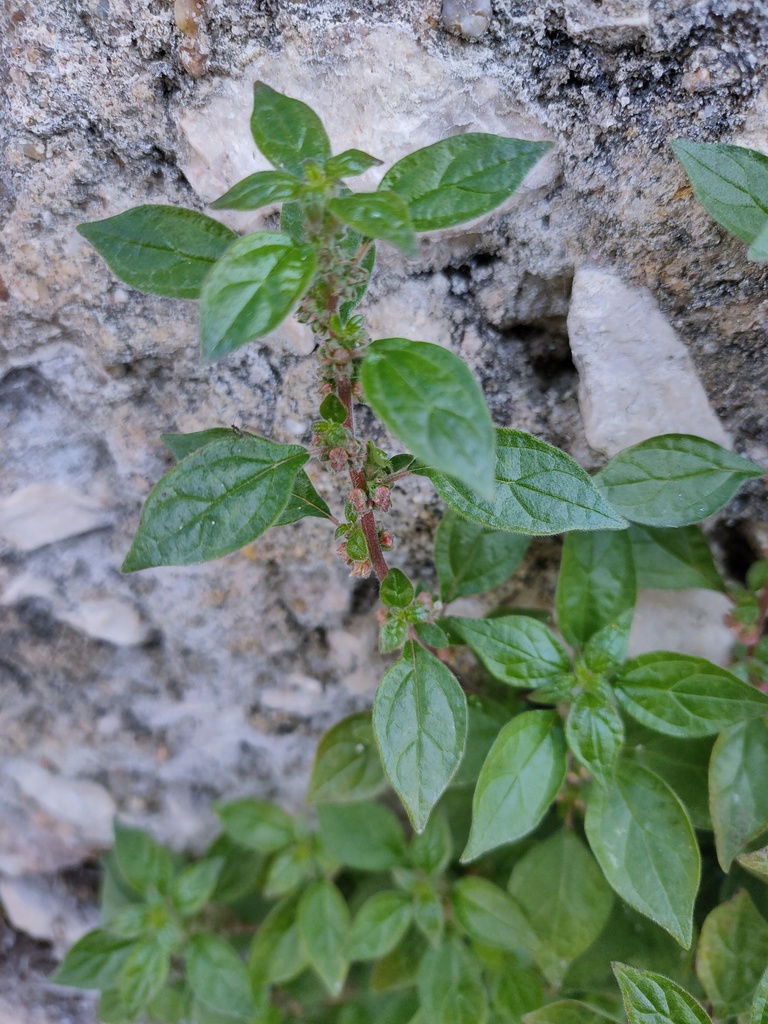
pellitory-of-the-wall
Parietaria judaica
Parietaria judaica, with common names spreading pellitory or pellitory of the wall, is a species of herbaceous perennial plant in the family Urticaceae, commonly nicknamed sticky-weed. The plant's pollen is highly allergenic. In Australia it is also known as asthma weed, due to the high incidence of allergy. It is unrelated to the herb pellitory (Anacyclus pyrethrum). It is easily confused with the very similar species Parietaria officinalis.
From the article Parietaria judaica on Wikipedia (CC BY-SA), quoted section by section
Description
Spreading pellitory is a perennial herb about 50 cm (up to 110 cm) tall with an upright to sprawling untidy habit. Plants can have many branched stems, which are pink or red and slightly woody and brittle at the base.
The leaves are alternate, oval lanceolate, typically 3 cm long x 1.5 cm wide (exceptionally up to 6 cm x 3 cm) with a petiole about half as long as the blade. The veins on the lower side of the leaf are softly hairy, as are the leaf margins and the petiole. The upper surface is often glossy and either glabrous or with scattered hairs, and with sunken veins.
Flowering can occur all year in suitable conditions in Europe. The inflorescence consists of clusters in the leaf axils. Each cluster comprises 3-8 white or pink flowers, subtended by tiny bracts, of which typically one is female-only and the other 2-7 are hermaphroditic (although towards the eastern part of its range, the presence of female flowers is less common.) The female flower has 4 perianth segments (petals) and is 2 mm diameter (in fruit). The hermaphroditic flowers are tubular and up to 3 mm across (in fruit), with 4-5 stamens, which mature first, and one stigma, which develops later. …
Range & habitat
Spreading pellitory is a native of Macaronesia, N. Africa, Europe to Central Asia and Central Himalaya but has been introduced to parts of north and south Americas, Scandinavia and Australia. The IUCN has not yet evaluated the global status of spreading pellitory, but in France, Britain and elsewhere it is considered unthreatened ("Least Concern", or LC), although in some regions it is rarer; for example, in Lorraine it is classified as endangered (EN) and it is absent from Alsace altogether. It is a lowland plant, being recorded from sea level up to about 125 m in California and no higher than 200 m anywhere in the United States. Altitudinal data for it is not collected in Britain, but analysis of the regions where it grows shows no land above 500 m and very little over 300 m.
Wikipedia: “Distribution and status”
What it does
In its native habitat, spreading pellitory grows on rocks and bare ground in slightly damp and sheltered places such as seasonal river valleys in limestone areas of the Eastern Mediterranean. It is, however, well adapted to synanthropic habitats in towns, where it can exploit the urban heat island effect to thrive in colder climates. It has also become common in other continents, where it can benefit by competitive release from its pests and predators.
In an urban landscape its main habitat is at the base of walls, where there is increased dampness, light shade and protection from trampling. It grows on bare soil or in the gap at the edge of the pavement and it is tolerant of light salinity, so it can occur in coastal towns and beside roads that are treated with salt. Plants are also found in gaps in the mortar between bricks or stones of older or damp walls, on shingle, and at the bottom of hedges. Plant density is highest in old town centres, thinning out in the suburbs until it becomes virtually absent from the open countryside. This is presumably because it is highly palatable to livestock. …
Wikipedia: “Habitat and ecology”
At the table
The pollen of spreading pellitory is one of the leading causes of respiratory allergies (asthma and rhinitis) in the Mediterranean region, particularly at peak flowering times in the spring and autumn. One study estimated that the huge population of pellitory in a city in Greece could produce as many as 5.4 billion pollen grains per square metre during the spring months, causing many medical problems. It has been established in Australia since 1902 or earlier, especially in Sydney, Melbourne and Fremantle, where it is considered a noxious weed. Control is effected by the application of glyphosate, although it can grow back quickly from the persistent soil seed bank. In herbal medicine it was supposed to be efficacious against kidney and bladder stones, presumably because its roots appear to be splitting stone walls. The celebrated herbalist of the early 20th century Maud Grieve considered that its "action upon the urinary calculus is perhaps more marked than any other simple agent at present employed". Some Romani people apparently use it to treat sores, ulcers and piles. Some authors consider that the plant listed by the Ancient Greek herbalist Dioscorides as Helxine is spreading pellitory. The description seems quite apt: "helxine grows in mounds and walls. …
Wikipedia: “Uses and effects”
Where it lives
Recorded sightings
—
geo-referenced records in GBIF, from museums, herbaria and field observers.
Drag the globe to turn it. Dots are where records exist, not a range map; darker means more records.
In the old herbals & bestiaries

Living Images of Plants
Otto Brunfels · 1532 · p.362

Latin Herbal
1484 · p.219

Herbarius
1485 · p.220

Herbarius latinus (with Dutch synonyms)
1486 · p.217

Ortus sanitatis
1491 · p.302

Garden of Health
Jacob Meydenbach · 1491 · p.302

Garden of Health
1507 · p.245

The Great Herbary with all the figures of the herbs
1532 · p.244

On the Names of Plants
Hieronymus Bock (Tragus) · 1552 · p.265
In the stacks
Searching the stacks…
Every page naming Parietaria judaica in the Biodiversity Heritage Library →
This page is assembled live from iNaturalist, GBIF, Wikipedia, the Source Library and the Internet Archive. It is not yet part of the hand-edited codex. iNaturalist taxon 57281.