- Plants
- ›Vascular Plants
- ›flowering plants
- ›Dicots
- ›proteas, lotuses, planes, and allies
- ›Protea family
- ›Singlet Proteas
- ›Nutseed Proteoid Clade
- ›Cape Nutseed Proteoids
- ›Mimetes
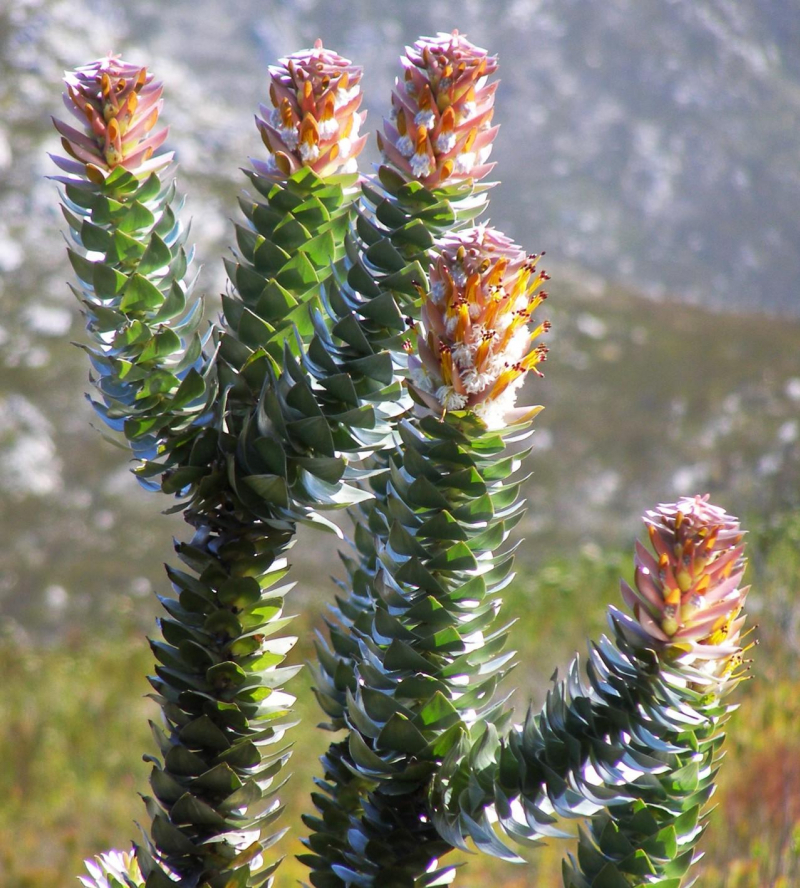
Mace Pagoda
Mimetes stokoei
Mimetes stokoei, the mace pagoda, is an evergreen, upright, hardly branching, large shrub of 1–2 m (3–6+1⁄2 ft) high in the family Proteaceae. It has silvery, oval leaves of 5–8 cm (2.0–3.2 in) long and 2+1⁄2–4 cm (1.0–1.6 in) wide, with one large tooth supported by two smaller teeth near the tip, at an upward angle and somewhat overlapping each other. The inflorescences are set just below the growing tip, are cylinder-shaped, 10–12 cm (4–5 in) high, topped by a crest of small, more or less horizontal, pinkish-purple tinged leaves. It consists of several flower heads in the axils of golden leaves with a pinkish wash that form a hood shielding the underlying flower head. Each flower head contains eight to twelve individual flowers, with amber-colored styles topped by blackish purple pollen presenters and grey silky perianth lobes. It is endemic to the Fynbos ecoregion of South Africa, being confined to the Kogelberg mountain range. The mace pagoda was twice presumed extinct, but reappeared in its natural habitat from seed, after a wildfire several decades later.
From the article Mimetes stokoei on Wikipedia (CC BY-SA), quoted section by section
Description
Mimetes stokoei is an evergreen, upright, slender, column-like, mostly unbranched shrub of 1–2 m (3–6+1⁄2 ft) high, with the main stem up to 2+1⁄2 cm (1 in) thick at ground level. In the upper part it may sometimes have up to three, felty hairy branches 1⁄2–3⁄4 cm (0.2–0.3 in) thick. The pointed, ovate or broadly oval leaves are set alternately along the branches, at an upward angle and somewhat overlapping, and lack both stipules and petioles. They are 5–8 cm (2.0–3.2 in) long and 2+1⁄2–4 cm (1.0–1.6 in) wide, silvery due to a dense layer of silky hairs, have a slightly heart-shaped base, and an entire margin with a prominent tooth at the tip, seconded by two smaller teeth. The inflorescences are set just below the top of the branches; they are broadly cylinder-shaped, 10–15 cm (4–6 in) high, and topped by a flattened crest of smallish, horizontal, pinkish-purple tinged leaves. It consists of several flowerheads in the axils of golden yellow leaves with a pinkish-purple wash during flowering, at a moderate upward angle that form a hood shielding the underlying flower head. Each flowerhead contains eight to twelve individual flowers. The outer whorl of involucral bracts, that encircle the flower heads, are oval to rounded, 1–1+2⁄3 cm (0.4–0.6 in) long and 3⁄4–1+1⁄2 cm (0.3–0.6 in) wide. …
Range & habitat
M. stokoei is endemic to the Kogelberg Nature Reserve, Western Cape province of South Africa, where it only occurs in one location on the Paardeberg, in the upper reaches of the Palmiet river near Kleinmond. It grows on a gentle slope of weathered Table Mountain Sandstone that is dry in the summer and wet during the winter at an altitude of 560–600 m (1,840–1,970 ft). The species is fast growing and relatively short-lived. Specimens were observed to start flowering at an age of around four years. Apparently, it is present in the soil seed bank for decades, until a suitably intense fire triggers germination. Flower heads may develop at any time during the year. It is assumed that like other Mimetes species, the mace pagoda is pollinated by birds and the seeds are distributed by ants.
Wikipedia: “Distribution and habitat”
Where it lives
Recorded sightings
—
geo-referenced records in GBIF, from museums, herbaria and field observers.
Drag the globe to turn it. Dots are where records exist, not a range map; darker means more records.
In the stacks
Searching the stacks…
Every page naming Mimetes stokoei in the Biodiversity Heritage Library →
This page is assembled live from iNaturalist, GBIF, Wikipedia, the Source Library and the Internet Archive. It is not yet part of the hand-edited codex. iNaturalist taxon 571186.