- Plants
- ›Vascular Plants
- ›flowering plants
- ›Dicots
- ›Mustards, Capers, and Allies
- ›mustard family
- ›Brassicoideae
- ›Heliophilodae
- ›Anastaticeae
- ›Lobularia
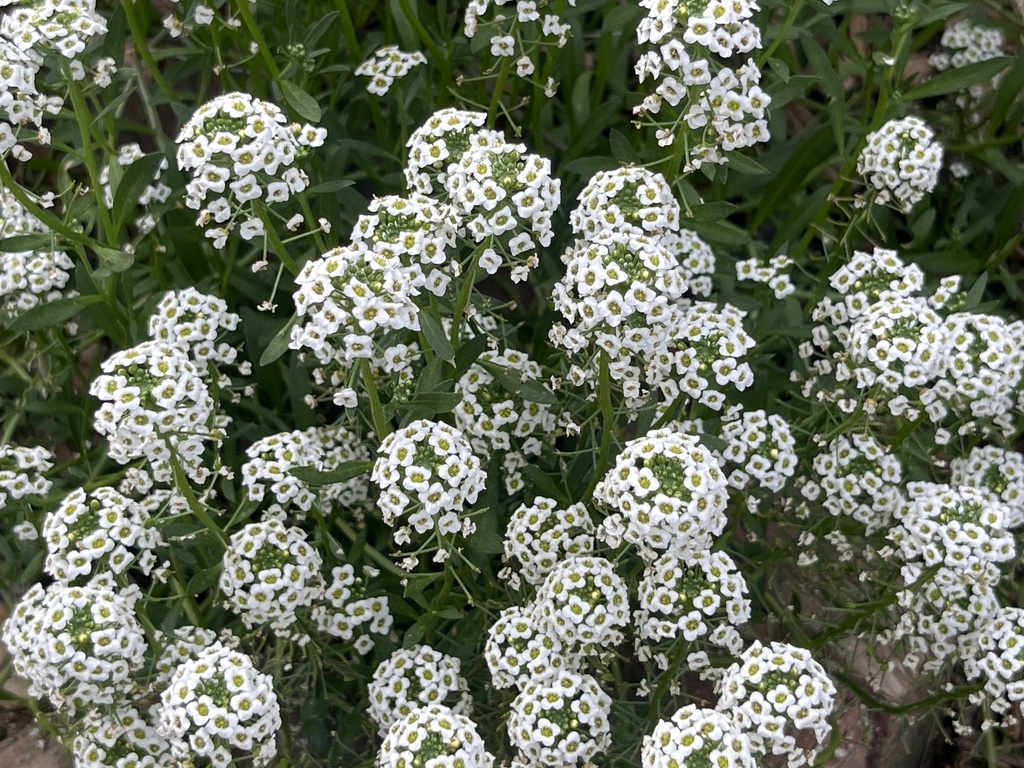
sweet alyssum
Lobularia maritima
Lobularia maritima (syn. Alyssum maritimum) is a species of low-growing flowering plant in the family Brassicaceae. Its common name is sweet alyssum or sweet Alison, also commonly referred to as just alyssum (from the genus Alyssum in which it was formerly classified).
From the article Lobularia maritima on Wikipedia (CC BY-SA), quoted section by section
Description
Lobularia maritima is an annual plant (rarely a short-lived perennial plant) growing to 5–30 cm (2–12 in) tall by 20–30 cm (8–12 in) broad. The stem is very branched, with dense clusters of small flowers. The leaves are 1–4 cm long and 3–5 mm, broad, alternate, sessile, quite hairy, oval to lanceolate, with an entire margin. The flowers are about 5 millimetres (0.20 in) in diameter, sweet-smelling, with an aroma similar to that of honey, with four white rounded petals (or pink, rose-red, violet. yellow and lilac) and four sepals. The six stamens have yellow anthers. The flowers are produced throughout the growing season, or year-round in areas free of frost. They are pollinated by insects (entomophily) as its sweet honey-like fragrance is attractive to bees, flower flies, stingless wasps and butterflies. The fruits are numerous elongated seedpods rather hairy, oval to rounded, each containing two seeds. The dispersal of seed is affected by the wind (anemochory).
Range & habitat
This plant is native to the Mediterranean Basin and the Macaronesia region: (Canary Islands, Madeira, Cape Verde). It is widely naturalized elsewhere in the temperate world, including the United States. There is an endemic subspecies in the local flora of the Columbretes Islands of the western Mediterranean.
Wikipedia: “Distribution”
How it is grown
Lobularia maritima is cultivated in gardens, with many horticultural varieties with purple or pink flowers. The plant is best planted in early spring, but requires little maintenance when growing. Although an annual, it may reseed in temperate climates. It will flower more profusely if spent blooms are trimmed. When grown in gardens, it is typically used as groundcover, as it rarely grows higher than 20 cm (8 in) tall. It is also grown in cracks in paving and walls, and is especially associated with coastal locations. It prefers partial shade, and is highly resistant to heat and drought. Plants with darker-colored flowers do better in cooler temperatures.
Cultivars. (Those marked agm have gained the Royal Horticultural Society's Award of Garden Merit.)
Wikipedia: “Cultivation”
In human culture
The genus name Lobularia comes from a Greek word meaning 'small pod,' referring to the shape of the fruits; the obsolete Alyssum can be translated as 'lack of madness,' referencing the historical use of the herb as a treatment against rabies. The name of the species maritima refers to its preferred coastal habitat.
Wikipedia: “Etymology”
Where it lives
Recorded sightings
—
geo-referenced records in GBIF, from museums, herbaria and field observers.
Drag the globe to turn it. Dots are where records exist, not a range map; darker means more records.
In the stacks
Searching the stacks…
Every page naming Lobularia maritima in the Biodiversity Heritage Library →
This page is assembled live from iNaturalist, GBIF, Wikipedia, the Source Library and the Internet Archive. It is not yet part of the hand-edited codex. iNaturalist taxon 56992.