- Plants
- ›Vascular Plants
- ›flowering plants
- ›Dicots
- ›beeches, oaks, walnuts, and allies
- ›beech family
- ›Quercus
- ›Cerris
- ›Cyclobalanopsis
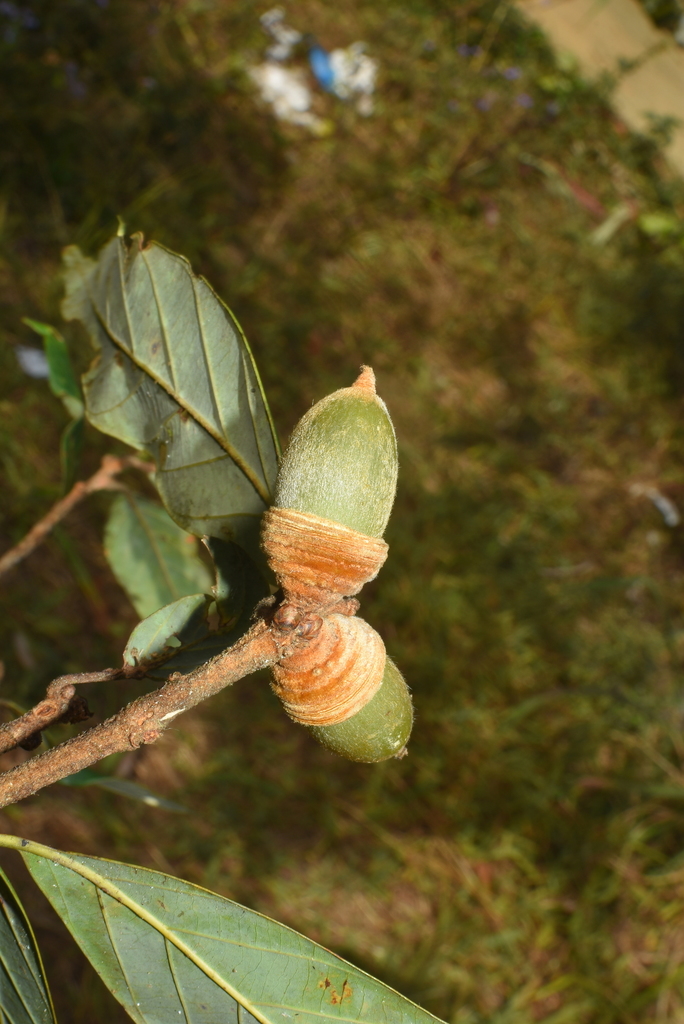
Quercus langbianensis
Quercus langbianensis is the accepted name of an uncommon oak tree species in the Asian sub-genus of Cyclobalanopsis in the family Fagaceae. These differ from other Quercus subgenera in that they have acorns with distinctive cups: usually with substantial rings, made-up of scales that have grown together. This species can be found in sub-tropical and tropical seasonal forests of Cambodia, China (mostly Yunnan) and Vietnam.
From the article Quercus langbianensis on Wikipedia (CC BY-SA), quoted section by section
Description
Quercus langbianensis is an evergreen tree that reaches a height of up to 15 m. The leaves measure 70-140 (up to 170) x 25–40 mm, elliptical-lanceolate to oblanceolate, leathery and glabrous on both sides, with margins having numerous small teeth that are obtuse, wavy near the apex: which is acuminate to slightly caudate; petioles are 15–20 mm and hairless. The acorns are sub-globose approximately 17–20 mm, covered with fine silky hair (sericeous), pale brown and ripening by September; scars are approximately 10 mm in diameter and convex. Their styles are persistent about 2 mm in diameter. Superficially, the cups are bowl-shaped, 8 x 20–25 mm approximately, enclosing 1/2 or 2/3 of the acorn. Outside and inside the reddish, tomentose acorn has a wall about 3 mm thick. The bracts are formed by 5 to 7 rings, with whole margins.
Where it lives
Recorded sightings
—
geo-referenced records in GBIF, from museums, herbaria and field observers.
Drag the globe to turn it. Dots are where records exist, not a range map; darker means more records.
In the stacks
Searching the stacks…
Every page naming Quercus langbianensis in the Biodiversity Heritage Library →
This page is assembled live from iNaturalist, GBIF, Wikipedia, the Source Library and the Internet Archive. It is not yet part of the hand-edited codex. iNaturalist taxon 569725.