- Plants
- ›Vascular Plants
- ›flowering plants
- ›Dicots
- ›Guinea-flowers and allies
- ›Guinea-flower family
- ›Hibbertia
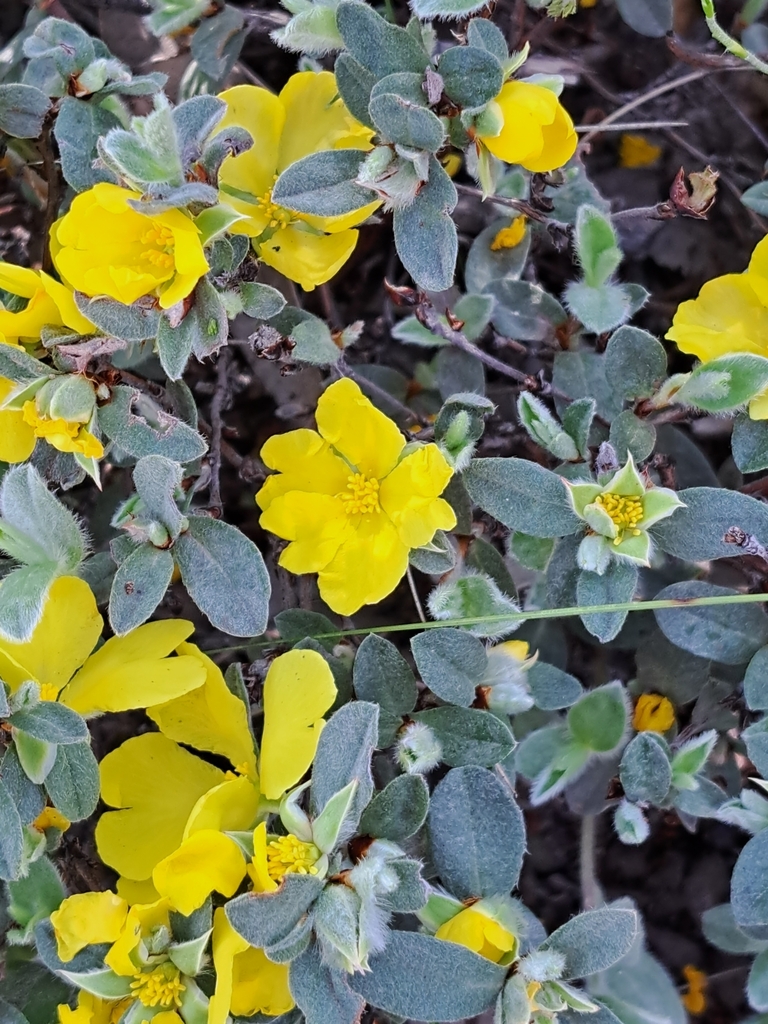
Hibbertia commutata
Hibbertia commutata is a species of flowering plant in the family Dilleniaceae and is endemic to the south-west of Western Australia. It is a low, erect, many-branched shrub with narrow elliptic to narrow egg-shaped leaves, and yellow flowers with fifteen to thirty stamens arranged around three carpels.
From the article Hibbertia commutata on Wikipedia (CC BY-SA), quoted section by section
Description
Hibbertia commutata is an erect to sprawling, many-branched shrub that typically grows to a height of 10–60 cm (3.9–23.6 in), sometimes to 1 m (3 ft 3 in) high and has sparsely hairy foliage. Its leaves are narrow elliptic to narrow egg-shaped with the narrower end towards the base, 6–40 mm (0.24–1.57 in) long and 2–11 mm (0.079–0.433 in) long, the edges sometimes slightly wavy. The flowers are sessile, 10–20 mm (0.39–0.79 in) in diameter with silky-hairy sepals and fifteen to thirty stamens alternating with the three glabrous carpels. Flowering occurs between July and November.
Range & habitat
This hibbertia grows in lateritic soils and is widely distributed in the south-west of Western Australia, occurring in the Avon Wheatbelt, Esperance Plains, Jarrah Forest, Swan Coastal Plain and Warren biogeographic regions.
Wikipedia: “Distribution and habitat”
Where it lives
Recorded sightings
—
geo-referenced records in GBIF, from museums, herbaria and field observers.
Drag the globe to turn it. Dots are where records exist, not a range map; darker means more records.
In the stacks
Searching the stacks…
Every page naming Hibbertia commutata in the Biodiversity Heritage Library →
This page is assembled live from iNaturalist, GBIF, Wikipedia, the Source Library and the Internet Archive. It is not yet part of the hand-edited codex. iNaturalist taxon 569584.