- Plants
- ›Vascular Plants
- ›flowering plants
- ›monocots
- ›Agaves, Orchids, Irises, and Allies
- ›agave and allies
- ›Hyacinth subfamily
- ›hyacinth tribe
- ›Scilla
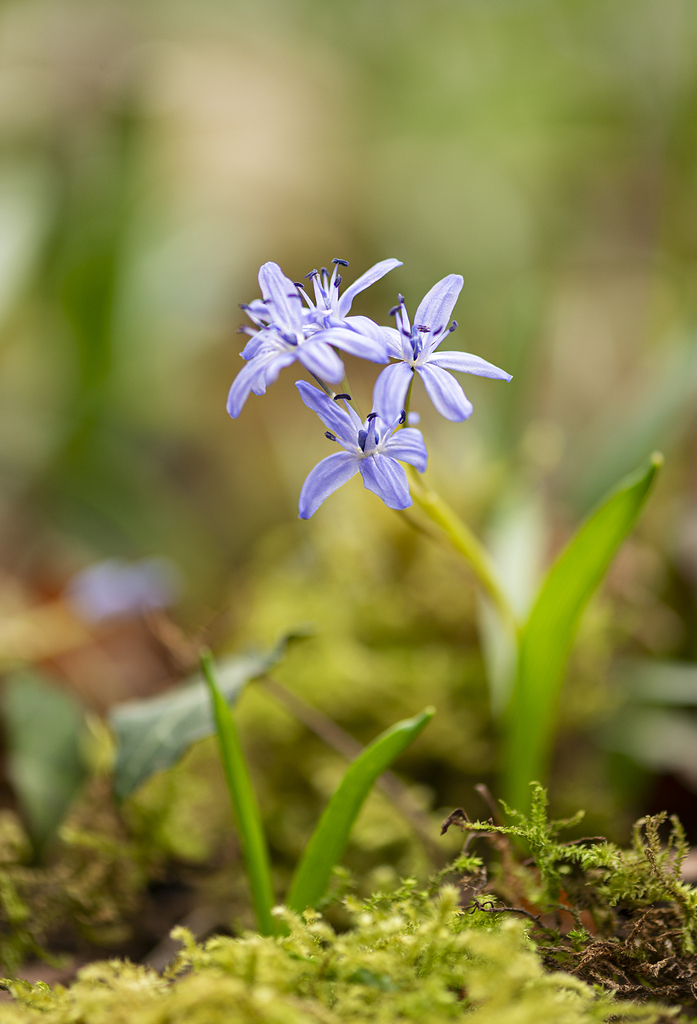
Alpine Squill
Scilla bifolia
Scilla bifolia, the alpine squill or two-leaf squill, is a herbaceous perennial plant growing from an underground bulb, belonging to the genus Scilla of the family Asparagaceae.
The Latin specific epithet bifolia means "twin leaved".
From the article Scilla bifolia on Wikipedia (CC BY-SA), quoted section by section
Description
Scilla bifolia grows from a bulb 1–2 cm (0.4–0.8 in) across. There are two or rarely three lance-shaped, curved, fleshy and shiny leaves and the bases of the leaves clasp up to about the half of the stem (amplexicaul). The flowering stems are erect and unbranched, 10–20 cm (4–8 in) high. The raceme bears 6-10 flowers, each 1 cm (0.4 in) across. The flowers of Scilla bifolia are upward-facing, unlike the nodding flowers of Scilla siberica (Siberian squill). They bloom from early to late spring. The six tepals are deep violet-blue, more rarely white, pink, or purple. The fruit is a capsule 6–8 mm (0.2–0.3 in) across. S. bifolia has gained the Royal Horticultural Society's Award of Garden Merit.
Range & habitat
Scilla bifolia is native to Europe and western Russia south through Turkey to Syria. The plant is found in shady places, woods of beech or deciduous trees, and mountain grasslands. It grows at an altitude of 100–2,000 m (330–6,560 ft) above sea level.
Wikipedia: “Distribution”
Where it lives
Recorded sightings
—
geo-referenced records in GBIF, from museums, herbaria and field observers.
Drag the globe to turn it. Dots are where records exist, not a range map; darker means more records.
In the stacks
Searching the stacks…
Every page naming Scilla bifolia in the Biodiversity Heritage Library →
This page is assembled live from iNaturalist, GBIF, Wikipedia, the Source Library and the Internet Archive. It is not yet part of the hand-edited codex. iNaturalist taxon 56934.