- Plants
- ›Vascular Plants
- ›flowering plants
- ›Dicots
- ›Roses, Elms, Figs, and Allies
- ›buckthorn family
- ›Ceanothus
- ›Ceanothus
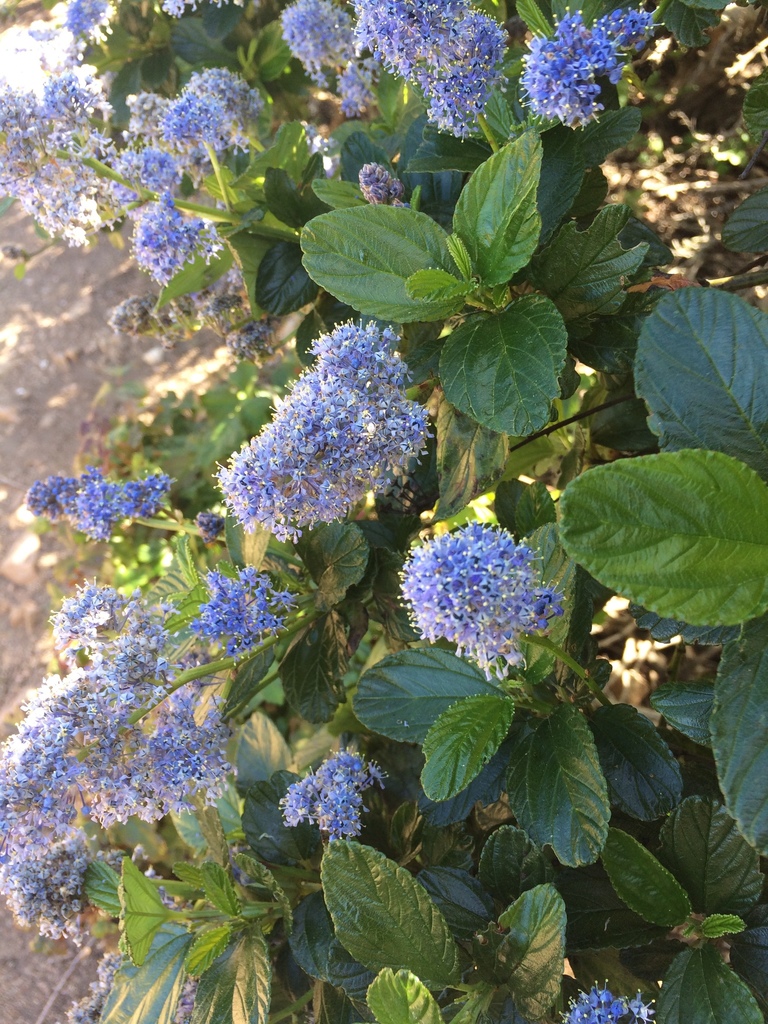
blueblossom
Ceanothus thyrsiflorus
Ceanothus thyrsiflorus, known as blueblossom or blue blossom ceanothus, is an evergreen shrub in the buckthorn family Rhamnaceae that is native to Oregon and California in the western United States and the state of Baja California in northwestern Mexico. The terms 'Californian lilac' and 'Mountain lilac' are also applied to this and other varieties of ceanothus, though it is not closely related to Syringa, the true lilac.
Two varieties are accepted:
From the article Ceanothus thyrsiflorus on Wikipedia (CC BY-SA), quoted section by section
Description
Ceanothus thyrsiflorus can grow more than 6 meters (20 ft) tall and broad in its native chaparral habitat, with glossy green leaves. The clusters of tiny flowers, borne in spring, vary from different shades of blue to close to white. The evergreen leaves are shiny and about 4 cm (1+1⁄2 in) long.
What it does
It is popular with birds, butterflies, and other pollinators. It is often visited by honeybees for its pollen.
Wikipedia: “Ecology”
How it is grown
Ceanothus thyrsiflorus has been used in gardens extensively. It prefers a warm, sheltered position in full sun. Several cultivars have been selected, including:
'Blue Mound' which can grow to 1.5 m (4 ft 11 in) tall 'Cascade' which may reach 8 m (26 ft) of height 'El Dorado', a variegated cultivar with gold edge foliage and powder blue flowers 'Repens' which stays as a shrub around 1–3 m (3 ft 3 in – 9 ft 10 in) tall 'Repens Victoria', forming a sturdy evergreen mound and most useful groundcover with powder blue flowers 'Skylark', a tall type with blue flowers (this cultivar has gained the Royal Horticultural Society's Award of Garden Merit) 'Snow Flurry', with white flowers
Wikipedia: “Cultivation”
In human culture
The Latin genus name Ceanothus is derived from the Ancient Greek keánōthos (κεάνωθος) 'a spiny plant'. The name was originally used by Theophrastus for another plant, and Linnaeus reused it for Ceanothus.
Wikipedia: “Etymology”
Where it lives
Recorded sightings
—
geo-referenced records in GBIF, from museums, herbaria and field observers.
Drag the globe to turn it. Dots are where records exist, not a range map; darker means more records.
In the stacks
Searching the stacks…
Every page naming Ceanothus thyrsiflorus in the Biodiversity Heritage Library →
This page is assembled live from iNaturalist, GBIF, Wikipedia, the Source Library and the Internet Archive. It is not yet part of the hand-edited codex. iNaturalist taxon 56617.