- Plants
- ›Vascular Plants
- ›flowering plants
- ›Dicots
- ›Mallows, Rock Roses, and Allies
- ›Mallow and Hibiscus Family
- ›Malvoideae
- ›Hibisceae
- ›Abelmoschus
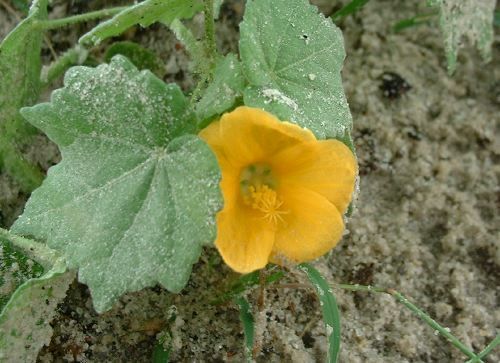
Hairy Okra
Abelmoschus crinitus
Abelmoschus crinitus is a species of flowering plant belonging to the mallow family. It was first described by Nathaniel Wallich in 1830.
From the article Abelmoschus crinitus on Wikipedia (CC BY-SA), quoted section by section
Description
Abelmoschus crinitus is a perennial shrub. Its stems grow up to 1 m tall. The leaves are "ovate-pentagonal" in shape with 3–5 shallow lobes and reach a maximum size of 8×7 cm. Stellate Trichome is present on both the upper and lower leaf surfaces, though it is more dense on the underside. The flowers are a "creamy-white to deep orange-yellow" colour and occasionally have a reddish centre. They have 5–6 bracts measuring 7–11 mm in length which are green when in flower and brown when in fruit.
Wikipedia: “Characteristics”
Range & habitat
Abelmoschus crinitus is native to China, the Philippines, India, Laos, Myanmar, Nepal, Thailand, Vietnam and Java. There have been a number of reports of the plant growing in Pakistan but its presence is rare. It is found in deciduous forests and on grassy slopes between 300 and 1300 m.
Wikipedia: “Habitat”
Where it lives
Recorded sightings
—
geo-referenced records in GBIF, from museums, herbaria and field observers.
Drag the globe to turn it. Dots are where records exist, not a range map; darker means more records.
In the stacks
Searching the stacks…
Every page naming Abelmoschus crinitus in the Biodiversity Heritage Library →
This page is assembled live from iNaturalist, GBIF, Wikipedia, the Source Library and the Internet Archive. It is not yet part of the hand-edited codex. iNaturalist taxon 566056.