- Plants
- ›Vascular Plants
- ›flowering plants
- ›Dicots
- ›sandalwoods, mistletoes, and allies
- ›showy mistletoes
- ›Psittacantheae
- ›Psittacanthinae
- ›Psittacanthus
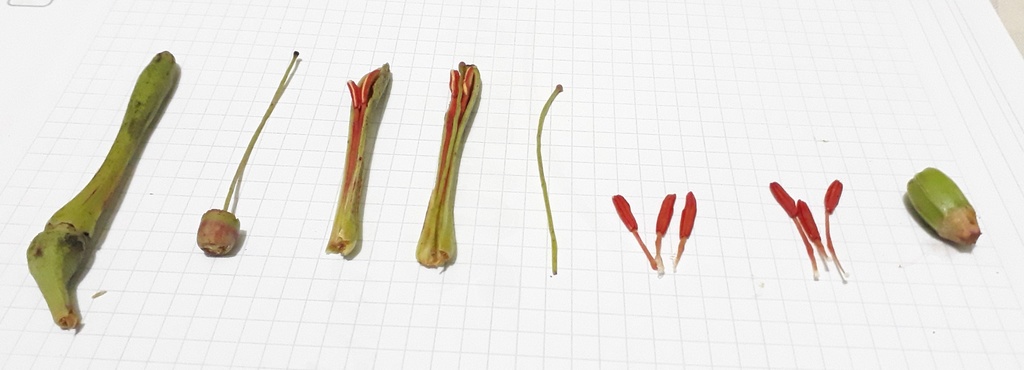
Psittacanthus cucullaris
Psittacanthus cucullaris is a species of mistletoe in the family Loranthaceae, and is native to Costa Rica, Bolivia, Colombia, Ecuador, French Guiana, Peru, Suriname, Venezuela and
Brazil.
From the article Psittacanthus cucullaris on Wikipedia (CC BY-SA), quoted section by section
Description
Psittacanthus cucullaris is a hemiparasite. The young stems grow upright, while adult stems are pendulous. In cross-section the young stems are ellipsoidal to circular and about 0.5–1 cm in diameter and 6–8 cm long, while adult branches have a circular cross-section which is up to 2 cm in diameter. The opposite and decurrent leaves are leathery and 15–20 cm long by 5–7 cm wide. They are falcate or ovate with an acute base and an acute or rounded apex. The petiole is 0.5 cm long with 3-5 obvious major ribs. Terminal and lateral racemose inflorescences occur at the apex of the branches. The greenish or red ovate flower bracts are persistent and 2.2 cm long by 1.8 cm wide. The flowers occur in sessile triads, with a main and secondary peduncle of the inflorescence which is 1–2 cm long. There is a pink or red dome beneath the flower which covers the calyx and base of the flower. The flower buds are 4.5-5.0 cm long, and straight with an acute apex. The petals are red, orange or yellow at the base and yellow or greenish at the apex. There are two forms of stamens. The anthers are 2.5-3.0 mm long and brown and the straight stylus is 4.0-4.5 cm long. The fruits are ovoid and 10–15 mm long by 9–12 mm wide, and are green when immature and black or purple when ripe and their base is encircled by the pink, orange or red subfloral dome. …
Range & habitat
In Brazil, it grows in the Amazon rainforest, the Central Brazilian savanna, and the Pantanal.
Wikipedia: “Habitat”
In human culture
Psittacanthus comes from the Greek psittakos (parrot), and the Greek anthos (flower), chosen according to Don, possibly because of the bright colours. The species epithet, cucullaris, comes from the Latin, cucullus ("covering", "hood"), and the adjective, cucullaris, refers to the bracts which "cover" (hood) the inflorescence and the fruit, so both flower and fruit are "hooded".
Wikipedia: “Etymology”
Where it lives
Recorded sightings
—
geo-referenced records in GBIF, from museums, herbaria and field observers.
Drag the globe to turn it. Dots are where records exist, not a range map; darker means more records.
In the stacks
Searching the stacks…
Every page naming Psittacanthus cucullaris in the Biodiversity Heritage Library →
This page is assembled live from iNaturalist, GBIF, Wikipedia, the Source Library and the Internet Archive. It is not yet part of the hand-edited codex. iNaturalist taxon 565006.