- Plants
- ›Vascular Plants
- ›flowering plants
- ›Dicots
- ›myrtles, evening primroses, and allies
- ›evening primrose family
- ›Chamaenerion
- ›Chamaenerion
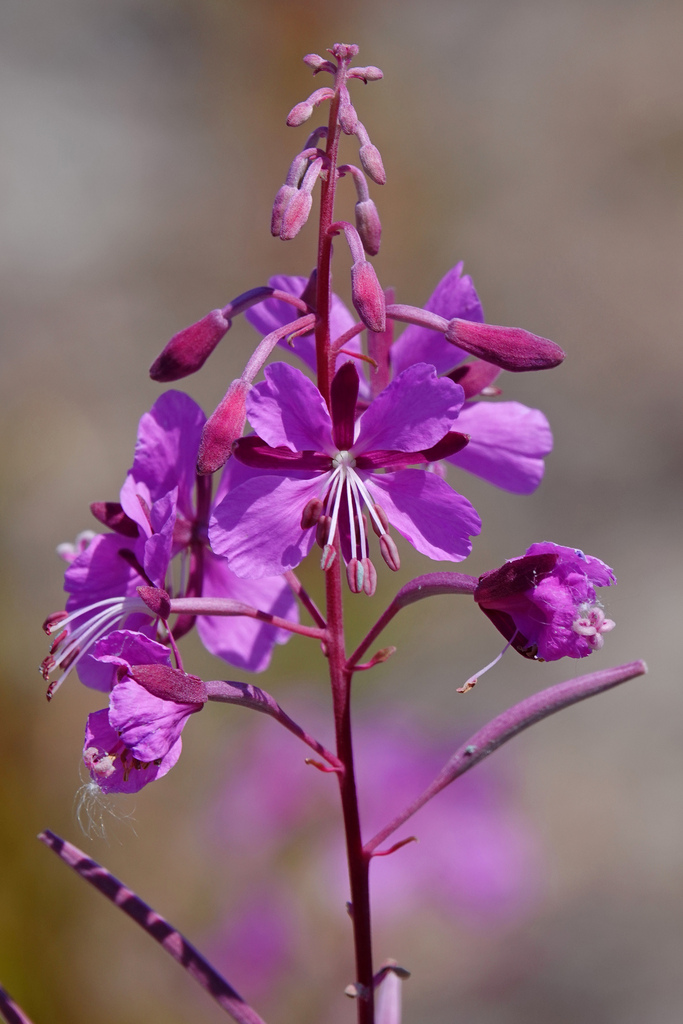
fireweed
Chamaenerion angustifolium
Chamaenerion angustifolium is a perennial herbaceous flowering plant in the willowherb family Onagraceae. It is known in North America as fireweed, in some parts of Canada as great willowherb, in Britain and Ireland as rosebay willowherb. In the United Kingdom it is also known as bombweed, as a result of its rapid appearance on city bomb sites during the Blitz of World War II.: 112 It is also known by the synonyms Chamerion angustifolium and Epilobium angustifolium....
From the article Chamaenerion angustifolium on Wikipedia (CC BY-SA), quoted section by section
Description
The reddish stems of this herbaceous perennial are usually simple, erect, smooth, 0.5–2 metres (1+1⁄2–6+1⁄2 feet) high with scattered alternate leaves. The leaves are spirally arranged, entire, narrowly lanceolate, and pinnately veined, the secondary leaf veins anastomosing, joining together to form a continuous marginal vein just inside the leaf margins. The inflorescence is a symmetrical terminal raceme that blooms progressively from bottom to top, producing a gracefully tapered shape. The flowers are 2 to 3 centimetres (3⁄4 to 1+1⁄4 inches) in diameter, slightly asymmetrical, with four magenta to pink petals and four narrower pink sepals behind. The protruding style has four stigmas. The floral formula is ✶/↓ K4 C4 A4+4 or 4+0 Ğ(4). The upright, reddish-brown linear seed capsule splits from the apex and curls open. It bears many minute brown seeds, about 300 to 400 per capsule and 80,000 per plant. The seeds have silky hairs to aid wind dispersal and are very easily spread by the wind, often becoming a weed and a dominant species on disturbed ground. Once established, the plants also spread extensively by underground roots, an individual plant eventually forming a large patch.
Range & habitat
This plant is found throughout the northern hemisphere, from 30° to 68°, but is most common in temperate climates. The species is present in the Pannonian macroregion, confirmed with herbarium specimens.
Wikipedia: “Distribution and habitat”
What it does
Fireweed is often abundant in wet calcareous to slightly acidic soils in open fields, pastures, and particularly burned-over lands. It is a pioneer species that quickly colonizes open areas with little competition, such as the sites of volcanos, forest fires and forest clearings. Plants grow and flower as long as there is open space and plenty of light. Fireweed reaches its average peak colonization after five years and then begins to be replaced as trees and brush grow larger. When a new fire or other disturbance occurs that opens up the ground to light again, the seeds germinate. Some areas with heavy seed counts in the soil can, after burning, be covered with pure dense stands of this species and when in flower the landscape is turned into fields of color. Fireweed is an effective colonizer; it may not be present until after a fire has moved through a landscape. Because of its very high dispersal capacity, "propagule pressure" from its regional presence will let it quickly colonize a disturbed area. Once seedlings are established, the plant quickly reproduces and covers the disturbed area via seeds and rhizomes. It is somewhat adapted to fire as well and so can prevent the reintroduction of fire to the landscape. …
Wikipedia: “Ecology”
At the table
The plant is not considered palatable, but the young shoots and leaves can be cooked and eaten. Fresh leaves can be eaten raw. The young flowers are also edible (being made into jelly in the Yukon) and the stems of older plants can be split to extract the edible raw pith. The root can be roasted after scraping off the outside, but often tastes bitter. To mitigate this, the root is collected before the plant flowers and the brown thread in the middle removed. The stem centers can also be prepared by splitting the outer stalk, and eaten raw. Traditionally the young shoots are collected in the spring by Native American and Siberian people and mixed with other greens. As the plant matures, the leaves become tough and somewhat bitter. Fireweed petals are made into jelly, and mature leaves are dried for use as tea. Roots are traditionally eaten raw by Siberian Native people. When properly prepared soon after picking they are a good source of vitamin C and provitamin A. The Denaʼina add fireweed to their dogs' food. Fireweed is also a medicine of the Upper Inlet Dena'ina, who treat pus-filled boils or cuts by placing a piece of the raw stem on the afflicted area. This is said to draw the pus out of the cut or boil and prevents a cut with pus in it from healing over too quickly. …
Wikipedia: “Uses”
In human culture
The generic name Chamaenerion means "dwarf rosebay" in allusion to the outward similarity to rosebay, Nerium oleander, while the specific epithet angustifolium means "narrow-leaved". It is commonly known in Britain as "rosebay willowherb", for the same reason. The common American name "fireweed" derives from the species' abundance as a colonizer on burnt sites after forest fires and other disturbances.
Wikipedia: “Etymology”
Where it lives
Recorded sightings
—
geo-referenced records in GBIF, from museums, herbaria and field observers.
Drag the globe to turn it. Dots are where records exist, not a range map; darker means more records.
In the stacks
Searching the stacks…
Every page naming Chamaenerion angustifolium in the Biodiversity Heritage Library →
This page is assembled live from iNaturalist, GBIF, Wikipedia, the Source Library and the Internet Archive. It is not yet part of the hand-edited codex. iNaturalist taxon 564969.