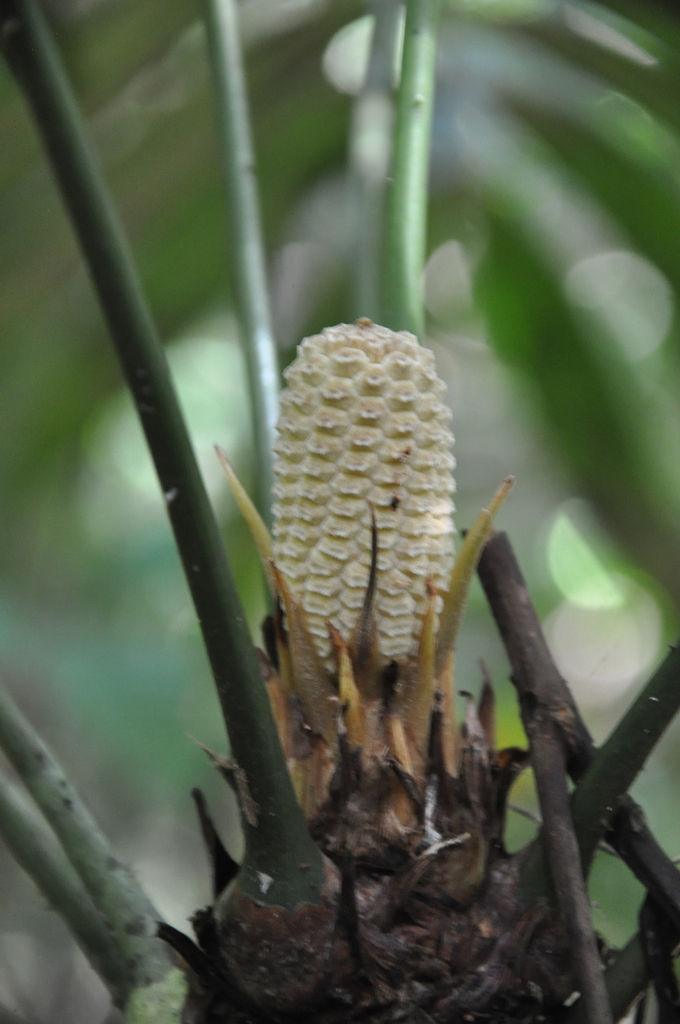
Zamia stevensonii
Zamia stevensonii (blanco) is a species of cycad in the family Zamiaceae. It is found in the vicinity of the Panama Canal and the Chagres River in central Panama.
Z. stevensonii was described in 2012 by Taylor Blake & Holzman from plants that had previously been identified as variously belonging to Z. elegantissima, Z. fairchildiana, and Z. pseudomonticola. While Z. stevensonii and Z. elegantissima in particular are similar, the authors found sufficient differences in vegetative and reproductive structures and in pollinators to separate Z. stevensonii from the other three species. The specific name srevensonii honors Dennis W. Stevenson, who has worked extensively on cycads in Panama and elsewhere in the Americas. The common name, also used in the horticultural trade, is blanco, because the emergent leaves are white.
From the article Zamia stevensonii on Wikipedia (CC BY-SA), quoted section by section
Description
The stem is usually upright but occasionally underground, and may be up to 1.5 metres (4 ft 11 in) tall and 2 to 8 centimetres (0.79 to 3.15 in) in diameter. There are up to 27 (mean is 11) compound leaves on a plant. The leaves are 25 to 120 centimetres (9.8 to 47.2 in) long, on a 28 to 63 centimetres (11 to 25 in) long stalk, with few or no prickles on stalk or leaf. Leaves emerge white and mature to glossy or dark green. There are 3 to 25 pairs of leaflets on a leaf. Leaflets are oblong, 10 to 25 centimetres (3.9 to 9.8 in) long and 2 to 5 centimetres (0.79 to 1.97 in) wide at the middle of the compound leaf. Z. stevensonii is, like all Zamias, dioecious, with each plant being either male or female. There are one to three male microstrobili (male cones) on a plant. The male cones are 5.5 to 17 centimetres (2.2 to 6.7 in) long and 2.5 to 4 centimetres (0.98 to 1.57 in) in diameter. They are reddish-golden to brownish-yellow in color, covered with hairs, cylindrical to elongate conical-cylindrical, and held on stalks 4 to 10 centimetres (1.6 to 3.9 in) long and 0.5 to 2 centimetres (0.20 to 0.79 in) in diameter. The is one, or rarely two, macrostrobili (female cones) on a female plant. The macrostrobili are 4.5 to 16 centimetres (1.8 to 6.3 in) long and 4 to 9 centimetres (1.6 to 3.5 in) in diameter. …
Range & habitat
Z. stevensonii grows in humid tropical forest between 110 and 700 metres (360 and 2,300 ft) elevation in the area of the Panama Canal. While the species is commonly found in humid forest, it is also dry hardy. The plants are resistant to injury, and small parts of a stem removed from a plant may rejuvenate into a new plant. Z. stevensonii is adundant near the Panama Canal, in the Chagres Valley, particularly at the site of a former U.S. Army post in Chagres National Park. Plants are being illegally removed for sale, and habitat destruction is occurring in part of the species' range.
Wikipedia: “Habitat”
What it does
Female plants usually have one cone, but a new cone may emerge on a plant that bears a cone from the previous year. Male plants reach reproductive maturity in four years, while female plants take eight years. Cones emerge in late July to early September and take about three-and-a-half months to mature. Pollen production and fertilization of the female cones occurs from mid-November to early December. It takes one to two years for seeds to mature. Pollination is mediated by a species of beetle in the Genus Pharaxonotha found in all populations of Z. stevensonii that have been studied and a species of weevil in the Genus Rhopalotria or a closely related Genus that have been found in many of the populations studied.
Wikipedia: “Reproduction”
Where it lives
Recorded sightings
—
geo-referenced records in GBIF, from museums, herbaria and field observers.
Drag the globe to turn it. Dots are where records exist, not a range map; darker means more records.
In the stacks
Searching the stacks…
Every page naming Zamia stevensonii in the Biodiversity Heritage Library →
This page is assembled live from iNaturalist, GBIF, Wikipedia, the Source Library and the Internet Archive. It is not yet part of the hand-edited codex. iNaturalist taxon 564559.