- Plants
- ›Vascular Plants
- ›flowering plants
- ›monocots
- ›screwpines, stemona, and allies
- ›screwpine family
- ›Pandanus
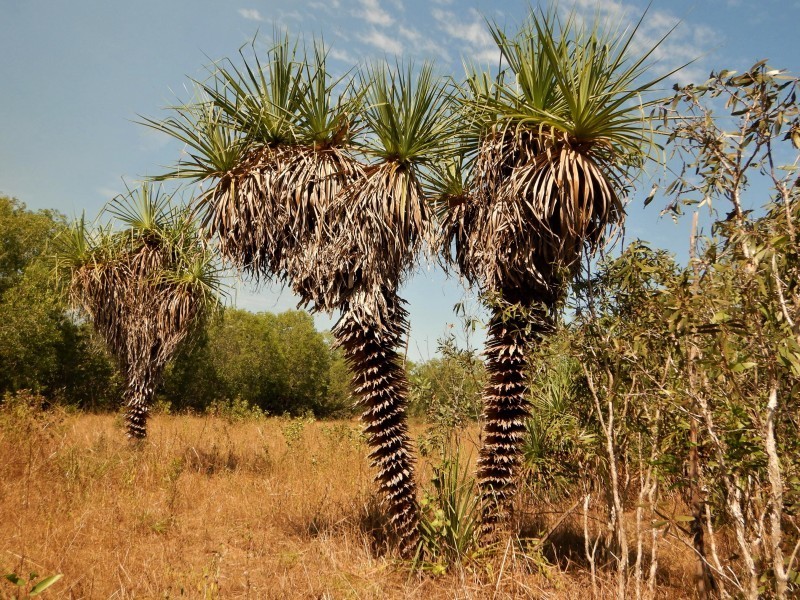
Screw Palm
Pandanus spiralis
Pandanus spiralis is a small tree in the family Pandanaceae native to northern Australia. It is commonly called pandanus, spring pandanus, screw palm or screw pine, although it is neither a palm nor a pine.
From the article Pandanus spiralis on Wikipedia (CC BY-SA), quoted section by section
Description
Pandanus spiralis is a small tree growing up to 10 m (33 ft) tall with a slender trunk, and often with a clumping habit. Prop roots may be present, but are more often absent. The leaves are 1–2 m (3 ft 3 in – 6 ft 7 in) long and 4–7 cm (1.6–2.8 in) wide, and they may or may not have sharp spines along the leaf margins and midrib. They are arranged spirally on the trunk and branches, and crowded towards their tips. As the leaves die they can form a dense pendant skirt around the trunk below the growing part, and lower down on the trunk the leaf bases often persist, forming a conspicuous spiral. The inflorescences are terminal—on the male plants it is a pendant string of several spadices each about 5 cm (2 in) long, while on the female plants it is a single head about 20–30 cm (8–12 in) long shrouded by large leafy bracts. The fruit is a multiple fruit consisting of 10–25 segments measuring 8–10 cm (3.1–3.9 in) long and 5–8 cm (2.0–3.1 in) wide, known as "phalanges". The phalanges are composed of a dense fibrous material with 5–7 seeds embedded in it. The fruit is initially green and turn orange or red when ripe.
Range & habitat
This species occurs in northern Queensland, the Northern Territory and the extreme north of Western Australia. It grows in savannah woodlands and poorly drained areas such as alongside creeks and rivers, the margins of floodplains, and coastal dunes, on various substrates including sand, alluvium and clay.
Wikipedia: “Distribution and habitat”
What it does
The dense skirt of old leaves provides a refuge for many forms of wildlife including birds, bats, rodents and lizards. The seeds within the fruit are eaten by cockatoos and possums.
Wikipedia: “Ecology”
At the table
The leaves of this tree are used to weave various products such as neckbands, armbands, baskets, mats, fish traps and shelters, and the fibre can be stripped out to make string for dillybags and other uses. The trunks are used to build rafts. The plant has a number of medicinal uses including as an antiseptic, analgesic, and to treat dysentery and diarrhoea.. The white stem part of the leaf is pounded to make an anaesthetic for tooth pain. The leaf bases are eaten and the seeds can be eaten raw or roasted, and may be ground to make flour. The fully ripe fruit are used ceremonially because of their scent.
Wikipedia: “Uses”
Where it lives
Recorded sightings
—
geo-referenced records in GBIF, from museums, herbaria and field observers.
Drag the globe to turn it. Dots are where records exist, not a range map; darker means more records.
In the stacks
Searching the stacks…
Every page naming Pandanus spiralis in the Biodiversity Heritage Library →
This page is assembled live from iNaturalist, GBIF, Wikipedia, the Source Library and the Internet Archive. It is not yet part of the hand-edited codex. iNaturalist taxon 563605.