- Plants
- ›Vascular Plants
- ›flowering plants
- ›Dicots
- ›Heathers, Balsams, Primroses, and Allies
- ›heath family
- ›typical heathers, azaleas, and allies
- ›Ericeae
- ›Erica
- ›Erica
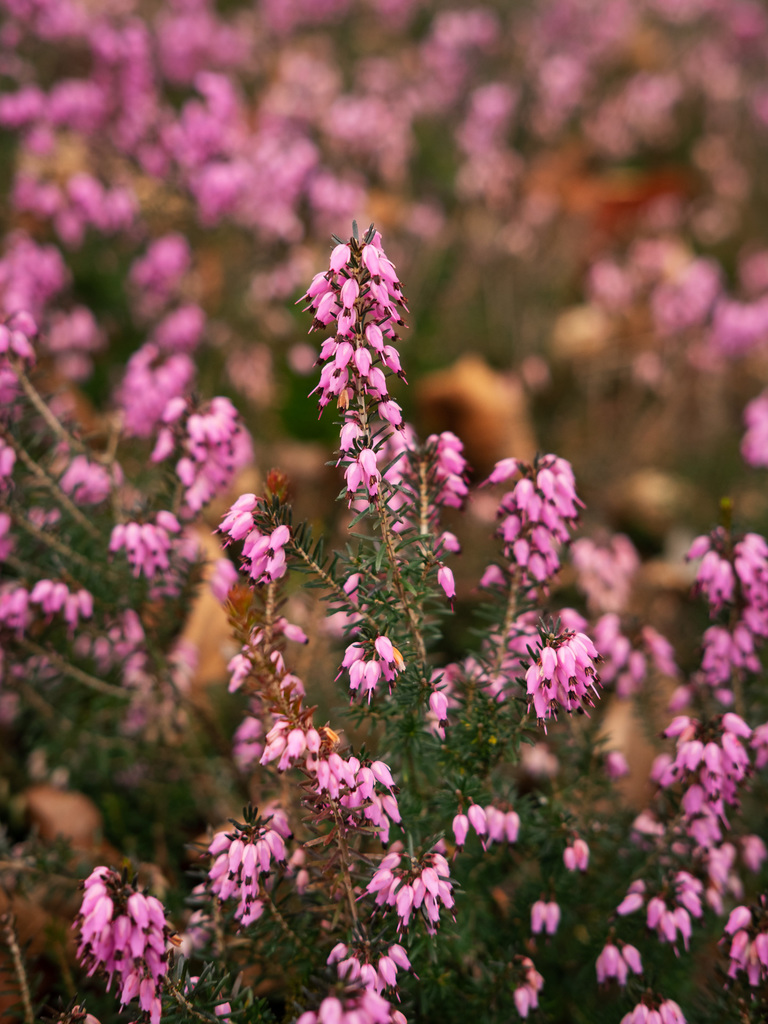
Spring Heath
Erica carnea
Erica carnea (winter heath, winter-flowering heather, spring heath, alpine heath; syn. E. herbacea, E. mediterranea) is a species of flowering plant in the family Ericaceae native to mountainous areas of central and southern Europe, where it grows in coniferous woodlands or stony slopes.
From the article Erica carnea on Wikipedia (CC BY-SA), quoted section by section
Description
It is a low-growing, spreading subshrub reaching 10–25 centimetres (4–10 inches) tall, with evergreen needle-like leaves 4–8 millimetres (1⁄8–3⁄8 in) long, borne in whorls of four. The flowers are produced in racemes in late winter to early spring, often starting to flower while the plant is still covered in snow; the individual flower is a slender bell-shape, 4–6 mm (3⁄16–1⁄4 in) long, dark reddish-pink, rarely white.
How it is grown
Erica carnea was being cultivated in the United Kingdom as early as 1763. It is very widely grown as an ornamental plant for its winter flowering; over 100 cultivars have been selected for variation in flower and leaf colour. Unlike most species of Erica, which are typically calcifuges, it tolerates mildly alkaline as well as acidic soils, making it easier to grow in many areas. Like other species within the genus Erica it is often seen as groundcover amongst plantings of dwarf conifers. The following cultivars, forms and hybrids have gained the Royal Horticultural Society's Award of Garden Merit:
Wikipedia: “Cultivation”
Where it lives
Recorded sightings
—
geo-referenced records in GBIF, from museums, herbaria and field observers.
Drag the globe to turn it. Dots are where records exist, not a range map; darker means more records.
In the stacks
Searching the stacks…
Every page naming Erica carnea in the Biodiversity Heritage Library →
This page is assembled live from iNaturalist, GBIF, Wikipedia, the Source Library and the Internet Archive. It is not yet part of the hand-edited codex. iNaturalist taxon 56306.