- Plants
- ›Vascular Plants
- ›flowering plants
- ›Dicots
- ›pinks, cactuses, and allies
- ›knotweed family
- ›Polygonoideae
- ›Persicarieae
- ›Persicariinae
- ›Persicaria
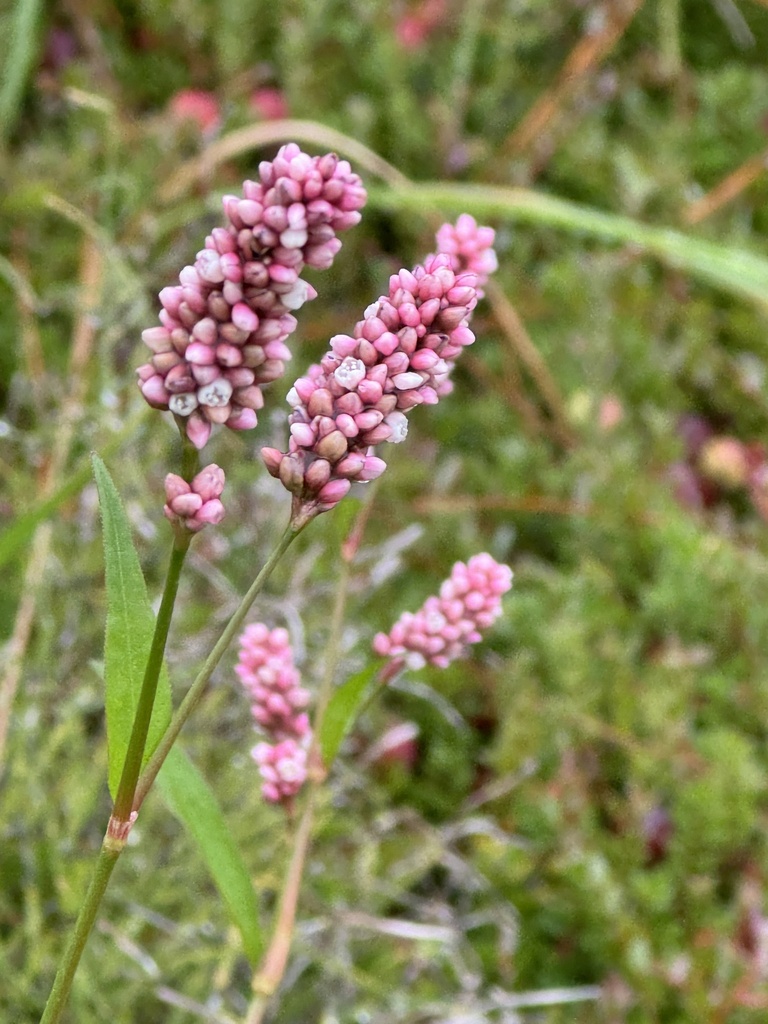
spotted lady's thumb
Persicaria maculosa
Persicaria maculosa (syn. Polygonum persicaria) is an annual plant in the buckwheat family, Polygonaceae. Common names include lady's thumb, spotted lady's thumb, Jesusplant, and redshank. It is widespread across Eurasia from Iceland south to Portugal and east to Japan. It is also present as an introduced and invasive species in North America, where it was first noted in the Great Lakes region in 1843 and has now spread through most of the continent.
From the article Persicaria maculosa on Wikipedia (CC BY-SA), quoted section by section
Description
Persicaria maculosa is an annual herb up to 1 metre (3 ft 3 in) tall, with an erect, rather floppy stem with swollen joints. The leaves are alternate and almost stalkless. The leaf blades often have a brown or black spot in the centre and are narrowly ovate and have entire margins. Each leaf base has stipules which are fused into a stem-enclosing sheath that is loose and fringed with long hairs at the upper end. The inflorescence is a dense spike. The perianth of each tiny pink flower consists of four or five lobes, fused near the base. There are six stamens, two fused carpels and two styles. The fruit is a shiny black, three-edged achene. This plant flowers from July to September in the temperate Northern Hemisphere.
Range & habitat
Persicaria maculosa is native to Europe and Asia, where it can be mistaken for Polygonum minus. The latter has narrower leaves, usually less than 1 cm wide. It has been introduced to North America and is naturalised throughout the mainland continent, growing along roadsides, riverbanks, and on fallow ground. In the United States, it is very similar to Pennsylvania smartweed, but redshank has a fringe of hairs at the top of the ochrea, something which Pennsylvania smartweed lacks. The species has also been found in New Zealand and Australia.
Wikipedia: “Distribution and habitat”
What it does
In the British Isles, this plant is a weed, without natural habitat, and always associated with human activity. It likes moist soils, particularly rich ones, and acid peaty loams. It does not like lime, and liming is cited as a means to fight it.
Wikipedia: “Ecology”
At the table
Persicaria maculosa contains persicarin and tannins. The young leaves may be eaten as a leaf vegetable. It is often seen as a weed and rarely cultivated. A yellow dye can be produced from this plant with alum used as a mordant.
Wikipedia: “Cultivation and uses”
Where it lives
Recorded sightings
—
geo-referenced records in GBIF, from museums, herbaria and field observers.
Drag the globe to turn it. Dots are where records exist, not a range map; darker means more records.
In the stacks
Searching the stacks…
Every page naming Persicaria maculosa in the Biodiversity Heritage Library →
This page is assembled live from iNaturalist, GBIF, Wikipedia, the Source Library and the Internet Archive. It is not yet part of the hand-edited codex. iNaturalist taxon 56166.