- Plants
- ›Vascular Plants
- ›flowering plants
- ›Dicots
- ›Mints, Plantains, Olives, and Allies
- ›Verbena Family
- ›Verbeneae
- ›Verbena
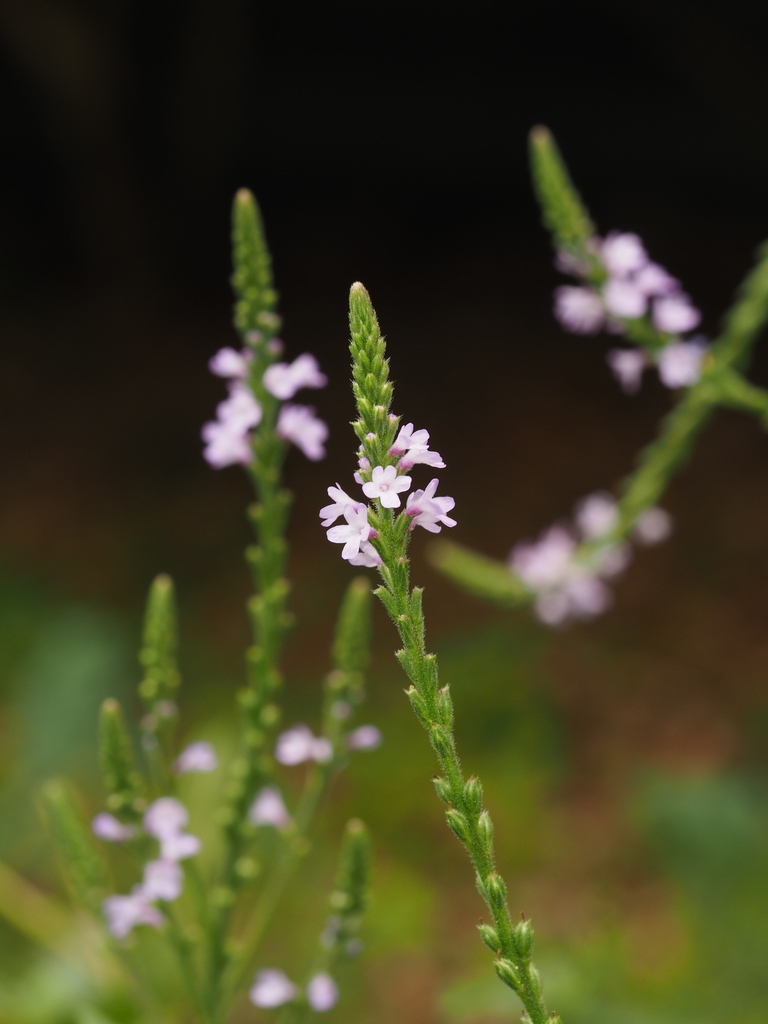
Common vervain
Verbena officinalis
Verbena officinalis, the common vervain or common verbena, is a perennial herb native to Europe. It grows up to a metre/yard high, with an upright habitus. The lobed leaves are toothed, the delicate spikes hold mauve flowers.
From the article Verbena officinalis on Wikipedia (CC BY-SA), quoted section by section
Description
It grows up to 70 centimetres (28 in) high, with an upright habitus. The lobed leaves are toothed, and the delicate spikes hold clusters of two-lipped mauve flowers.
Chemistry. Chemical investigations of petroleum ether and chloroform extracts led to the isolation of β-sitosterol, ursolic acid, oleanolic acid, 3-epiursolic acid, 3-epioleanolic acid and minor triterpenoids of derivatives of ursolic acid and oleanolic acids. Chromatographic purification of the methanol extract yield two iridoid glucosides (verbenalin and hastatoside), a phenylpropanoid glycoside, verbascoside and β-sitosterol-D-glucoside. Hastatoside and verbenalin have sleep-promoting (soporific) properties. It also contains a monoterpene alcohol called verbenol. In another study, four compounds were isolated and identified as apigenin, 4'-hydroxywogonin, verbenalin, and hastatoside. Aucubin has also been found as one of the active constituents.
Range & habitat
The plant is native to Europe but is widely naturalised outside its native range, for example in North America. It prefers limey soils.
Wikipedia: “Distribution and habitat”
At the table
Common vervain has been held in high esteem since classical antiquity; it has long been associated with divine and other supernatural forces, and it has an equally long-standing use as a medicinal plant. Herbal capsules are used as a soporific drug in much the same way as for the better known valerian. Verbena officinalis herb has been used in the traditional Austrian medicine internally (as tea or liqueur) for treatment of infections and fever. Medical use of Common Vervain is usually as a herbal tea; Nicholas Culpeper's 1652 The English Physitian discusses folk uses. "Vervain", presumably this species, is one of the original 38 Bach flower remedies, prescribed against "over-enthusiasm". In the modern era, it is sometimes considered a powerful "ally" of poets and writers, as its relaxing effects can relieve writer's block. It cannot be considered safe to use during pregnancy as it might cause miscarriages. While common vervain is not native to North America, it has been introduced there and the Pawnee have adopted it as an entheogen enhancer and in oneiromancy, and is often referred to as the North American version of Calea zacatechichi. It is occasionally grown as an ornamental plant but perhaps more often for the powerful properties some herbalists ascribe to it. Propagation is by root cuttings or seed. …
Wikipedia: “Uses”
In human culture
The scientific name of the genus references the Ancient Roman term verbena, used for any sacrificial herb considered very powerful (as described e.g. by Pliny the Elder). Officinalis, meanwhile, is Latin for "used in medicine or herbalism".
Wikipedia: “Etymology”
Where it lives
Recorded sightings
—
geo-referenced records in GBIF, from museums, herbaria and field observers.
Drag the globe to turn it. Dots are where records exist, not a range map; darker means more records.
In the old herbals & bestiaries

The Book of Health: The Art of Distillation
Brunschwig, Hieronymus · 1505 · p.159

The Book of Health: The Art of Distillation
Brunschwig, Hieronymus · 1505 · p.208

Notable Commentaries on the History of Plants
Leonhart Fuchs · 1542 · p.626

Compendium of Materia Medica
李時珍 · 1596 · p.38

History of Rare Plants
Carolus Clusius · 1601 · p.421

Collected Illustrations of the Three Realms: Herbs
王圻, 王思義 · 1607 · p.70

Illustrated Compendium of Materia Medica (Vol. 14)
吳其濬 · 1848 · p.19

Albertus Magnus on Women and the Birth of Children
Albertus, Magnus, Heiliger · 1700 · p.34
In the stacks
Searching the stacks…
Every page naming Verbena officinalis in the Biodiversity Heritage Library →
This page is assembled live from iNaturalist, GBIF, Wikipedia, the Source Library and the Internet Archive. It is not yet part of the hand-edited codex. iNaturalist taxon 56163.