- Plants
- ›Vascular Plants
- ›flowering plants
- ›Dicots
- ›pinks, cactuses, and allies
- ›pink family
- ›Caryophylloideae
- ›Caryophylleae
- ›Saponaria
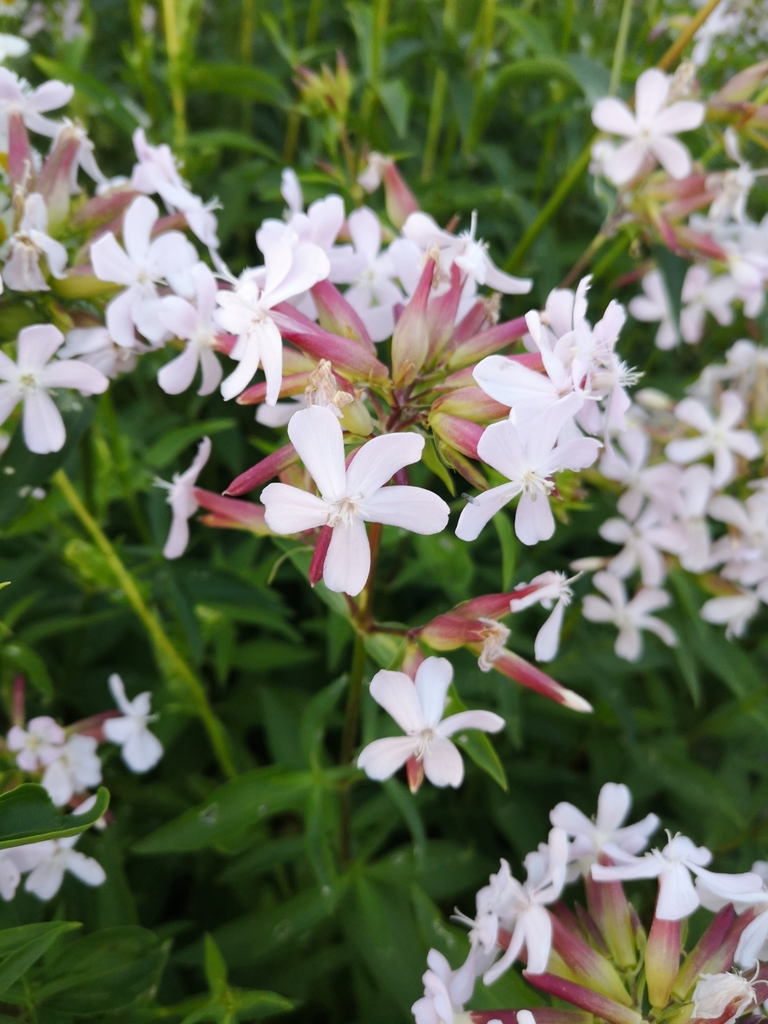
common soapwort
Saponaria officinalis
Saponaria officinalis is a common perennial plant from the family Caryophyllaceae. This plant has many common names, including common soapwort, bouncing-bet, crow soap, and soapweed. There are about 20 species of soapworts altogether.
The scientific name Saponaria is derived from the Latin sapo (stem sapon-) meaning "soap", which, like its common name, refers to its utility in cleaning. From this same Latin root is derived the name of the toxic substances saponins found in many plants, including a specific saporin saponarin contained in the roots at levels up to 20 percent when the plant is flowering (Indian soapnuts contain only 15 percent). The flowers colouring likely reflects the chemical environment of saponarin. Saponins produce a lather when in contact with water. The epithet officinalis indicates its medicinal functions. It is a common host plant for some moth species, including the white-lined sphinx.
From the article Saponaria officinalis on Wikipedia (CC BY-SA), quoted section by section
Description
The plant possesses leafy, unbranched stems (often tinged with red). It grows in patches, attaining a height of 70 cm (28 in). The broad, lanceolate, sessile leaves are opposite and between 4 and 12 cm long. Its sweetly scented flowers are radially symmetrical and pink, or sometimes white. Each of the five flat petals have two small scales in the throat of the corolla. They are about 2.5 cm (1 in) wide. They are arranged in dense, terminal clusters on the main stem and its branches. The long tubular calyx has five pointed red teeth.
The individual flowers open in the evening, and stay open for about three days. They produce a stronger scent at night and supplement nectar production during the night. The flowers are protandrous: on the second night of blooming, the pollen is released, and the stigma develops to its final position by the third night. Much of the seed production comes from self-pollination. The flowers are visited by various insects including Noctuidae, Sphingidae, bumblebees, and hoverflies. In the Northern Hemisphere Saponaria officinalis blooms from May to September, and in the Southern Hemisphere October to March.
Where it lives
Recorded sightings
—
geo-referenced records in GBIF, from museums, herbaria and field observers.
Drag the globe to turn it. Dots are where records exist, not a range map; darker means more records.
In the old herbals & bestiaries


In the stacks
Searching the stacks…
Every page naming Saponaria officinalis in the Biodiversity Heritage Library →
This page is assembled live from iNaturalist, GBIF, Wikipedia, the Source Library and the Internet Archive. It is not yet part of the hand-edited codex. iNaturalist taxon 56154.