- Plants
- ›Vascular Plants
- ›flowering plants
- ›monocots
- ›Agaves, Orchids, Irises, and Allies
- ›amaryllis, onions, and allies
- ›onion subfamily
- ›Allieae
- ›Allium
- ›Amerallium
- ›Arctoprasum
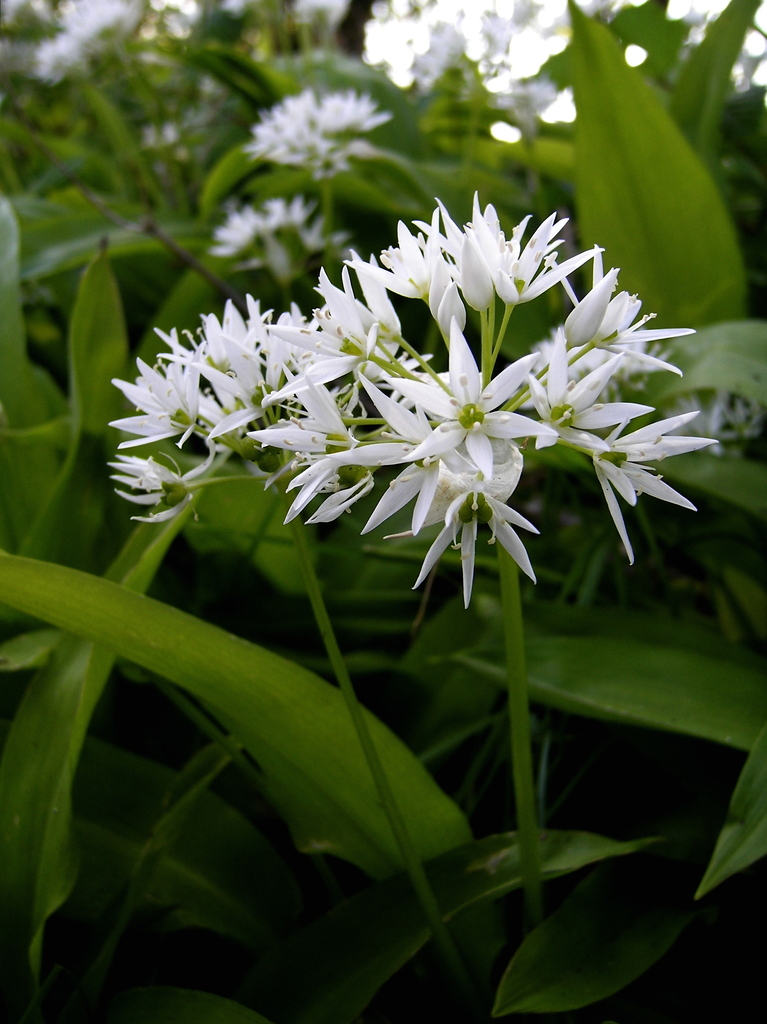
Ramsons
Allium ursinum
Allium ursinum, known as wild garlic, ramsons, cowleekes, cows's leek, cowleek, buckrams, broad-leaved garlic, wood garlic, bear leek, Eurasian wild garlic, onion grass, or bear's garlic, is a bulbous perennial flowering plant in the amaryllis family, Amaryllidaceae. It is native to Eurasia, where it grows in moist woodland. It is a wild relative of onion and garlic, all belonging to the same genus, Allium. There are two recognized subspecies: A. ursinum subsp. ursinum and A. ursinum subsp. ucrainicum.
From the article Allium ursinum on Wikipedia (CC BY-SA), quoted section by section
Description
Allium ursinum is a bulbous, perennial herbaceous monocot, that reproduces primarily by seed. The narrow bulbs are formed from a single leaf base and produce bright green entire, elliptical leaves up to 25 cm (10 in) long by 7 cm (3 in) wide with a petiole up to 20 cm (8 in) long. The inflorescence is an umbel of six to 20 white flowers, lacking the bulbils produced by some other Allium species such as Allium vineale (crow garlic) and Allium oleraceum (field garlic). The flowers are star-like with six white tepals, about 16–20 mm (5⁄8–13⁄16 in) in diameter, with stamens shorter than the perianth. It flowers in the British Isles from April to June, starting before deciduous trees leaf in the spring. The flower stem is triangular in cross-section and the leaves are broadly lanceolate, similar to those of the toxic lily of the valley (Convallaria majalis).
Similarity to poisonous plants. Plants that may be mistaken for A. ursinum include lily of the valley, Colchicum autumnale, Arum maculatum, and Veratrum viride or Veratrum album, all of which are poisonous. …
Range & habitat
It is native to Europe and Asia, where it grows in moist woodland. It can be found in temperate Europe from Ireland east to the Caucasus. It is common in much of the lowlands of the British Isles with the exception of the far north of Scotland, Orkney and Shetland. The ursinum subspecies is found in western and central Europe, while the ucrainicum subspecies is found in the east and southeast. It grows in deciduous woodlands with moist soils, preferring slightly acidic conditions. In the British Isles, colonies are frequently associated with bluebells (Hyacinthoides non-scripta), especially in ancient woodland. It is considered to be an ancient woodland indicator species.
Wikipedia: “Distribution and habitat”
What it does
As its name suggests, A. ursinum is an important food for brown bears. The plant is also a favourite of wild boar. A. ursinum is the primary larval host plant for a specialised hoverfly, Portevinia maculata (ramsons hoverfly). The flowers are pollinated by bees.
Wikipedia: “Ecology”
At the table
All parts of A. ursinum are edible. The leaves can be used as a salad or boiled as a vegetable. A variety of Cornish Yarg cheese has a rind coated in wild garlic leaves. In the Swiss Neolithic settlement of Thayngen-Weier (Cortaillod culture), a high concentration of pollen from A. ursinum was found in the settlement layer, interpreted by some as evidence for use of the plant as fodder.
Wikipedia: “Uses”
In human culture
The Latin specific name ursinum translates to 'bear' and refers to the supposed fondness of the brown bear for the bulbs; folk tales describe the bears consuming them after awakening from hibernation. Another theory is that the "ursinum" may refer to Ursa Major, as A. ursinum was perhaps one of the most northerly distributed Allium species known to the ancient Greeks, though this hypothesis is disputed. Common names for the plant in many languages also make reference to bears. Cows love to eat them, hence the modern vernacular name of cows' leek. In Devon, dairy farmers have occasionally had the milk of their herds rejected because of the garlic flavour imparted to it by the cows having grazed upon the plant. Ramsons is from the Old English word hramsa, meaning "garlic". There is evidence it has been used in British cuisine since the Celtic Britons over 1,500 years ago. Early healers among the Celts, Gaels, and Teutonic tribes and ancient Romans were familiar with the wild herb and called it herba salutaris, meaning 'healing herb'.
Wikipedia: “Etymology”
Where it lives
Recorded sightings
—
geo-referenced records in GBIF, from museums, herbaria and field observers.
Drag the globe to turn it. Dots are where records exist, not a range map; darker means more records.
In the old herbals & bestiaries


In the stacks
Searching the stacks…
Every page naming Allium ursinum in the Biodiversity Heritage Library →
This page is assembled live from iNaturalist, GBIF, Wikipedia, the Source Library and the Internet Archive. It is not yet part of the hand-edited codex. iNaturalist taxon 56152.