- Plants
- ›Vascular Plants
- ›flowering plants
- ›Dicots
- ›Mustards, Capers, and Allies
- ›mustard family
- ›Brassicoideae
- ›Camelinodae
- ›Cardamineae
- ›Barbarea
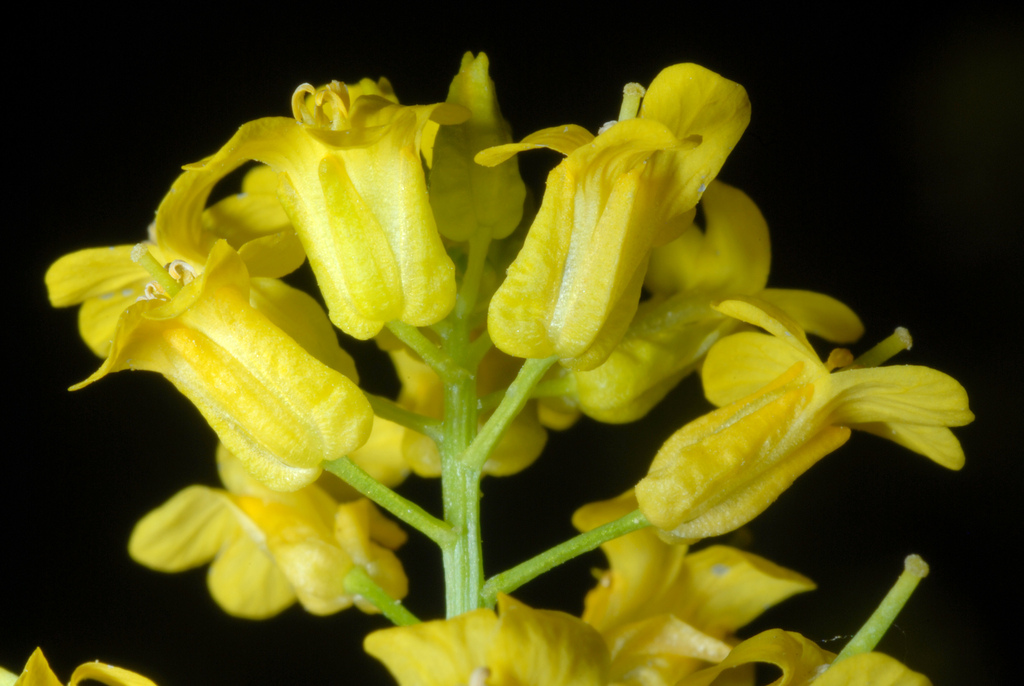
bitter wintercress
Barbarea vulgaris
Barbarea vulgaris, called wintercress (usual common name), or alternatively winter rocket, rocketcress, yellow rocketcress, yellow rocket, wound rocket, herb barbara, creases, or creasy greens, is a biennial herb of the genus Barbarea, belonging to the family Brassicaceae.
From the article Barbarea vulgaris on Wikipedia (CC BY-SA), quoted section by section
Description
The plant grows to 80 cm (31 in) high and 25 cm (10 in) wide. The stem is ribbed and hairless, branched at the base. It has basal rosettes of shiny, dark green leaves. The basal leaves are stalked and lyre-pinnatifid, that is with a large terminal lobe and smaller lower lobes. The cauline leaves are smaller, ovate, toothed, or lobed. The flowers are borne in spring in dense terminal clusters above the foliage. They are 7–9 mm (1⁄4–3⁄8 in) long, with four bright yellow petals. The flowering period extends from about April through July. The fruits are a siliques (seed capsules) of length 15–30 mm (5⁄8–1+1⁄8 in). A single B. vulgaris plant can produce up to 88,000 seeds per year, its seeds are long lived, remaining viable for 10–20 years. Wintercress is also known to reproduce vegetatively from roots or buds near its base, presenting as cauline rosettes. Chemical substances in this species include saponins, flavonoids, and glucosinolates. It usually has a peppery taste.
Range & habitat
Native to Eurasia and North Africa, it is naturalised in many parts of North America and New Zealand as a weed.
Range. It is found in temperate North Africa within Algeria and Tunisia. Also in Asia, within Afghanistan, Armenia, Azerbaijan, the Caucasus, China (in the provinces of Heilongjiang, Jiangsu, Jilin and Xinjiang), Georgia, Iran, Iraq, Japan (in the provinces Hokkaido, Honshu, Kyushu, Ryukyu Islands and Shikoku), Kazakhstan, Kyrgyzstan, Mongolia, Siberia, Tajikistan, Turkmenistan and Turkey. It is also found in tropical parts of Asia, such as India, Pakistan and Sri Lanka. In eastern Europe, it is found within Belarus, Estonia, Latvia, Lithuania, Moldova and Ukraine. In middle Europe, it is in Austria, Belgium, the Czech Republic, Germany, Hungary, the Netherlands, Poland, Slovakia and Switzerland. In northern Europe, in Denmark, Ireland, Sweden and United Kingdom. In southeastern Europe, within Albania, Bosnia and Herzegovina, Bulgaria, Croatia, Greece, Italy, Montenegro, North Macedonia, Romania, Serbia and Slovenia. Lastly, it is found in southwestern Europe, it is found in France, Portugal and Spain.
Habitat. The plant prefers fresh or moist places, on roadsides, along rivers, in arable land, wastelands and docklands, or on the slopes and in ditches, at an altitude of 0–2,500 m (0–8,202 ft) above sea level. …
Wikipedia: “Distribution and habitat”
What it does
A pubescent type (the "P-type") has been described from southern Scandinavia and Russia. While this chemotype is rare in Scandinavia, it seems to be dominant in Russia according to the only survey made so far. This type has atypical chemistry and is devoid of resistance to the diamondback moth and the flea beetle Phyllotreta nemorum. The P-type belongs morphologically to the variety B. vulgaris var. arcuata, but may also be identical to the variety originally described as Barbarea arcuata Rchb. var. pubescens N. Busch. In this context, the usual type of B. vulgaris var. arcuata is called the "G-type" (for glabrous (hairless) leaves). This type is reported to be dominant in Central Europe. On a genomic scale, more than 22.000 genes (89% of those tested) were found to have fixed differences between the two types. A chemotype with deviating glucosinolate content has been described from Western and Central Europe and named the "NAS-type" (because it is dominated by the glucosinolate glucoNASturtiin. This type has increased resistance to some specialized insects. In this context, the usual chemotype of B. vulgaris is called the "BAR" type (because it is dominated by glucoBARbarin). While the P-type and G-type differ in multiple genetic, chemical and morphological features, the NAS and BAR types seem to be a simple monogenic variation. …
Wikipedia: “Natural chemotypes with distinct ecology”
At the table
The young leaves can be eaten raw or cooked. The buds and flowers are also edible, as are the flower shoots after cooking. It can also be used as a dead-end trap crop for diamondback moth, the caterpillar of which is a pest on cruciferous plants like cabbage.
Wikipedia: “Uses”
In human culture
The genus name Barbarea derives from Saint Barbara, the patron saint of artillerymen and miners, as this plant in the past was used to soothe the wounds caused by explosions. The species Latin name vulgaris means "common".
Wikipedia: “Etymology”
Where it lives
Recorded sightings
—
geo-referenced records in GBIF, from museums, herbaria and field observers.
Drag the globe to turn it. Dots are where records exist, not a range map; darker means more records.
In the old herbals & bestiaries


In the stacks
Searching the stacks…
Every page naming Barbarea vulgaris in the Biodiversity Heritage Library →
This page is assembled live from iNaturalist, GBIF, Wikipedia, the Source Library and the Internet Archive. It is not yet part of the hand-edited codex. iNaturalist taxon 56126.