- Plants
- ›Vascular Plants
- ›flowering plants
- ›Dicots
- ›Mustards, Capers, and Allies
- ›mustard family
- ›Brassicoideae
- ›Camelinodae
- ›Camelineae
- ›Capsella
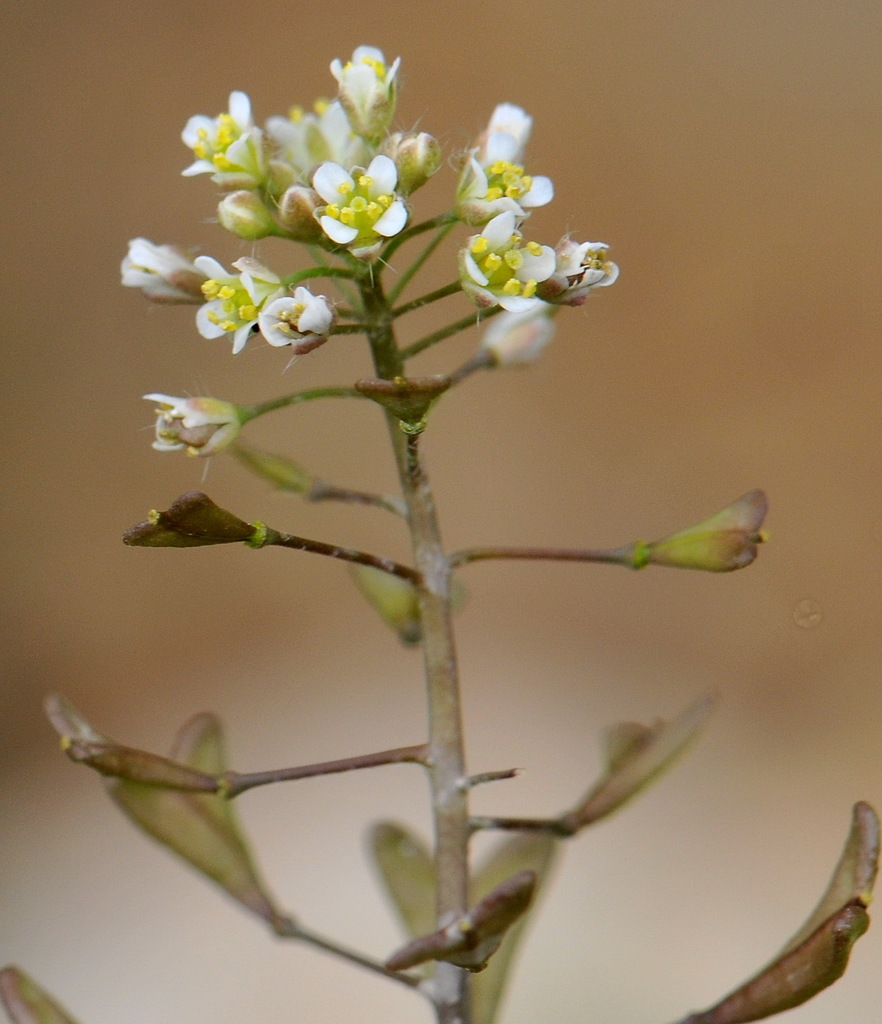
shepherd's-purse
Capsella bursa-pastoris
Capsella bursa-pastoris, known by its common name shepherd's purse because of its triangular flat fruits, which are purse-like, is a small (up to 0.5 m) annual and ruderal flowering plant in the mustard family Brassicaceae. It is native to eastern Europe and Asia minor, but is naturalized and considered a common weed in many parts of the world, especially in colder climates, including British Isles, where it is regarded as an archaeophyte, North America and China, but...
From the article Capsella bursa-pastoris on Wikipedia (CC BY-SA), quoted section by section
Description
Capsella bursa-pastoris is a ruderal and an annual or biennial plant. It grows from a rosette of lobed leaves at the base. From the base emerges a stem most often 10–50 cm (4–20 in) tall, but occasionally as much as 70 cm (28 in) or as little as 2 cm (3⁄4 in), which bears a few pointed leaves partly grasping the stem, each up to 6.5 cm (2+1⁄2 in) long. The flowers, which appear in any month of the year in the British Isles, are white and small, 2.5 mm (1⁄8 in) in diameter, with four petals and six stamens. They are borne in loose racemes, and produce flattened, two-chambered seed pods known as silicles, which are about 6 mm long and triangular to heart-shaped, each containing several seeds.
Research. Like a number of other plants in several plant families, its seeds contain a substance known as mucilage, a condition known as myxospermy. Recently, this has been demonstrated experimentally to perform the function of trapping nematodes, as a form of 'protocarnivory'. Capsella bursa-pastoris is closely related to the model organism Arabidopsis thaliana and is also used as a model organism, because the variety of genes expressed throughout its life cycle can be compared to genes that have been well studied in A. thaliana. Unlike most flowering plants, it flowers almost all year round. Like other annual ruderals exploiting disturbed ground, C. …
Range & habitat
It is native to eastern Europe and Asia minor, but is naturalized and considered a common weed in many parts of the world, especially in colder climates, including the British Isles (where it is regarded as an archaeophyte), North America, and China, but also in the Mediterranean and North Africa. C. bursa-pastoris is the second-most prolific wild plant in the world and is common on cultivated ground and waysides and meadows.
Wikipedia: “Distribution and habitat”
What it does
Pathogens of this plant include:
White rust Albugo candida One species of downy mildew Hyaloperonospora parasitica Phoma herbarum
Wikipedia: “Ecology”
At the table
Capsella bursa-pastoris gathered from the wild or cultivated has many uses, including for food, to supplement animal feed, for cosmetics, and in traditional medicine—reportedly to stop bleeding. The plant can be eaten raw; the leaves are best when gathered young. Native Americans ground it into a meal and made a beverage from it.
Cooking. It is eaten as a leaf vegetable and cultivated as a commercial food crop in Asia. In China, where it is known as jìcài (荠菜; 薺菜) its use as food has been recorded since the Zhou dynasty. Historically, it was used to make geng soup, congee, and preserved as yāncài (醃菜). In the Ming-dynasty famine survival guide Jiuhuang bencao, it was recommended to mix jìcài with water and other ingredients to make bread-like bing. Today, it is commonly used in food in Shanghai and the surrounding Jiangnan region. The savory leaf is stir-fried with nian gao rice cakes and other ingredients or as part of the filling in wontons. It is one of the ingredients of the symbolic dish consumed in the Japanese spring-time festival, Nanakusa-no-sekku. In Korea, it is known as naengi (냉이) and used in the characteristic Korean dish, namul (fresh greens and wild vegetables).
Wikipedia: “Uses”
In human culture
A very early European illustration of Capsella bursa-pastoris was published in a medieval Herbarius in approximately 1486. The book was printed in Louvain in what is now Belgium. The species was apparently not included in the ancient pharmacopoeia with William Turner stating in 1548 that it and twenty or thirty others had come to be known as medicinal plants from Arab sources. It was formally described by the Swedish botanist Carl Linnaeus in his seminal publication Species Plantarum (1753) and then published by Friedrich Kasimir Medikus in Pflanzen-Gattungen (Pfl.-Gatt.) in 1792.
Wikipedia: “History”
Where it lives
Recorded sightings
—
geo-referenced records in GBIF, from museums, herbaria and field observers.
Drag the globe to turn it. Dots are where records exist, not a range map; darker means more records.
In the old herbals & bestiaries

The Book of Health: The Art of Distillation
Brunschwig, Hieronymus · 1505 · p.247

The Great Herbary with all the figures of the herbs
1532 · p.75

Notable Commentaries on the History of Plants
Leonhart Fuchs · 1542 · p.645

Notable Commentaries on the History of Plants
Leonhart Fuchs · 1549 · p.643

Illustrated Compendium of Materia Medica (Vol. 3)
吳其濬 · 1848 · p.87

Illustrated Compendium of Materia Medica (Vol. 6)
吳其濬 · 1848 · p.9

Complete Treatise on Agricultural Administration
Xu Guangqi · 1909 · p.847
In the stacks
Searching the stacks…
Every page naming Capsella bursa-pastoris in the Biodiversity Heritage Library →
This page is assembled live from iNaturalist, GBIF, Wikipedia, the Source Library and the Internet Archive. It is not yet part of the hand-edited codex. iNaturalist taxon 56121.