- Plants
- ›Vascular Plants
- ›flowering plants
- ›Dicots
- ›proteas, lotuses, planes, and allies
- ›Protea family
- ›Paired Proteas
- ›Embothrieae
- ›Hakeinae
- ›Hakea
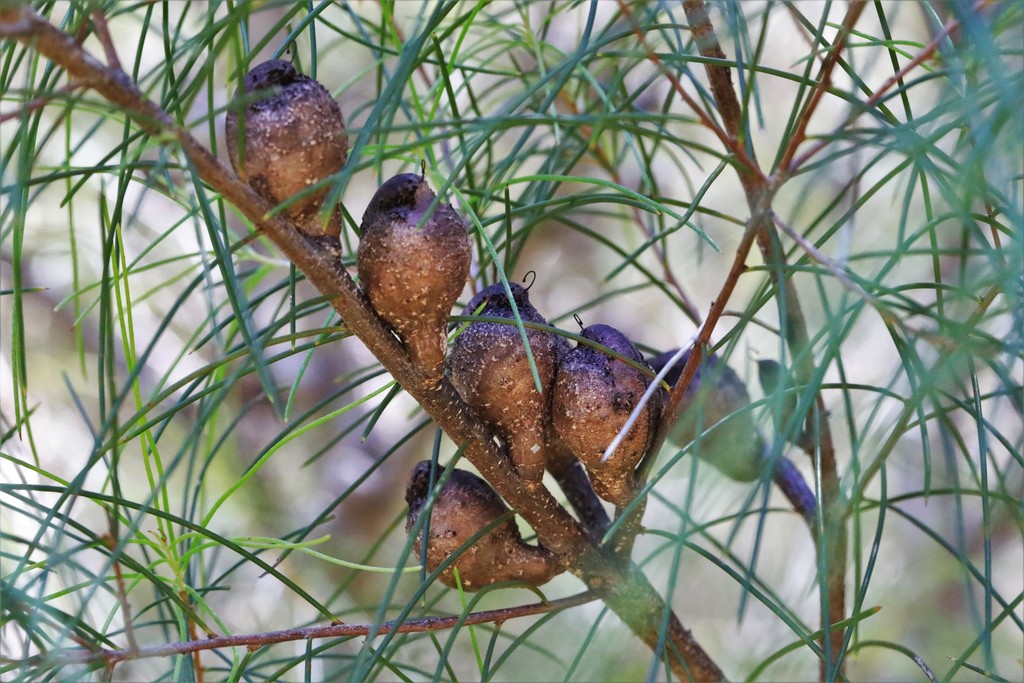
mulloway needle bush
Hakea actites
Hakea actites, commonly known as the mulloway needle bush or wallum hakea is a shrub or tree of the Proteaceae family native to areas in north eastern New South Wales and south eastern Queensland. White nectar-rich flowers appear in abundance from late autumn to early spring.
From the article Hakea actites on Wikipedia (CC BY-SA), quoted section by section
Description
Hakea actites is a prickly shrub or tree growing to 0.3 to 5 metres (1.0 to 16.4 ft) high and forms a lignotuber. Smaller branches are silky to densely covered with short matted hairs. The light green leaves are smooth, needle-like 3.5 to 13.5 centimetres (1.4 to 5.3 in) long and 0.3 to 1.3 millimetres (0.0 to 0.1 in) in diameter ending with a sharp point 1–2 mm (0.04–0.08 in) long. The inflorescence consists of 1-6 white flowers appearing in clusters in leaf axils. Flower stalks are 0.6–1 mm (0.02–0.04 in) long covered in short rusty coloured matted hairs. The pedicel is 1.8–3 mm (0.07–0.1 in) long covered sparsely or with matted silky white and rusty coloured hairs. Perianth 3.1–4.3 mm (0.1–0.2 in) long, white and smooth, occasionally a bluish-green with a powdery film. The wrinkled egg-shaped fruit are 20–35 mm (0.8–1 in) long and 16–25 mm (0.6–1 in) wide ending with a smooth rounded beak and obscure horns. Occasionally, fruits appear with coarse blister-like protuberances. Flowers appear from May to September. Hakea actites resembles the better known Hakea sericea.
Range & habitat
Hakea actites is found in swampy locations in coastal areas from around Hervey Bay in south-eastern Queensland in the north to a little north of Coffs Harbour in New South Wales in the south. It grows well in damp sand to sandy clay soils and is often part of open wallum heathland and Eucalyptus forest communities.
Wikipedia: “Distribution and habitat”
At the table
A very hardy species that may be grown from seed and suited to coastal swampy situations. Provides protection, nesting sites and nectar for small birds due to its prickly habit and profuse flowering.
== References ==
Wikipedia: “Uses in horticulture”
Where it lives
Recorded sightings
—
geo-referenced records in GBIF, from museums, herbaria and field observers.
Drag the globe to turn it. Dots are where records exist, not a range map; darker means more records.
In the stacks
Searching the stacks…
Every page naming Hakea actites in the Biodiversity Heritage Library →
This page is assembled live from iNaturalist, GBIF, Wikipedia, the Source Library and the Internet Archive. It is not yet part of the hand-edited codex. iNaturalist taxon 560613.