- Plants
- ›Vascular Plants
- ›flowering plants
- ›Dicots
- ›Mallows, Rock Roses, and Allies
- ›Mallow and Hibiscus Family
- ›Malvoideae
- ›Malveae
- ›Malva
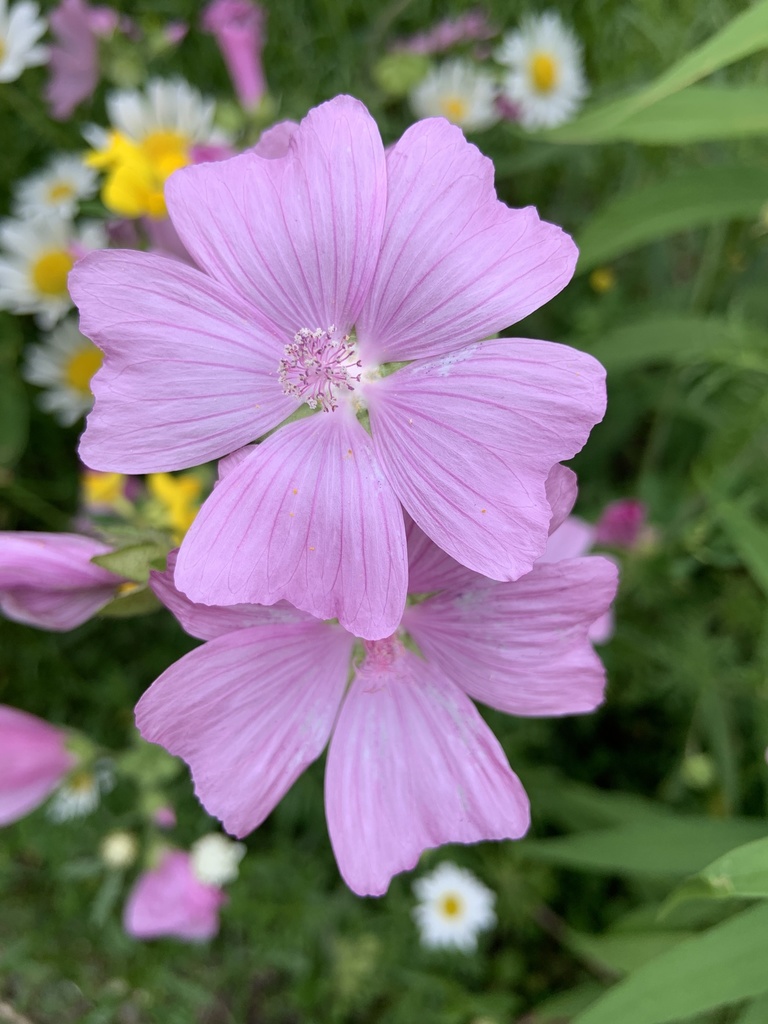
musk mallow
Malva moschata
Malva moschata, the musk mallow or musk-mallow, is a species of flowering plant in the family Malvaceae. It is a herbaceous plant producing pink, five-petaled flowers in summer. It is native to Eurasia and has been introduced elsewhere, being cultivated as an ornamental plant.
From the article Malva moschata on Wikipedia (CC BY-SA), quoted section by section
Description
The perennial plant grows up to 60 centimetres (24 in) tall. It has hairy stems and foliage. The leaves are alternate, 2–8 cm (3⁄4–3+1⁄4 in) long and broad, palmately lobed with five to seven lobes. The basal leaves are very shallowly lobed, while those higher on the stems are deeply divided, with narrow, acuminate lobes. Blooming in summer, flowers appear in clusters in the leaf axils, each flower 3.2–5 cm (1+1⁄4–2 in) in diameter, with five bright pink petals that have a truncated to notched apex; they have a distinctive musky odour. The fruit is a disc-shaped schizocarp 3–6 millimetres (1⁄8–1⁄4 in) in diameter, containing 10–16 seeds, the seeds individually enclosed in a mericarp covered in whitish hairs. It has a chromosome count of 2n=42.
Range & habitat
The species is native to Europe and southwestern Asia, from Spain north to the British Isles and Poland, and east to southern Russia and Turkey. It has been introduced to and become naturalised in several areas with temperate climates away from its native range, including Scandinavia, New Zealand, and North America.
Wikipedia: “Distribution and habitat”
What it does
It occurs on dry, but fertile soils at altitudes from sea level up to 1,500 m (4,900 ft). Natural hybrids with the closely related Malva alcea are occasionally found. The flowers are usually pollinated by bees.
Wikipedia: “Ecology”
At the table
Malva moschata is widely grown as an ornamental plant for its attractive scented flowers, produced for a long period through the summer. Several cultivars have been selected for variation in flower colour, including 'Rosea' with dark pink flowers. The leaves and flowers can be added to salads. The seeds are also edible.
Wikipedia: “Uses”
Where it lives
Recorded sightings
—
geo-referenced records in GBIF, from museums, herbaria and field observers.
Drag the globe to turn it. Dots are where records exist, not a range map; darker means more records.
In the stacks
Searching the stacks…
Every page naming Malva moschata in the Biodiversity Heritage Library →
This page is assembled live from iNaturalist, GBIF, Wikipedia, the Source Library and the Internet Archive. It is not yet part of the hand-edited codex. iNaturalist taxon 55977.