- Plants
- ›Vascular Plants
- ›flowering plants
- ›Dicots
- ›honeysuckles, moschatels, and allies
- ›elder family
- ›Viburnum
- ›Viburnum opulus
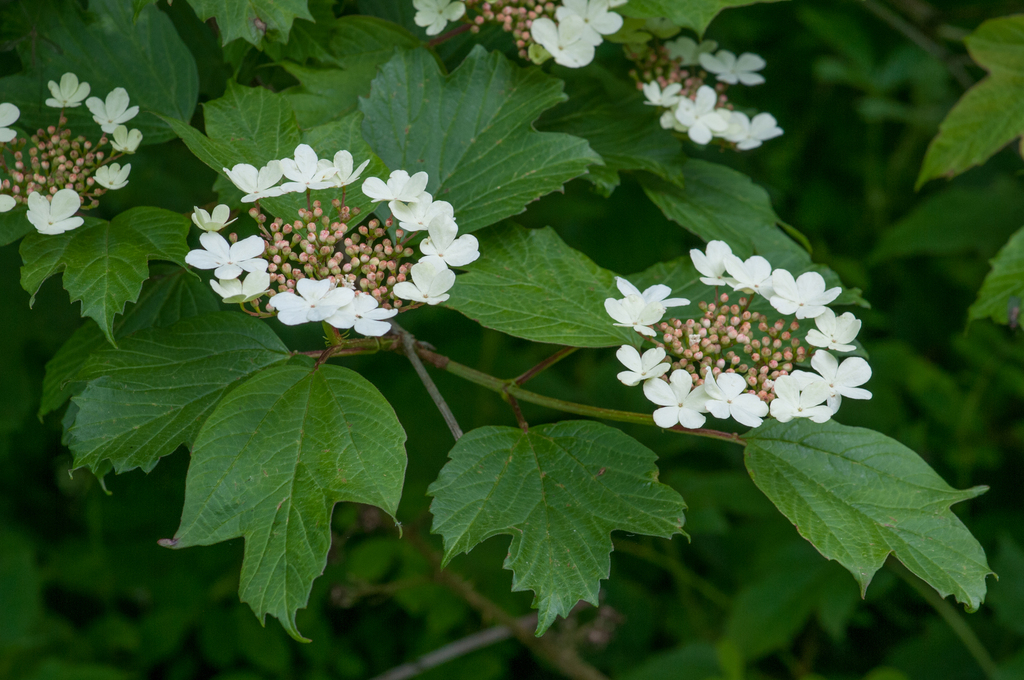
guelder-rose
Viburnum opulus
Viburnum opulus, commonly known as the guelder-rose, or guelder rose () and highbush cranberry is a Eurasian and North American species of flowering plant in the family Viburnaceae.
From the article Viburnum opulus on Wikipedia (CC BY-SA), quoted section by section
Description
Viburnum opulus is a deciduous shrub growing to 4–5 m (13–16 ft) tall. The leaves are opposite, three-lobed, 5–10 cm (2–4 in) long and broad, with a rounded base and coarsely serrated margins; they are superficially similar to the leaves of some maples, most easily distinguished by their somewhat wrinkled surface with impressed leaf venation. The leaf buds are green, with valvate bud scales. The hermaphrodite flowers are white, produced in corymbs 4–11 cm (2–4 in) in diameter at the top of the stems. Each corymb comprises a ring of outer sterile flowers 1.5–2 cm (5⁄8–3⁄4 in) in diameter with conspicuous petals, surrounding a center of small (5 mm or 1⁄4 in) fertile flowers. The flowers are produced in early summer and are pollinated by insects. The fruit is a globose bright red drupe 7–10 mm (1⁄4–3⁄8 in) in diameter, containing a single seed. The seeds are dispersed by birds. Its fruit persists for an average of 200 days, and always bears 1 seed per fruit. Fruits average 88.0% water, and their dry weight includes 17.3% carbohydrates and 1.3% lipids.
Range & habitat
Viburnum opulus var. opulus is native to Europe, northern Africa, and central Asia. It is naturalised in North America. Viburnum opulus var. americanus is native to North America.
Wikipedia: “Distribution and habitat”
At the table
The fruit is edible in small quantities, with a very bitter taste; it can be used to make jam. It is however mildly toxic, and may cause vomiting or diarrhea if eaten in large amounts. The ripe fruit is often ignored by birds and avoided by humans due to a foul smell emitted when crushed, described by some as "musty socks" or "urine and vomit". The term 'cramp bark' is related to the bark's use in traditional medicine for cramps, but there is no scientific evidence of its effectiveness for this use or any other.
Wikipedia: “Toxicity and uses”
How it is grown
Viburnum opulus is grown as an ornamental plant for its flowers and berries, growing best on moist, moderately alkaline soils, though tolerating most soil types well. Several cultivars have been selected, including 'Roseum', in which all the flowers are only of the larger sterile type, with globular flower heads. The shrub is also cultivated as a component of hedgerows, cover plantings, and as part of other naturalistic plantings in its native regions. The cultivars 'Notcutt's Variety', 'Roseum' and the yellow-fruited 'Xanthocarpum' have gained the Royal Horticultural Society's Award of Garden Merit.
Wikipedia: “Cultivation”
In human culture
Mentions of the viburnum can be found throughout Ukrainian folklore such as songs, decorative art, Ukrainian embroidery, and poetry. Its symbolic roots can be traced to the Slavic paganism of millennia ago. According to a legend, kalyna was associated with the birth of the Universe, the so-called Fire Trinity: the Sun, the Moon, and the Star. Its berries symbolize one's home and native land, blood, and family roots. Kalyna is often depicted on Ukrainian embroidery: ritual cloths and shirts. In Slavic paganism kalyna also represents the beauty of a young lady, which rhymes well in the Ukrainian language: ka-ly-na – div-chy-na. The song "Chervona Kalyna" was the anthem of the Ukrainian Sich Riflemen and the Ukrainian Insurgent Army; along with these national liberating movements in 20th century guelder rose was established as a symbol of riflemen honor, and state independence. In Russia the Viburnum fruit is called kalina (калина) and is commonly found in folklore. Kalina derived in Russian language from kalit' or raskalyat', which means "to make red-hot". The red fiery color of the berries represents beauty in Russian culture and together with sweet raspberries it symbolises the passionate love of a beautiful maiden, since berries were always an erotic symbol in Russia. The bitter side of the red fruit also symbolizes love separation in Russian folk culture. …
Wikipedia: “In culture”
Where it lives
Recorded sightings
—
geo-referenced records in GBIF, from museums, herbaria and field observers.
Drag the globe to turn it. Dots are where records exist, not a range map; darker means more records.
In the old herbals & bestiaries

Book of Herbs
Hieronymus Bock (Tragus) · 1546 · p.797

Stirpium adversaria nova
Matthias de Lobel · 1571 · p.468

Six Groups of the History of Plants
Rembert Dodoens · 1583 · p.855

Jan Moninckx; Maria Moninckx — Moninckx Atlas, vol. 2 (1686)
Jan Moninckx; Maria Moninckx · 1686 · p.24

Elements of Botany
Joseph Pitton de Tournefort · 1719 · p.127
In the stacks
Searching the stacks…
Every page naming Viburnum opulus in the Biodiversity Heritage Library →
This page is assembled live from iNaturalist, GBIF, Wikipedia, the Source Library and the Internet Archive. It is not yet part of the hand-edited codex. iNaturalist taxon 55969.