- Plants
- ›Vascular Plants
- ›flowering plants
- ›Dicots
- ›proteas, lotuses, planes, and allies
- ›Protea family
- ›Paired Proteas
- ›Embothrieae
- ›Hakeinae
- ›Hakea
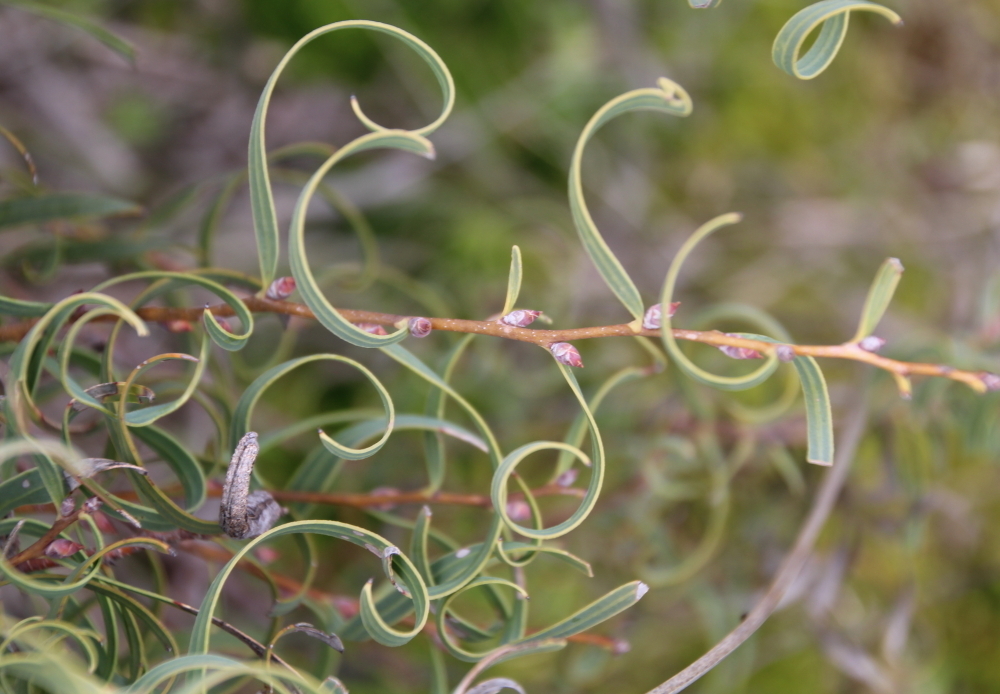
narrow-fruited hakea
Hakea stenocarpa
Hakea stenocarpa is a shrub in the family Proteaceae, commonly known as narrow-fruited hakea. It has scented creamy-white flowers in clusters, often with curling leaves and is endemic to an area in the Mid West, western Wheatbelt, Peel and the South West regions of Western Australia.
From the article Hakea stenocarpa on Wikipedia (CC BY-SA), quoted section by section
Description
Hakea stenocarpa is a small, rounded multi-stemmed shrub that typically grows to 0.3 to 1 metre (1 to 3 ft) high and forms a lignotuber. The branchlets are more or less smooth at flowering time. The inflorescence is a single raceme of 14-20 sweetly scented white, creamy-white or yellow flowers in leaf axils in the upper branchlets. The smooth pedicels are cream-white, the perianth cream-white and the pistil 4.4–5 mm (0.17–0.20 in) long. The linear leaves are 6–11 cm (2–4 in) long and 2–7 mm (0.08–0.3 in) wide with a prominent pale yellow longitudinal mid-vein. The leaves generally curl in an upward spiral. Unlike most species of hakea, the fruit are long, narrow-ovoid, 2.8–3 cm (1.1–1.2 in) long and 0.6–0.8 cm (0.24–0.31 in) wide, tapering to a pointed beak. The fruit are rough and warty where they attach to the branches.
Range & habitat
Narrow-fruited hakea grows in heath, low open shrubland and woodland in deep sand, loam, clay and gravel sometimes over laterite. Requires a well-drained site in sun or partial shade. An ornamental shrub, may be used as a groundcover.
Wikipedia: “Distribution and habitat”
Where it lives
Recorded sightings
—
geo-referenced records in GBIF, from museums, herbaria and field observers.
Drag the globe to turn it. Dots are where records exist, not a range map; darker means more records.
In the stacks
Searching the stacks…
Every page naming Hakea stenocarpa in the Biodiversity Heritage Library →
This page is assembled live from iNaturalist, GBIF, Wikipedia, the Source Library and the Internet Archive. It is not yet part of the hand-edited codex. iNaturalist taxon 559459.