- Plants
- ›Vascular Plants
- ›flowering plants
- ›monocots
- ›Agaves, Orchids, Irises, and Allies
- ›Orchids
- ›Orchidoid Orchids
- ›Diurideae
- ›Caladeniinae
- ›Caladenia
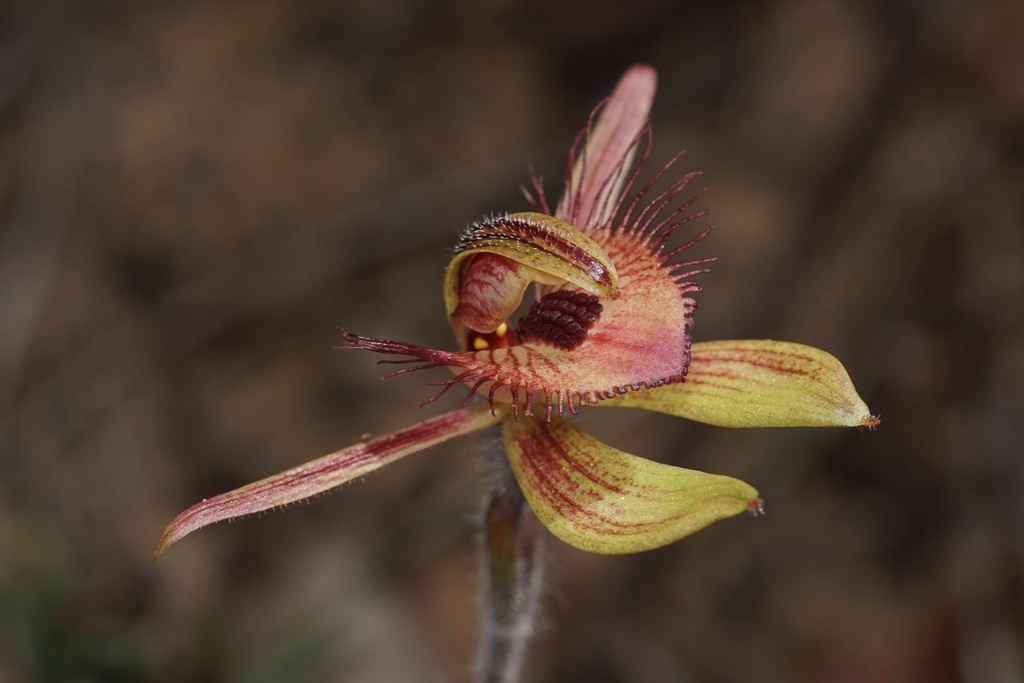
Dancing Spider Orchid
Caladenia discoidea
Caladenia discoidea, commonly known as the dancing spider orchid, antelope orchid or bee orchid, is a species of orchid endemic to the south-west of Western Australia. It is distinguished by its horizontally arranged flowers and unusually short sepals and petals.
From the article Caladenia discoidea on Wikipedia (CC BY-SA), quoted section by section
Description
Caladenia discoidea has a single leaf, 8–18 mm (0.3–0.7 in) long, about 8 mm (0.3 in) wide and hairy on both surfaces. The flower stem is 90–450 mm (4–20 in) long and bears 1 to 4 flowers, each 20–30 mm (0.8–1 in) long and wide. The flowers are oriented horizontally, are yellow and green with red stripes, have very short petals and sepals and a rounded, fringed labellum with dark calli. Flowers appear between August and early October.
Range & habitat
The dancing spider orchid is widespread in the drier areas of the south-west between Kalbarri and Israelite Bay, growing in woodland, sometimes on the edges of salt lakes. It occurs in the Avon Wheatbelt, Esperance Plains, Geraldton Sandplains, Jarrah Forest, Mallee and Swan Coastal Plain biogeographic regions of Western Australia.
Wikipedia: “Distribution and habitat”
In human culture
This species was featured on an Australian postage stamp in 2014.
== References ==
Wikipedia: “Cultural reference”
Where it lives
Recorded sightings
—
geo-referenced records in GBIF, from museums, herbaria and field observers.
Drag the globe to turn it. Dots are where records exist, not a range map; darker means more records.
In the stacks
Searching the stacks…
Every page naming Caladenia discoidea in the Biodiversity Heritage Library →
This page is assembled live from iNaturalist, GBIF, Wikipedia, the Source Library and the Internet Archive. It is not yet part of the hand-edited codex. iNaturalist taxon 559449.