- Plants
- ›Vascular Plants
- ›flowering plants
- ›Dicots
- ›geraniums, bridal wreaths, and allies
- ›Geranium family
- ›Geranium
- ›Robertium
- ›Ruberta
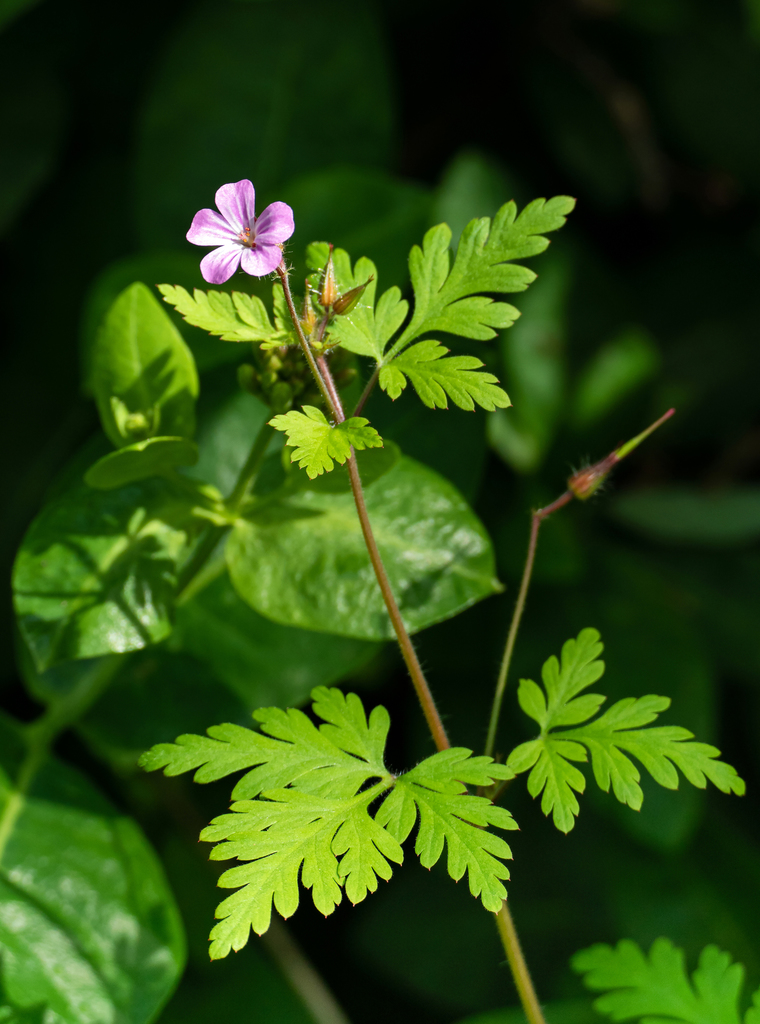
Herb Robert
Geranium robertianum
Geranium robertianum, commonly known as herb-robert or, in North America, as Robert's geranium, is a species of cranesbill that is widespread throughout the northern hemisphere and introduced to some countries in the southern. It is common in woods, hedges, gardens, and on waste ground, and can also be found on shingle beaches and limestone pavements. It is not rare or threatened and in some places it is considered to be invasive.
From the article Geranium robertianum on Wikipedia (CC BY-SA), quoted section by section
Description
Herb-robert is a small, usually biennial but sometimes annual or even short-lived perennial herb that typically grows to about 30 cm (1 ft) tall and broad, or sometimes up to about twice that size. Young plants have a very short vegetative stem with effectively a basal rosette of leaves on petioles 2–5 cm (0.79–1.97 in) long, while older plants put up flowering stems from the axils of one or more of these basal leaves. The flowering stems can arise vertically or sprawl along the ground, and some of them can turn into stolons by putting down roots at the nodes. The whole plant is variously hairy, with a mixture of long simple hairs and shorter gland-tipped ones. Fresh material has what is often described as a "strong, unpleasant" odour when bruised or uprooted (even to the extent that it is sometimes given the nickname "stinky Bob"), but this property fades with time. Its colour can vary from entirely green, to reddish at the nodes or on the stems or leaves, or the whole plant (except the petals) can be bright red, especially when growing in bright sunshine.
The leaves are arranged alternately along the stems, and are typically divided into three stalked lobes, the lower two of which are further split to produce a 5-lobed (palmate) outline, up to about 11 cm (4.3 in) in diameter in the largest, lower leaves. …
Range & habitat
The main areas of distribution of herb-robert are throughout Europe northwards to the Baltic and eastwards as far as Russia. It also occurs in north Africa and it is considered also to be native in north America, although in some western states it is regarded as a weed.
It grows at altitudes from sea level to 700 m (2,300 ft) at Great Dun Fell in England and up to 2,400 m (7,900 ft) in Kashmir. The IUCN has not assessed the threat status of this species, but in some countries it is classified as Least Concern.
Wikipedia: “Distribution and status”
What it does
Its Ellenberg values in Britain are L=5, N=6, F=6, R=6 and S=0, which means that it typically grows in places with light shade, moist neutral soils with moderate fertility and no salinity. However, it can occupy a wide range of habitats, including shingle beaches in full sun and grikes in limestone pavements. Despite these neutral-sounding values, it is primarily a plant of woodland, and it is quite tolerant of at least moderate shade. It is also much more of a calcicole than a calcifuge, being most common in limestone and chalk woodlands, and absent from many acid habitats. The most typical vegetation communities for it in Britain include ash woods and hawthorn hedges.
In Europe there are 52 habitats in which it is found. In two of these it is a diagnostic species. Under the EUNIS habitat system these are: T1-F Forêts de ravin (ravine forests) and T1-G Aulnaies à Alnus cordata (Italian alder carr). It is also considered characteristic of E5.43 shady forest edges, F3.11 Central European thickets on moist soils, H2.6C Illyrian sub-Mediterranean screes, and G1.7A1212 Pannonic alkali steppe oak woods. A re-evaluation of its ecological attributes in Switzerland assigned it the following Ellenberg Values: L=3, N=4, F=3, R=6, T=3+ and K=3. The British database of insects and foodplants lists nine species which are phytophagous on herb-robert. …
Wikipedia: “Habitat and ecology”
At the table
White-flowered varieties of herb-robert have been cultivated in gardens for centuries. A small-flowered, fragrant white variety, 'Celtic White', is currently a popular garden plant. Folk etymology provides several possible origins of the name of herb-robert. Some claim it is from St Rupert, who is also known as Saint Robert, because a German name for it is ruprechtskraut (another, more prosaic one is Stinkender Storchschnabel). Alternatively, a link to Saint Robert of Molesme has been proposed. Another explanation is that it could be derived from Robin Goodfellow, a hobgoblin in northern European mythology. In Britain there are dozens of other country names for herb-robert, some of which ("robin-in-the-hedge", "robin's-flower") make reference to the European robin because of the colour and the habitat. The medicinal value of herb-robert is uncertain. Maud Grieve, for example, did not mention it at all in her influential herbal, but there are other accounts of it being used in the folk medicine of several countries, including as a treatment for diarrhea, to improve functioning of the liver and gallbladder, for toothache and nosebleeds, and as a vulnerary (used for or useful in healing wounds). Freshly picked leaves, when rubbed on the body, are said to repel mosquitoes. Chemical constituents include tannins, a bitter compound called geraniin, and essential oils. …
Wikipedia: “Uses and in culture”
Where it lives
Recorded sightings
—
geo-referenced records in GBIF, from museums, herbaria and field observers.
Drag the globe to turn it. Dots are where records exist, not a range map; darker means more records.
In the old herbals & bestiaries

Living Images of Plants
Otto Brunfels · 1532 · p.380

Introductio Generalis in Rem Herbariam
Augustus Quirinus Rivinus · 1690 · p.521

The Book of Health: The Art of Distillation
Brunschwig, Hieronymus · 1505 · p.139

The Great Herbary with all the figures of the herbs
1532 · p.179

Notable Commentaries on the History of Plants
Leonhart Fuchs · 1542 · p.240

Notable Commentaries on the History of Plants
Leonhart Fuchs · 1549 · p.238

On the Names of Plants
Hieronymus Bock (Tragus) · 1552 · p.180

Six Groups of the History of Plants
Rembert Dodoens · 1583 · p.82

Herbarium Portatile, Oder Behendes Kräuter- und Gewächs-Buch: Darinn nicht allein 1363. so wol Einheimische als Außländndische Kräuter mit Lateinisch und Deutscher Benennung abgebildet, sondern auch die meisten, so in der Medicin gebräuchlich, kürtzlich erkläret werden
Panckow, Thomas · 1656 · p.136
In the stacks
Searching the stacks…
Every page naming Geranium robertianum in the Biodiversity Heritage Library →
This page is assembled live from iNaturalist, GBIF, Wikipedia, the Source Library and the Internet Archive. It is not yet part of the hand-edited codex. iNaturalist taxon 55925.