- Plants
- ›Vascular Plants
- ›flowering plants
- ›Dicots
- ›Roses, Elms, Figs, and Allies
- ›rose family
- ›brambles, roses, strawberries, and allies
- ›agrimonies and burnets
- ›agrimony subtribe
- ›Agrimonia
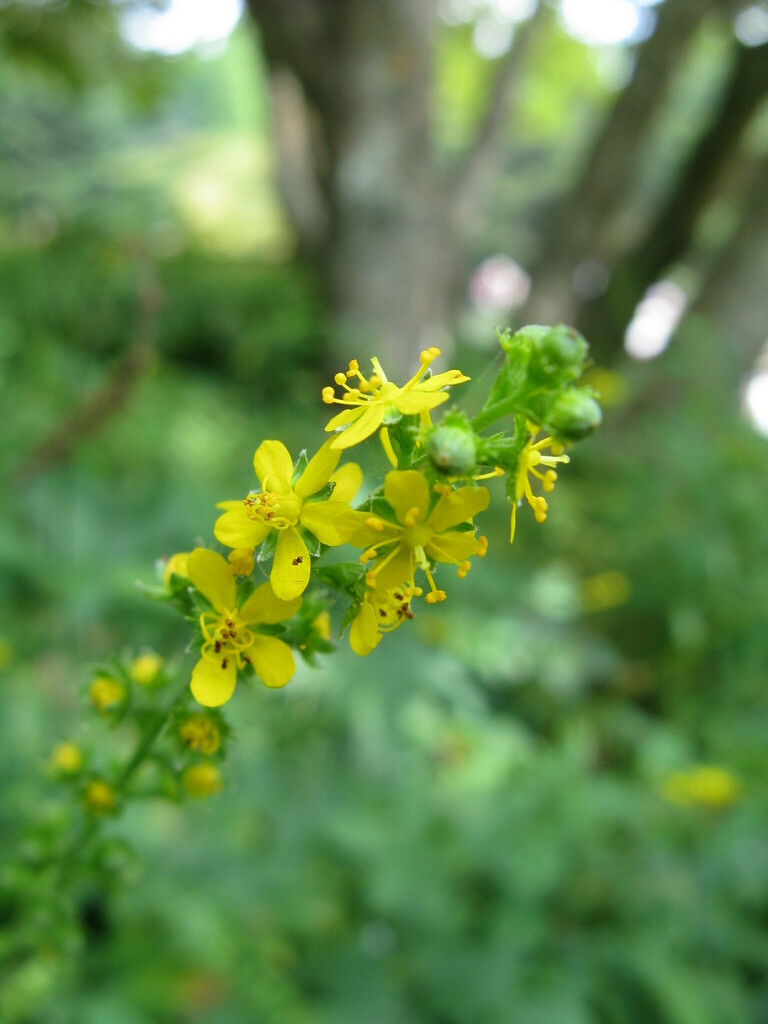
Hairy Agrimony
Agrimonia pilosa
Agrimonia pilosa (Hangul: 짚신나물), also known as hairy agrimony, is a flowering plant in the Rosaceae family. It is distributed primarily over the Korean Peninsula, Japan, China, Siberia, and Eastern Europe.
From the article Agrimonia pilosa on Wikipedia (CC BY-SA), quoted section by section
Description
Agrimonia pilosa is a perennial herb with erect stem growing 30–120 cm (12–47 in) in height. It grows along roadsides or in grassy areas at diverse altitudes. It can grow in light sandy, loamy, or heavy soils. Its suitable pH for growing properly is acid or basic alkaline soils. It has many lateral roots and its rhizome is short and usually tuberous. Its stems are colored yellowish green or green and its upper part is sparsely pubescent and pilose, but the lower part had dense hairs. Its leaves are green, alternate and odd-pinnate with two to four pairs of leaflets. The number of leaflets reduces to three on upper leaves. The leaves are oval and edged with pointy teeth of similar size. The leaves are 3–6 cm (1.2–2.4 in) long and 1.5–3.5 cm (0.59–1.38 in) wide, and they are hairy on both sides.
In medicine
Agrimonia pilosa is traditionally used in Korea for boils, eczema, and taeniasis (a tape worm condition). In Nepal and China, A. pilosa is traditionally used for abdominal pain, sore throat, headaches, and heat stroke.
== References ==
Wikipedia: “Traditional medicine”
Where it lives
Recorded sightings
—
geo-referenced records in GBIF, from museums, herbaria and field observers.
Drag the globe to turn it. Dots are where records exist, not a range map; darker means more records.
In the old herbals & bestiaries

In the stacks
Searching the stacks…
Every page naming Agrimonia pilosa in the Biodiversity Heritage Library →
This page is assembled live from iNaturalist, GBIF, Wikipedia, the Source Library and the Internet Archive. It is not yet part of the hand-edited codex. iNaturalist taxon 55894.