- Plants
- ›Vascular Plants
- ›flowering plants
- ›Dicots
- ›pinks, cactuses, and allies
- ›knotweed family
- ›Polygonoideae
- ›Polygoneae
- ›Polygoninae
- ›Polygonum
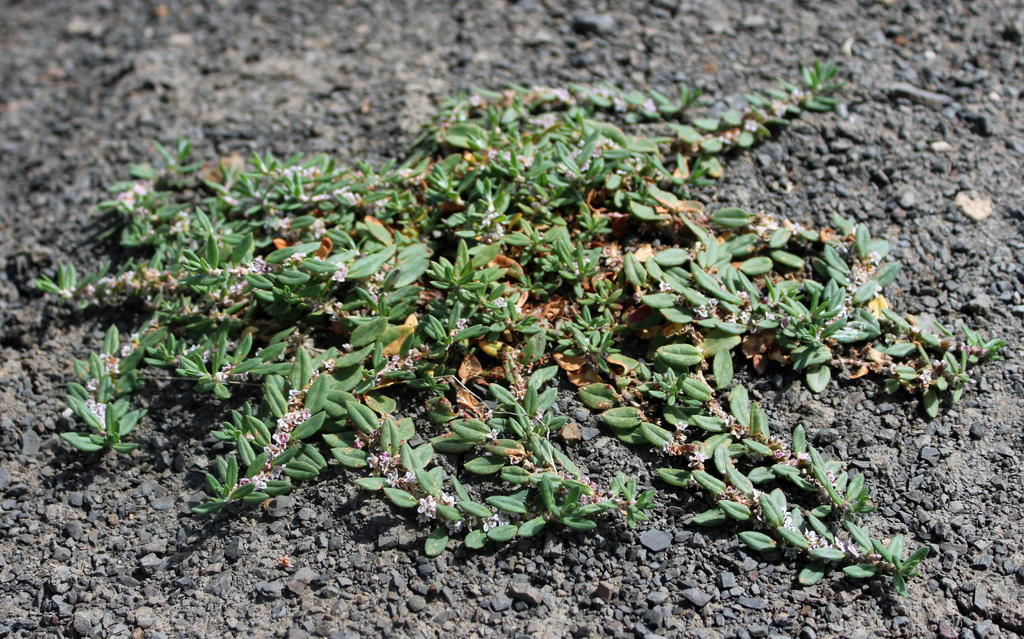
Polygonum alpestre
Polygonum cognatum, commonly called Indian knotgrass or madimak (from Turkish madımak), is an edible weedy creeping perennial herb in the genus Polygonum, frequently eaten by people of Turkey. It has larger leaves than most other species of Polygonum.
From the article Polygonum cognatum on Wikipedia (CC BY-SA), quoted section by section
Description
Polygonum cognatum is a perennial, prostrate or ascending branched herb, 15–30 cm long with a thick stout root stock. Stems are prostrate, green like the leaves. Leaves oblong-elliptic, petiolate, often slightly mucronate. Flowers in bundles in the leaf axils. Perianth pinkish, 4–5 mm, hardening and accrescent in fruit. Nut glossy, included in the perianth.
Range & habitat
Irano-Turanian Region or Iran-Turan Plant Geography Region element, grows between 760 and 5600 meters elevation on rocky and drier slopes; distribution: Central to Western Asia, Turkey, Caucasia (Georgia), Iran, Afghanistan and Pakistan. The madimak is a weed found in both agricultural and non-agricultural areas.
Wikipedia: “Habitat”
At the table
The madimak is one of the widely known traditional edible plants in Turkey particularly Central Anatolia Region. To be able to compensate increasing demand easily and supply the plant to the markets, farmers started cultivating madimak in Central Anatolia.
Wikipedia: “Cuisine”
In medicine
The highest antioxidant activity was found in the water extract.
== References ==
Wikipedia: “Pharmacology”
Where it lives
Recorded sightings
—
geo-referenced records in GBIF, from museums, herbaria and field observers.
Drag the globe to turn it. Dots are where records exist, not a range map; darker means more records.
In the stacks
Searching the stacks…
Every page naming Polygonum alpestre in the Biodiversity Heritage Library →
This page is assembled live from iNaturalist, GBIF, Wikipedia, the Source Library and the Internet Archive. It is not yet part of the hand-edited codex. iNaturalist taxon 558707.