- Plants
- ›Vascular Plants
- ›flowering plants
- ›Dicots
- ›Gentians, Dogbanes, Madders, and Allies
- ›Dogbane Family
- ›Rauvolfioideae
- ›periwinkles, devil peppers and kin
- ›European periwinkles
- ›Vinca
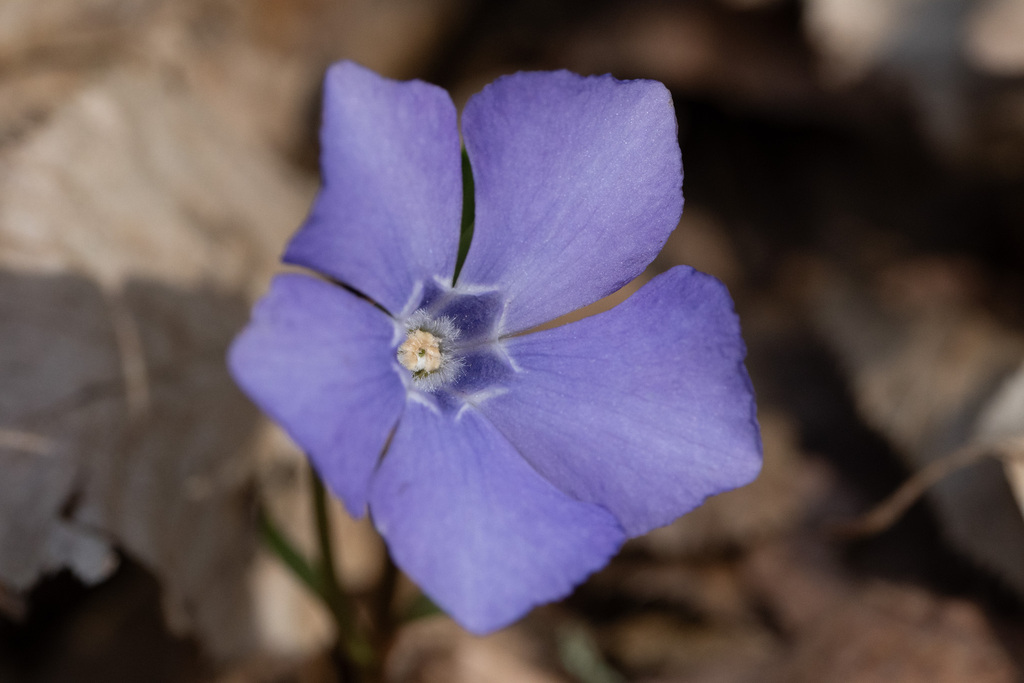
lesser periwinkle
Vinca minor
Vinca minor (common names lesser periwinkle or dwarf periwinkle) is a species of flowering plant native to central and southern Europe, from Portugal and France north to the Netherlands and the Baltic States, east to the Caucasus, and also southwestern Asia in Turkey. Other vernacular names used in cultivation include small periwinkle, common periwinkle, and sometimes in the United States, myrtle or creeping myrtle.
From the article Vinca minor on Wikipedia (CC BY-SA), quoted section by section
Description
Vinca minor is a trailing subshrub, spreading along the ground and rooting along the stems to form large clonal colonies and occasionally scrambling up to 40 centimetres (16 in) high but never twining or climbing. The leaves are evergreen, opposite, 2–4.5 cm (3⁄4–1+3⁄4 in) long and 1–2.5 cm (1⁄2–1 in) broad, glossy dark green with a leathery texture and an entire margin. The flowers are solitary in the leaf axils and are produced mainly from early spring to mid summer but with a few flowers still produced into the autumn; they are violet-purple (pale purple or white in some cultivated selections), 2–3 cm (3⁄4–1+1⁄4 in) diameter, with a five-lobed corolla. The fruit is a pair of follicles 2.5 cm (1 in) long, containing numerous seeds.
Chemistry. Vinca minor contains more than 50 alkaloids, including vincamine. Other alkaloids include reserpine, rescinnamine, akuammicine, majdine, vinerine, ervine, vineridine, tombozine, vincamajine, vincanine, vincanidine, vinburnine, apovincamine, vincaminol, desoxyvincaminol, vincorine and perivincine.
Similar species. The closely related Vinca major is similar, but larger in all parts, and also has relatively broader leaves with a hairy margin.
Range & habitat
Vinca minor is native to central and southern Europe, from Portugal and France north to the Netherlands and the Baltic states, east to the Caucasus, and also southwestern Asia in Turkey.
Wikipedia: “Distribution and habitat”
At the table
Vinpocetine (brand names: Cavinton, Intelectol; chemical name: ethyl apovincaminate) is a semisynthetic derivative alkaloid of vincamine with purported medicinal uses.
Wikipedia: “Uses”
How it is grown
The species is commonly grown as a groundcover in temperate gardens for its evergreen foliage, spring and summer flowers, ease of culture, and dense habit that smothers most weeds. It was once commonly planted in cemeteries in parts of the Southern U.S. and naturalized periwinkle may indicate the presence of graves whose other markers have disappeared.
Cultivars. There are numerous cultivars, with different flower colours and variegated foliage. Many have a less vigorous habit than the species, and are therefore more suitable for smaller gardens. The following cultivars have gained the Royal Horticultural Society's Award of Garden Merit:
'Argenteovariegata' (leaves have creamy white margins) 'Atropurpurea' (burgundy-purple flowers) 'Azurea Flore Pleno' (double blue flowers) 'Bowles's Variety' (violet-blue flowers: also known as 'Bowles's Blue' and 'La Grave') 'Ralph Shugert'
Wikipedia: “Cultivation”
Where it lives
Recorded sightings
—
geo-referenced records in GBIF, from museums, herbaria and field observers.
Drag the globe to turn it. Dots are where records exist, not a range map; darker means more records.
In the old herbals & bestiaries


In the stacks
Searching the stacks…
Every page naming Vinca minor in the Biodiversity Heritage Library →
This page is assembled live from iNaturalist, GBIF, Wikipedia, the Source Library and the Internet Archive. It is not yet part of the hand-edited codex. iNaturalist taxon 55844.