- Plants
- ›Vascular Plants
- ›flowering plants
- ›Dicots
- ›Buttercups, Poppies, and Allies
- ›buttercup family
- ›Anemones, buttercups, larkspurs and allies
- ›hellebores and Lenten roses
- ›Helleborus
- ›Helleborus
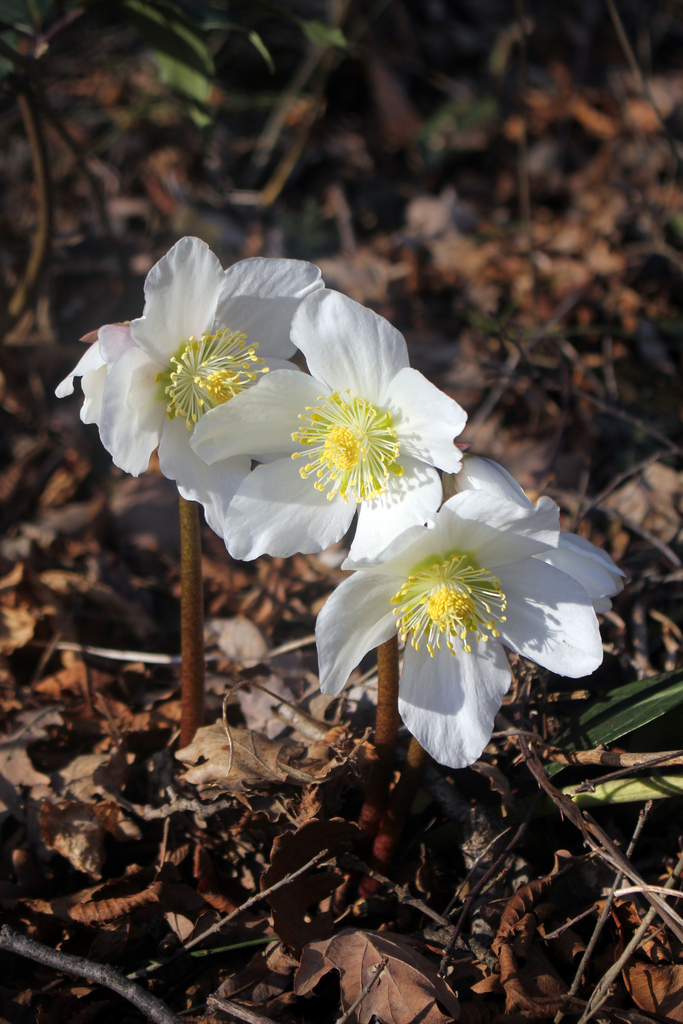
Christmas-rose
Helleborus niger
Helleborus niger, commonly called Christmas rose or black hellebore, is an evergreen perennial flowering plant in the buttercup family, Ranunculaceae. It is one of about 20 species from the genus Helleborus.
It is a poisonous cottage garden favourite because it flowers in the depths of winter.
From the article Helleborus niger on Wikipedia (CC BY-SA), quoted section by section
Description
Helleborus niger is an evergreen plant with dark leathery pedate leaves carried on stems 9–12 in (23–30 cm) tall. The large flat flowers, borne on short stems from midwinter to early spring, are generally white, but occasionally with a pink tinge. The tips of the petals may be flushed pink or green, and there is a prominent central boss of yellow.
Range & habitat
The natural distribution stretches from the eastern northern Alps (including the Julian Alps, Triglav) and southern Alps, west to Vorarlberg. In addition, Helleborus niger is common in the Apennines and northern Dinaric Alps of Slovenia and Croatia. It has been observed up to an elevation of 1900 meters. In the Berchtesgaden Alps, it grow up to an elevation of 1560 meters. In Germany, Helleborus niger is only native to Bavaria and in the Allgäu Alps Helleborus niger is not indigenous.
Wikipedia: “Distribution”
At the table
Helleborus niger is commonly called the Christmas rose, due to an old legend that it sprouted in the snow from the tears of a young girl who had no gift to give the Christ child in Bethlehem. One legend states that the flower blooms at the abbey in England founded by St. Thomas. It is said to bloom near the new calendar date of 6 January. This date had been Christmas Day under the old Julian calendar. So when Christmas Day under the new calendar came around and the flower did not bloom, it was such a frightful omen that England did not adopt the Gregorian calendar at that time in 1588; adoption had to wait until 1751. In the Middle Ages, people strewed the flowers on the floors of their homes to drive out evil influences. They blessed their animals with it and used it to ward off the power of witches. These same people believed, however, that witches employed the herb in their spells and that sorcerers tossed the powdered herb into the air around them to make themselves invisible. In the early days of medicine, two kinds of hellebore were recognized: black hellebore, which included various species of Helleborus, and white hellebore (now known as Veratrum album or "false hellebore", which belongs to a different plant family, the Melanthiaceae). Black hellebore was used by the ancients to treat insanity, melancholy, gout and epilepsy. …
Wikipedia: “Folklore and early medicinal uses”
Toxicity
All parts of the Christmas Rose plant are considered toxic upon consumption or physical contact with sap from damaged plant tissues. This is due to the fact that its organs contain varying levels of different glycosides - which are common plant defense mechanisms against herbivores and microorganisms.
Aerial toxins. The leaves, stems and flowers of Helleborus niger contain ranunculin and ranuncoside - glycosides whose breakdown yields the toxin protoanemonin when plant cells are damaged. Protoanemonin has an unpleasant taste and can cause irritation of the skin, mucosa and eyes upon contact. If large amounts are ingested, the toxin can cause itching and blistering of the mouth and throat as well as gastroenteritis and hematemesis in both humans and animals.
Root toxins. A key compound in the roots of Helleborus niger is Hellebrin, a bufadienolide which has similar cardiac activity but is less toxic than the cardiac glycosides found in Digitalis and Strophanthus plants. The degradation products of Hellebrin also strengthen heart contractions, but are more toxic than their parent molecule. The aglycon Hellebrigenin has the lowest lethal dose along with stronger cardiac activity than the original glucoside Hellebrin. …
Wikipedia: “Poisonous constituents”
How it is grown
The plant is a traditional cottage garden favourite because it flowers in the depths of winter. Large-flowered cultivars are available, as are pink-flowered and double-flowered selections. It has been awarded an Award of Garden Merit (AGM) H4 (hardy throughout the British Isles) by the Royal Horticultural Society, as has one of its hybrids (see below). It can be difficult to grow well; acidic soil is unsuitable, as are poor, dry conditions and full sun. Moist, humus-rich, alkaline soil in dappled shade is preferable. Leaf-mould can be dug in to improve heavy clay or light sandy soils; lime can be added to 'sweeten' acid soils.
Cultivars. Since the 1950s, 'Potter's Wheel' has been one of the most famous names associated with H. niger. It originated with a self-sown seedling given by Major G. H. Tristram of Dallington, Sussex, to Hilda Davenport-Jones who had a nursery at nearby Washfield, Kent. The seedling proved to be exceptionally large-flowered, but it was too slow-growing to be 'bulked up' quickly, so she propagated it as a rigorously-selected uniform seed strain rather than as a vegetatively propagated cultivar.
'Potter's Wheel' 'Marion' (double-flowered; there are also other unnamed double selections) 'Praecox' (early flowering)
Hybrids. Nurserymen have tried for many years to cross H. niger with oriental hellebores (Lenten roses) H. …
Wikipedia: “Horticulture”
Where it lives
Recorded sightings
—
geo-referenced records in GBIF, from museums, herbaria and field observers.
Drag the globe to turn it. Dots are where records exist, not a range map; darker means more records.
In the old herbals & bestiaries

Hortus Eystettensis
Basilius Besler · 1640 · p.383

Discourses on the Six Books of Dioscorides
Dioscorides; Pietro Andrea Mattioli (comm.) · 1568 · p.1463

Discourses on the Six Books of Dioscorides
Dioscorides; Pietro Andrea Mattioli (comm.) · 1568 · p.1462

The Flowering Garden: Winter
Crispijn van de Passe · 1614 · p.11

Living Images of Plants
Otto Brunfels · 1532 · p.40

Latin Herbal with German Synonyms
1484 · p.153

Latin Herbal
1484 · p.125

Herbarius
1485 · p.126

Ortus sanitatis
1491 · p.163

Herbal of Virtues
1499 · p.125

Living Images of Plants
Otto Brunfels · 1532 · p.37

Notable Commentaries on the History of Plants
Leonhart Fuchs · 1549 · p.307
In the stacks
Searching the stacks…
Every page naming Helleborus niger in the Biodiversity Heritage Library →
This page is assembled live from iNaturalist, GBIF, Wikipedia, the Source Library and the Internet Archive. It is not yet part of the hand-edited codex. iNaturalist taxon 55841.