- Plants
- ›Vascular Plants
- ›flowering plants
- ›Dicots
- ›Mustards, Capers, and Allies
- ›mustard family
- ›Brassicoideae
- ›Arabodae
- ›Arabideae
- ›Draba
- ›Erophila
- ›Draba verna
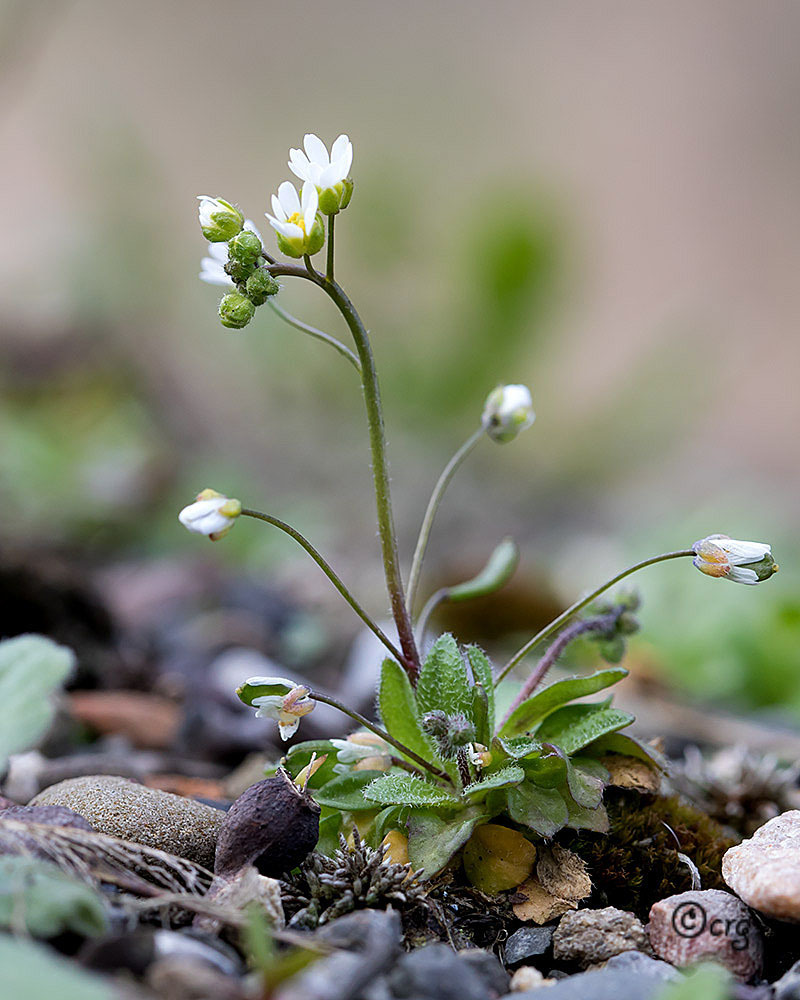
Common Whitlowgrass
Draba verna
Draba verna (syn. Erophila verna) may also go by the names spring draba, shadflower, nailwort, common whitlowgrass, vernal whitlow grass, early witlow grass or whitlow-grass. It is a small plant found in sagebrush country in the inland western United States, North Africa, temperate Asia, and most of Europe, including Britain. It was once thought to have been introduced to America from Europe, but is now considered native to both continents. It grows in very early spring....
From the article Draba verna on Wikipedia (CC BY-SA), quoted section by section
Description
Common whitlowgrass is a spring-flowering annual, typically up to 10 cm (4 in) tall (sometimes as much as 25 cm (10 in)) with a basal rosette and one or more leafless flowering stems. It is variably hairy, sometimes almost completely glabrous (hairless), especially on the stems. The elliptical leaves are up to 20 mm (1 in) long (exceptionally up to 35 mm (1.4 in)) and 8 mm (0.3 in) wide and are often entire, but sometimes with a single tooth on one or both sides, and they taper gradually into a more-or-less distinct petiole. The surfaces and margins usually have a scattering of hairs that are forked, or Y-shaped, at the tips. The central vein is faintly visible on the top side of the leaf but easily distinguishable on the underside. Mature leaves can turn a reddish colour.
Flowering occurs in early spring, March–May in northern latitudes. Each stem (of which there can be several) bears a lax raceme of about 10 long-stalked flowers with 4 white petals, about 3 mm (0.1 in) long, which are so deeply divided (bifid) that it can appear that there are 8 petals. The flowers have 6 stamens with yellow anthers, and one style. The sepals are about 2 mm (0.1 in) long, green, hairy and often have a purplish margin. The fruit (called a silique), forms immediately after flowering while the petals are still present, due to self-pollination. …
Range & habitat
Common whitlowgrass is native to Europe, western Asia and parts of North Africa southwards to Ethiopia. It is also widely established in the temperate regions of the Americas, Australia, New Zealand and Japan. It has been postulated that it was brought to North America when the European colonizers came to the New World.
It is sometimes listed as an invasive species in places where it is introduced, such as the United States, but there is no suggestion that it causes any harm. Its global status has not been assessed, but in countries where it is native it is generally listed as "Least Concern."
Wikipedia: “Distribution and status”
What it does
Typical places for common whitlowgrass to grow include almost any place where there is bare soil, including limestone pavements, sand dunes, field margins, urban pavements and quarry waste. Its Ellenberg values in Britain are L = 3, F = 3, R = 6, N = 3, and S = 0, which shows that it favours relatively dry, neutral soils and low levels of fertility. The UK's database of Insects and their Food Plants lists just 4 species that feed on common whitlowgrass. Three of these are weevils: the cabbage leaf weevil, Ceutorhynchus contractus, the cabbage stem weevil, C. quadridens, and C. hirtulus. The other is a butterfly, the orange tip, which is a common species whose larvae feed on the flowers of plants in the cabbage family. Two species of downy mildew infect common whitlowgrass, particularly when it is suffering from water stress: Hyaloperonospora erophilae coats the leaves and turns them chlorotic, whereas H. praecox has more localised and less obvious symptoms. They can be identified by the differences in their haustoria.
Wikipedia: “Habitat and ecology”
At the table
There appear to be no recorded uses for whitlowgrass. In the 1600s Culpeper described it as "exceedingly good for those imposthumes in the joints, and under the nails, which they call Whitlows, Felons, Andicorns and Nail-wheals", but Vickery explains that it was never really used in folk medicine either in Britain or Ireland. Neither is it mentioned in American herbals. Presumably Culpeper ascribed to it this property according to the doctrine of signatures, owing to the unusual shape of the leaves.
== References ==
Wikipedia: “Uses”
Where it lives
Recorded sightings
—
geo-referenced records in GBIF, from museums, herbaria and field observers.
Drag the globe to turn it. Dots are where records exist, not a range map; darker means more records.
In the stacks
Searching the stacks…
Every page naming Draba verna in the Biodiversity Heritage Library →
This page is assembled live from iNaturalist, GBIF, Wikipedia, the Source Library and the Internet Archive. It is not yet part of the hand-edited codex. iNaturalist taxon 55823.