- Plants
- ›Vascular Plants
- ›flowering plants
- ›monocots
- ›palms, bullanocks, and allies
- ›Dasypogonaceae
- ›Calectasia
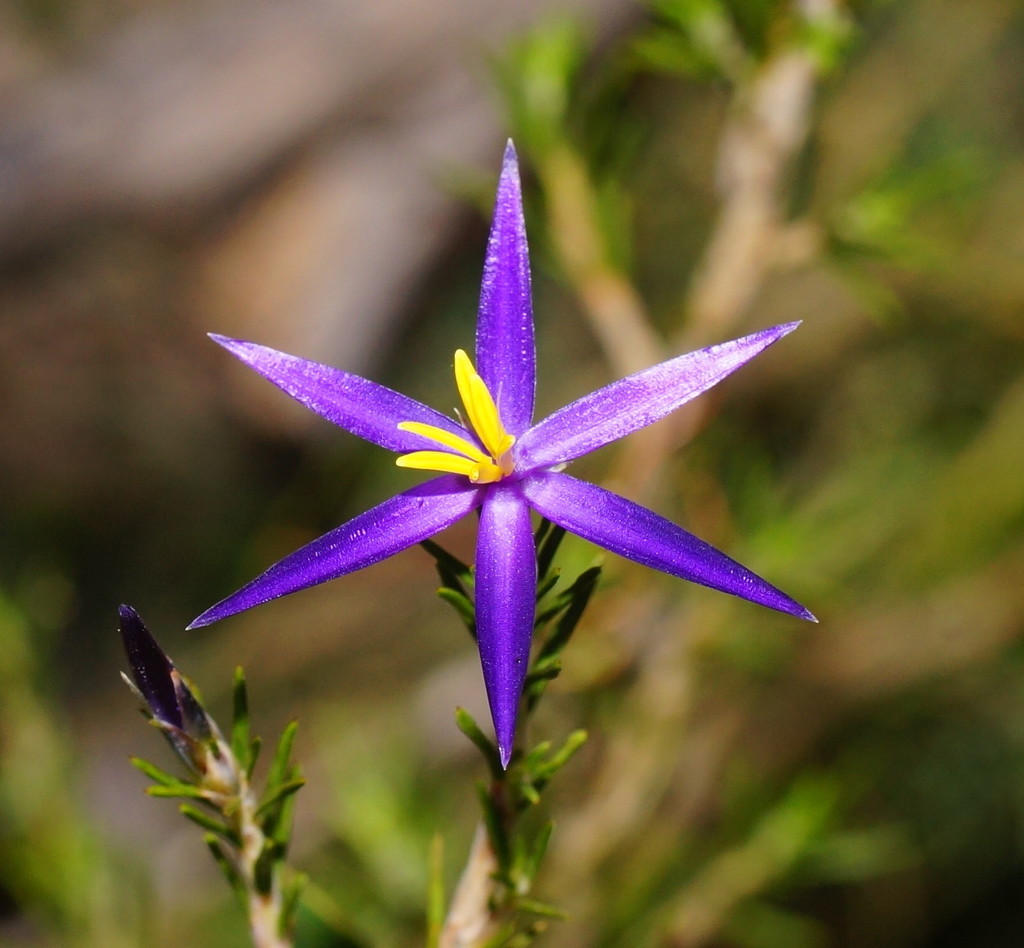
blue tinsel-lily
Calectasia intermedia
Calectasia intermedia, commonly known as blue tinsel-lily or eastern tinsel lily is a species of flowering plant in the family Dasypogonaceae, endemic to the border areas of western Victoria and south-eastern South Australia and flowering in early spring. It is the only member of the genus Calectasia that is not endemic to Western Australia.
From the article Calectasia intermedia on Wikipedia (CC BY-SA), quoted section by section
Description
Calectasia intermedia is a rhizomatous perennial herb growing to a height of about 65 cm (25.5 in) as an undershrub. The rhizome is about 50 cm (19.5 in) long, horizontal and buried about 7–10 cm (3–4 in) deep and there are no stilt roots. The stems have many side branches and bear leaves with few hairs. Each leaf is about 5.7–16.8 x 0.5–0.8 mm (0.2–0.7 x 0.02–0.03 in) and tapers to a short, sharp point on the end. The base of the petals (strictly tepals) form a tube 10.5–11.6 mm (0.41–0.46 in) long, while the outer parts spread outwards to form a blue, papery star-like pattern which does not fade with age. In the centre of the star are six yellow stamens forming a tube which turns orange-brown with age. The thin style extends beyond the stamens. Flowers appear from September to October.
Range & habitat
C. intermedia occurs from Bordertown in the far south-eastern corner of South Australia including the Calectasia Conservation Park, east to the Grampians and Little Desert, south-western Victoria. It grows in open Eucalyptus woodland on sandy soil and in heath. Its distribution is sporadic, due to the clearing of its habitat but it is not considered to be at risk.
Wikipedia: “Distribution and habitat”
Where it lives
Recorded sightings
—
geo-referenced records in GBIF, from museums, herbaria and field observers.
Drag the globe to turn it. Dots are where records exist, not a range map; darker means more records.
In the stacks
Searching the stacks…
Every page naming Calectasia intermedia in the Biodiversity Heritage Library →
This page is assembled live from iNaturalist, GBIF, Wikipedia, the Source Library and the Internet Archive. It is not yet part of the hand-edited codex. iNaturalist taxon 557986.